
The mold is approved, the first production order is placed, and parts are shipping. Months later the mold stops — a broken ejector pin, a cooling leak, a worn slide — and production stops with it. Nobody agreed who fixes it, who pays, or how fast.
A mold maintenance agreement should name, before production starts, who performs each kind of maintenance, which wear parts are covered, who pays for each item, how fast each kind of failure gets a response, and what happens when the mold wears out. If it is not written down, each breakdown becomes a negotiation — while your production line waits.
How to use this guide: the first table is the agreement itself — take it to your supplier and fill in the blanks together. The wear-parts checklist is what to ask for in the quotation. The response-time table is what to hold the supplier to when the mold stops.
The maintenance schedule is not the agreement
Every mold needs regular care. Cleaning the cavity and core, checking the ejector pins, blowing cooling channels dry, inspecting runners and vents — these are technical tasks, and they run on a schedule set by cycles, resin, and observed wear. Xometry’s injection mold maintenance checklist describes those tasks in detail: inspect the mold before and after each production cycle, clean after each run, check that the shot counter is working, and log the date and scope of every cleanup. Poorly maintained molds, Xometry notes, may produce parts that fail to meet specifications, causing extra downtime, wasted raw material, and higher cost.
That schedule is the technical layer. Our mold-life article covers it — the preventive-maintenance intervals, the wear components to watch, and the records to keep at each service — and this article does not repeat it. The agreement is the commercial layer on top of that schedule. It answers a different set of questions: who does the work, who supplies the parts, who pays, how quickly, and what evidence you receive. A factory can follow a perfect maintenance schedule and still leave you arguing about a repair bill, because the schedule never said who pays for it.
The distinction matters because the two documents are written by different people for different purposes. The schedule is written by the toolroom, for the toolroom. The agreement is written by the buyer and the supplier together, before the first production order, so that when something breaks at the worst possible moment, nobody has to improvise. If your quotation mentions maintenance only as a single line — "maintenance included" or "maintenance as required" — you do not have an agreement. You have a sentence that each side will read differently when it matters most.
What the agreement has to cover
A maintenance agreement can be one page, or one schedule attached to your supply agreement. Length is not the point. Coverage is. Before production starts, the agreement should settle six things, and each of them should be specific enough that a third person could check whether it happened.
First, the scope of work: which maintenance tasks are covered, and on what trigger — per run, per shot count, or per calendar period. The trigger should point at the technical schedule in the mold-life article, not restate it. Second, the responsibility split: who performs each task and who pays for it. Third, the wear parts: which components are consumables, which are covered, and what spares are held. Fourth, response times: what happens, and how fast, when the mold stops. Fifth, storage and preservation between orders: who protects the mold while it waits. Sixth, the end of the mold’s life: how wear-out is decided, and who pays for refurbishment or a replacement.
Two things the agreement should also name, even though they belong to neighbouring documents. One is ownership: the maintenance agreement assumes someone owns the mold and someone else holds it, and the ownership terms decide who can authorize a repair or a modification. Our mold ownership guide covers ownership, storage, and release in full, including the asset list each tool should have. The other is cost: maintenance is part of the total cost of the tool over its life, not a footnote to the mold price. Our injection mold cost breakdown treats future responsibility — spare parts, maintenance, modifications, storage, and ownership — as one of the main cost areas to compare between quotes.
A short caution before going further: this article explains what a buyer should agree in writing. It is not legal advice, and it is not a substitute for it. Have a qualified adviser review your own agreement before you sign it.
Who does what, and who pays
The table below is the heart of the agreement. Every row is a question that will be asked sooner or later, and every row should have an answer written down before production starts. The "typically" column describes common practice to agree in writing — it is not a statement of Cavity Mold’s terms, and any supplier may propose a different split. What matters is that the split you agree is written down, not that it matches this table.
| Maintenance item | Who typically does it | Who typically pays | What to write down |
|---|---|---|---|
| Routine cleaning and lubrication | The factory, as part of running the mold | Included in the unit price | That routine care follows the agreed schedule, and that the log is sent with each order |
| Preventive service at set shot counts | The factory’s toolroom | Included in the unit price, within the agreed shot life | The shot-count trigger, what the service includes, and the record kept |
| Wear-part replacement | The factory’s toolroom | The factory, within the agreed shot life; the buyer, after it | The list of wear parts, the shot life they are covered to, and the price of each part after cover ends |
| Damage repair (broken component, crash, mishandling) | The factory’s toolroom, or a specialist the factory appoints | Whoever caused the damage; if the cause is disputed, the agreement should say how the cause is decided | How damage is distinguished from wear, who inspects it, and who approves the repair |
| Major refurbishment (re-cut, re-polish, new inserts) | The factory, or the original mold maker | The buyer, quoted in advance — unless the mold failed before its agreed shot life | What counts as refurbishment rather than repair, and that no refurbishment starts without a written quote and your approval |
| Storage preservation between orders | The factory | Included in the unit price, or a stated storage charge | Cleaning, rust prevention, and the condition record kept while the mold waits |
Three rows in this table cause most of the arguments, and they deserve a closer look.
The first is wear-part replacement. A wear part is a component designed to wear out — an ejector pin, a spring, a seal — and replacing it is normal, not a failure. The argument starts when nobody agreed which parts count as wear parts, or when the cover ends. Name the parts, name the shot life they are covered to, and name the price of each part once cover ends. Then a worn ejector pin is a routine replacement, not a surprise invoice.
The second is damage repair. Damage and wear look alike on a broken component, and the difference decides who pays. The agreement should say how the cause is decided: who inspects the mold, what photos and measurements are taken, and what happens if the two sides disagree. A common arrangement is an independent inspection, or a joint inspection with the condition report shared the same day. Whatever the mechanism, agree it before the damage happens, because after it happens each side has a reason to prefer a different answer.
The third is major refurbishment. Refurbishment is the grey area between a repair and a new mold: re-cutting a worn cavity, re-polishing a surface, fitting new inserts. It is also the most expensive item in the table, and the one most often started without a quote. The agreement should say that no refurbishment starts without a written quotation and your written approval, and it should say what counts as refurbishment rather than repair. A worn cavity that needs re-cutting is refurbishment. A broken ejector pin is not.
Wear parts and spares: what to list before the first order
A mold that cannot be repaired quickly is a mold that stops your production for the time it takes to order a part. The agreement should list the wear parts, say which ones are held as spares, and say how many. The list below is a starting point — adapt it to your own mold, and ask the mold maker to confirm which items apply.
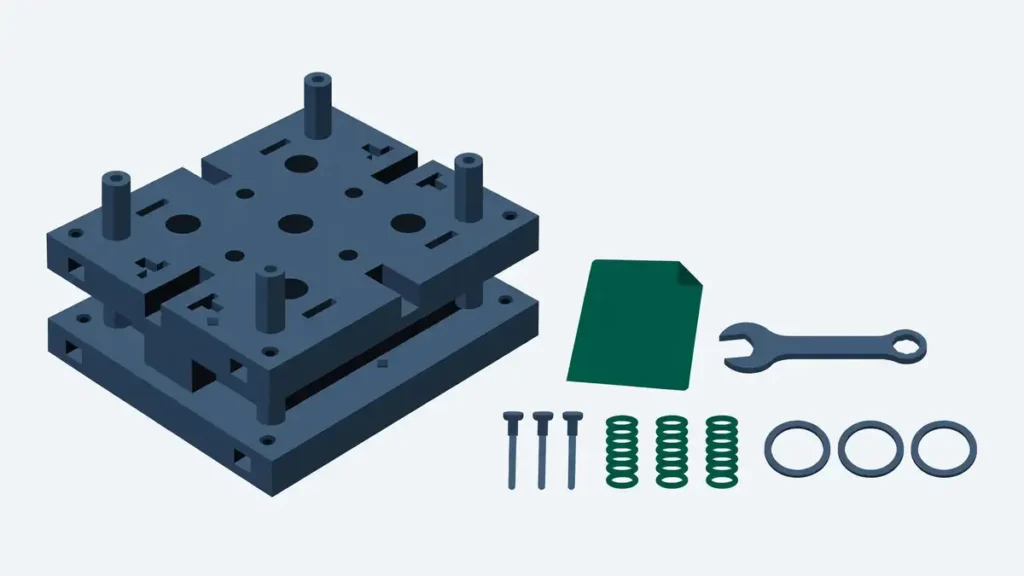
- Ejector pins and sleeves. Pins bend, stick, or wear, and a bent pin can stop ejection or damage a part. Xometry’s maintenance checklist notes that ejector pins that get bent may not eject parts properly, and that major maintenance involves measuring alignment features against the mold’s original tolerances.
- Return pins and springs. Springs lose force with use, and a weak spring can leave the ejector plate forward. Hold spares in the same specification as the originals.
- Seals and O-rings. Xometry’s checklist notes that all O-rings or sealing elements should be replaced when the mold is disassembled for major maintenance. Seals are cheap; a cooling leak from a failed seal is not.
- Heater bands and thermocouples (hot runner molds). A failed heater band stops a hot runner zone. The agreement should say whether heater bands are held as spares and who replaces them.
- Cooling fittings, hoses, and connectors. Leaks and scale build-up in cooling channels reduce cooling efficiency and change cycle time. Fittings and O-rings for the cooling circuit belong on the spares list.
- Leader pins and bushings. Guide components wear with every cycle. The agreement should name the inspection that decides when they are replaced, and hold at least one set as spares for a production mold.
- Slides, lifters, and wear plates. Moving mechanisms wear, and their spares are often the slowest to obtain because they are made to order. Agree which of these are held, and which are ordered when wear is found.
- Gate inserts and shutoff components. The gate area is one of the most likely places for a mold to wear, and a worn gate changes part quality before it stops the mold. Name the gate inserts as wear parts in the agreement.
Two questions to ask about every item on the list. First, is it a standard purchased part or a custom-made part? A standard ejector pin can be ordered in days; a custom slide may take weeks to make. The spares stock should be deeper for the parts that take longest to replace. Second, who holds the spares — the factory, or you? The usual arrangement is that the factory holds the spares for a mold running in its own plant, and the spares list is part of the handover package if the mold ever moves. Whatever the arrangement, write it down, with quantities.
Shot life is the number the whole spares list hangs from, so it should be named in the agreement too. The SPI mold classes, set by the Society of the Plastics Industry (now the Plastics Industry Association), give both sides a shared vocabulary: as Xometry’s mold-life guide explains, Class 101 molds are built for over one million cycles, Class 102 for 500,000 to one million, Class 103 for under 500,000, Class 104 for under 100,000, and Class 105 prototype tooling for under 500 cycles. Xometry also notes that these classifications indicate, but do not guarantee, quality — a Class 101 mold can decay rapidly with inappropriate maintenance. Name the class in the agreement, and name the shot life the maintenance cover runs to. A Class 101 mold that fails at a fraction of its expected life is a different conversation from a Class 104 mold that fails at the same count — but only if the class and the cover were written down at the start.
When the mold stops: what "respond" means
"Respond within 24 hours" is one of the most common phrases in a maintenance discussion, and one of the least useful — because nobody agreed what "respond" means. Does it mean an email acknowledging the problem? A diagnosis? A repair plan? Parts on order? A running mold? The agreement should define response in stages, and put a clock on each stage. The number of hours or working days for each stage is for the two parties to agree and write down; the table below defines what each stage must contain, so the clock measures something real.
| Failure type | What "respond" means | Evidence the buyer should receive |
|---|---|---|
| Minor wear found at service (worn pin, tired spring, light flash) | Acknowledge the finding, replace the wear part from spares, and confirm the mold is back in tolerance before the next run | A photo of the replaced part, the shot counter reading, and the updated maintenance log |
| Broken ejector or damaged mechanism (mold stops, parts cannot be ejected) | Acknowledge the stoppage, confirm the mold is out of the press, diagnose the cause, and give a written repair plan with a date | A condition report with photos of the damaged area, the cause assessment, the repair plan, and trial samples from the first run after repair |
| Cooling leak or blocked channel (cycle time drifts, parts go out of dimension) | Acknowledge the symptom, check flow and pressure against the original figures, and state whether the mold can keep running | Flow and pressure readings before and after the fix, photos of the affected channel or fitting, and dimensional results from the next run |
| Cavity or core damage (surface damage, cracked insert, dimensional failure) | Acknowledge the failure, stop the mold, inspect and photograph the damage, and give a written assessment of repair versus refurbishment | A full condition report with photos, measurements against the original tolerances, a quoted repair or refurbishment plan, and re-approved samples before volume resumes |
Notice what each row has in common: the response is not finished when someone replies to an email. It is finished when the buyer has evidence — a photo, a reading, a report, a sample — that the mold is back to the condition the agreement requires. That evidence is also what protects the factory: a condition report with photos taken on the day of the failure is the record that separates wear from damage, and a repair plan with a date is the record that the factory did what it promised.
Two practical points about the clock. First, the clock should run in working days or hours that both sides understand — state whether weekends count, and what happens if a failure is reported late in the day. Second, the clock should have a second stage: if the first repair does not hold, or the diagnosis turns out to be wrong, the agreement should say what happens next, and who decides. A repair that fails twice is a different problem from a repair that fails once, and the agreement should treat it as one.
What published terms look like — and why yours should be written down
Maintenance terms vary widely between suppliers, and that variation is itself the reason to get them in writing. One supplier’s published terms can show what the variables are, even though your own terms will differ. Protolabs, the US manufacturer, publishes a comparison of its two injection molding service options: its prototyping service guarantees mold life for at least 2,000 shots and stores molds for 18 months of inactivity, while its on-demand manufacturing service offers unlimited guaranteed mold life, stores molds for three years of inactivity, and confirms mold ownership. The point of that example is not the numbers — your mold, your volumes, and your supplier are different. The point is that guaranteed life, storage period, and ownership are all terms that can be stated plainly, in a table, before an order is placed. If one supplier publishes them, yours can write them down too.
Ask for the same clarity in your own quotation. A quotation that states the guaranteed shot life, the storage period, the wear parts covered, and the response stages is a quotation you can compare with another. A quotation that says only "maintenance included" is a price for a promise nobody defined.
Storage and the gap between orders
Molds do not only wear while they run. They corrode while they wait. A mold left unprotected between orders rusts, and rust on a cavity surface is a repair bill that arrives with the next order — along with a delay while the surface is re-polished. Xometry’s checklist is direct on this point: before storing a mold, make sure it is totally dry, because moisture can cause corrosion even if the mold is sealed, and apply a rust inhibitor to protect it from atmospheric moisture. Cooling channels must be blown dry as well, since water can easily get trapped in them.
The agreement should therefore treat storage preservation as maintenance, not as an extra. It should say who cleans and protects the mold when a run ends, what rust prevention is applied, where the mold is stored, and what record is kept. The storage terms themselves — the address, access on reasonable notice, the no-scrapping rule, and insurance — belong to the ownership agreement, and our mold ownership guide covers them in full. The maintenance agreement adds the preservation duty: the mold must be stored in the condition the next order needs, and the condition record should show when it last ran, when it was cleaned and protected, and what its current condition is. Ask for that record with each order, alongside the shot counter reading.
The gap between orders is also when a mold is most likely to be forgotten. If your program runs seasonally, or if orders pause for months, the agreement should say how often the mold is inspected while it waits, and who pays for that inspection. A mold checked twice a year is a mold that can be restarted. A mold nobody looked at for a year is a mold whose condition is discovered on the day production is due to restart.
Damage, modifications, and the end of the mold’s life
Three more questions belong in the agreement, and all three are easier to settle before production than during it.
The first is damage: who pays when the mold is damaged, and how is damage distinguished from wear? Wear is gradual and expected; damage is sudden and has a cause — a crash, a wrong setting, mishandling, a foreign object in the cavity. The agreement should say who inspects the mold when damage is suspected, what evidence is collected, and how the cause is decided. If the factory caused the damage, the repair is usually the factory’s cost. If the buyer specified a resin or a process that damaged the tool, the position is different. The agreement cannot decide every case in advance, but it can decide the procedure: inspection, photos, a written assessment, and a decision both sides accept before the repair starts.
The second is modifications. A mold in production is sometimes changed — a gate moved, a shutoff adjusted, an insert replaced with a different design. The agreement should say that no modification happens without your written approval, and that the modification is recorded with the revision, the reason, and the trial evidence. An unrecorded modification is a mold whose drawings no longer match its steel, and that mismatch will surface the next time the mold needs repair or moves to another factory.
The third is the end of the mold’s life. Every mold wears out. The agreement should say how wear-out is decided — by shot count against the agreed class, by dimensional results, by surface condition, or by a combination — and what happens then. The usual options are refurbishment, quoted in advance, or a replacement mold, quoted as a new tool. What the agreement must prevent is the third option arriving unannounced: a message that the mold is worn out, with no evidence, no quote, and no time to plan. A wear-out decision supported by measurements, a shot counter reading, and a condition report is a decision the buyer can plan around. A wear-out declared without evidence is a negotiation.
The records that prove the agreement is working
An agreement without records is a promise without proof. The maintenance log is the document that turns the agreement into something both sides can check, and it should travel with every order. Xometry’s checklist makes the same point: all maintenance activities should follow a maintenance plan, each step should be properly logged, and any faults or anomalies must be listed, because they can help identify the root causes of future failures.
Ask for four records, and ask for them as a matter of routine rather than only when something goes wrong:
- The maintenance log. Date, shot count, what was done, what was found, what was replaced, and who did it. One line per service, kept against the mold number.
- The shot counter reading. A photo of the counter with each order. Shots multiplied by cavities should roughly equal the parts invoiced, plus setup and scrap — a counter running far ahead of your orders is a question worth asking.
- The condition report. Photos of the cavity and core surfaces, the wear parts, and any damage, taken at each major service and whenever a failure occurs.
- The trial evidence after a repair. Dimensional results and samples from the first run after a repair or refurbishment, approved against the same standard as the original samples before volume resumes.
These records also protect the factory. A log that shows regular service, a counter that matches the orders, and photos that show the mold’s condition on a given date are the factory’s evidence that it maintained the tool as agreed. Records are not paperwork for its own sake. They are the shared memory of the mold’s life, and without them, every disagreement becomes a matter of recollection.
What to ask for in the quotation
Before the first production order, ask for the maintenance terms to be stated in the quotation itself — not in a separate document that arrives later, and not as a verbal assurance. The quotation should name the guaranteed shot life and the SPI class it rests on, the wear parts covered and the spares held, the response stages and their clocks, the storage preservation duty, the modification rule, and the end-of-life procedure. It should also name the records you will receive with each order.
Use the tables in this article as a checklist when you read the quotation back. Every blank row is a question to ask. If the supplier’s answer is "that is included", ask what "included" covers and to what limit. If the answer is "we will handle it", ask how, and what evidence you will receive. A supplier that answers those questions clearly is a supplier whose maintenance you can plan around. A supplier that will not put the answers in writing is telling you something about the relationship, not about the tool.
Frequently asked questions
Can I sign a maintenance agreement after production has already started?
Yes. A maintenance agreement can be signed at any point in a mold’s life — list the tool, state the shot count it has already run, record its current condition with photos, and agree the terms from that point forward. It is easier to negotiate before the first order, when neither side is under pressure, but a signed agreement after the fact is far better than none. Have your adviser review it before signing, as with any agreement.
What if the factory says maintenance is included but will not list what is covered?
Treat the word "included" as unfinished. Ask for the list: which tasks, which wear parts, to what shot life, with what response times, and with what evidence. If the factory will not list them, the maintenance is not agreed — it is assumed, and assumptions are what break down when a mold stops. Compare the quotation against the cost breakdown in our injection mold cost breakdown, which treats future maintenance responsibility as a cost area to compare between quotes.
Does the agreement cover a mold I own but the factory stores?
It should, and it should say so explicitly. Ownership and maintenance are separate questions: you can own the mold while the factory maintains it, and the agreement should name who performs each task and who pays, regardless of who owns the steel. The ownership terms — including storage, access, and release — are covered in our mold ownership guide.
Ask for the maintenance terms in the quotation before the first production order
The cheapest time to settle mold maintenance is before the mold runs its first production order. Send the inquiry through our contact page and include the STEP file, the 2D drawing with its revision, the resin grade, the annual volume and order quantities, the expected shot life, your storage expectations, and your target timing — and ask for the maintenance terms to be stated in the quotation itself. The contact form has no secure file upload, so send CAD files by email after the initial reply.
A quotation that states who maintains the mold, which wear parts are covered, who pays, and how fast a breakdown gets fixed is a quotation you can compare with another. A quotation that only says "maintenance included" is a promise nobody defined — and a mold that stops without an agreement is a production line waiting on a negotiation.