
Picking the wrong plastic can cost you a lot. I have seen buyers order HDPE, feel happy about the price, then find out it can’t touch food. Now the batch is useless. Recalls, wasted molds, angry customers. That hurts. The good news? Once you know the safety rules, you can avoid this mess and buy with confidence.
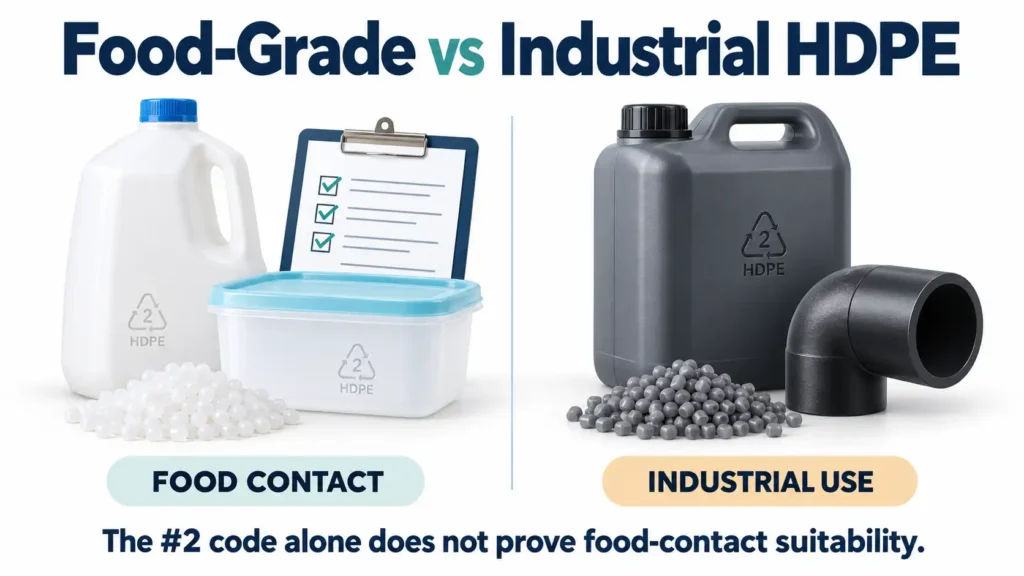
Food-grade HDPE is made from pure virgin resin, uses only FDA-approved additives, and follows Good Manufacturing Practices with full batch traceability. Industrial HDPE is the same #2 plastic, but it can hold recycled or mixed content, unapproved additives, and has little food-contact proof. So the real difference is not the resin code — it’s the purity, the additives, the process control, and the paperwork that backs it up.
I want to make this simple for you. Below I break down what the #2 code really means, why virgin resin matters, which standards you must check, and how to read the documents that prove compliance. Let’s go step by step.
Does the #2 Recycling Code Mean HDPE Is Food-Safe?
Many buyers see the little "2" inside the triangle and relax. They think it means "safe for food." But it doesn’t. This small mistake can lead to a big problem, because that code was never made to prove food safety at all.
No. The #2 resin identification code only tells you the polymer type — high-density polyethylene. It says nothing about the purity, additives, or food-contact suitability of a specific batch. Both food-grade and industrial HDPE share the same #2 code. To confirm food safety, you must check FDA compliance, virgin resin content, and batch documents, not just the recycling symbol on the part.
Let me explain why this matters so much. The resin code system was built for recycling sorting, not for safety. It helps recyclers group plastics by type. That’s it. So when a supplier points at the #2 symbol as "proof" of food safety, that’s a red flag for me.
What the code does and does not tell you
Here is a simple way to think about it:
| Question | Does the #2 code answer it? |
|---|---|
| Is this HDPE? | Yes |
| Is it virgin or recycled resin? | No |
| Are the additives food-safe? | No |
| Was it made under clean conditions? | No |
| Is there batch traceability? | No |
So the code answers one question and skips the four that actually matter for food contact.
I always tell buyers like Michael to treat the symbol as a starting point, not an answer. Ask the supplier three things. First, is this virgin resin or does it hold recycled content? Second, which FDA regulation does it meet? Third, can you send batch documents? If the answers are clear and backed by paper, you are on solid ground. If the only proof is the triangle symbol, keep asking. In my experience, good suppliers never hide behind the code. They give you real data, fast.
What Makes HDPE Truly Food-Grade?
You might think "food-grade" is a loose label anyone can use. But that idea is risky. If you assume it and skip the checks, you could end up with plastic that leaks chemicals into food. That’s the kind of thing that ends a business fast.
Food-grade HDPE must be made from pure virgin resin, use only additives sanctioned under FDA 21 CFR (like 177.1520), and be produced under Good Manufacturing Practices with contamination segregation. It also needs batch-specific Certificates of Analysis and food-contact compliance declarations. Industrial HDPE skips these steps — it may hold recycled content, mixed polymer batches, and additives like heavy-metal stabilizers or UV inhibitors that are not approved for food.
Let me break down the four pillars I always check.
1. Pure virgin resin
Food-grade HDPE starts with clean, virgin resin. No leftover mystery material. Industrial HDPE often mixes in post-consumer or post-industrial recycled content. That recycled stream can carry contamination, because you never fully know what the old plastic once held. For food, that risk is not worth it.
2. Approved additives only
Plastic is rarely just plastic. It has colorants, slip agents, stabilizers, and sometimes UV inhibitors. In food-grade HDPE, every additive must be on the FDA-approved list. In industrial HDPE, additives are chosen for performance, not food safety. Some contain heavy metals. Those should never touch what people eat.
3. Clean production process
Good Manufacturing Practices, or GMP, means the factory keeps food-grade material separate from everything else. Separate lines, clean equipment, controlled handling. Industrial HDPE plants usually don’t bother with this segregation, so cross-contamination is a real risk.
4. Real paperwork
This is the part buyers forget. Food-grade material comes with batch-specific Certificates of Analysis and a compliance declaration that names the exact FDA rule. Industrial grades give you little or no food-contact traceability. When I help a client vet a supplier, missing paperwork tells me more than any sales pitch. In molding and plastic manufacturing, documentation is proof — talk is not.
Which Safety Standards and Certifications Should You Check?
FDA rules are just the start. If you sell across states or countries, one standard might not be enough. Miss a required certification for a target market and your product can get blocked at the border. That delay can wreck a launch and burn through your budget.
Beyond FDA 21 CFR (including 177.1520), check NSF/ANSI 51 for food equipment materials and EU Regulation No. 10/2011 for the European market. Recycled HDPE for food use needs FDA case-by-case review and a letter of non-objection. Food-grade material should also pass migration testing under overall and specific migration limits, proving that chemical transfer stays below legal thresholds. Industrial HDPE skips all of these checks.
Here’s how I keep these straight for buyers who serve more than one market.
Match the standard to the market
| Standard | Where it matters | What it covers |
|---|---|---|
| FDA 21 CFR 177.1520 | USA | Food-contact polyolefins like HDPE |
| NSF/ANSI 51 | USA foodservice | Materials in food equipment |
| EU Regulation 10/2011 | Europe | Plastics in contact with food |
Use conditions change everything
Here is a point many people miss. A resin approved for dry, room-temperature contact is not automatically fine for hot-fill or high-fat foods. Heat and fat pull more chemicals out of plastic. So food-grade status is tied to how the material is used, not just the material itself. Always tell your supplier the real conditions: the temperature, the food type, and the contact time.
Migration testing and recycled resin
Migration testing checks how much substance moves from the plastic into the food. It must stay under overall and specific migration limits. Food-grade HDPE goes through this. Industrial HDPE does not. And if you want to use recycled HDPE for food, the FDA reviews it case by case and issues a letter of non-objection before you can reuse it. Industrial recycled resin faces no such clearance, which is exactly why it stays out of food jobs. Also, resins #2, #4, and #5 (HDPE, LDPE, polypropylene) are the ones most trusted for food contact, while #3 and #7 are usually avoided for chemical concerns.
Conclusion
The #2 code only names the plastic — it never proves food safety. Food-grade HDPE means virgin resin, approved additives, clean GMP production, and real batch paperwork. Industrial HDPE skips those steps. So match the material and its certifications (FDA, NSF, EU) to your market and your exact use conditions. Ask for documents every time. Do that, and you protect your product, your customers, and your business.