
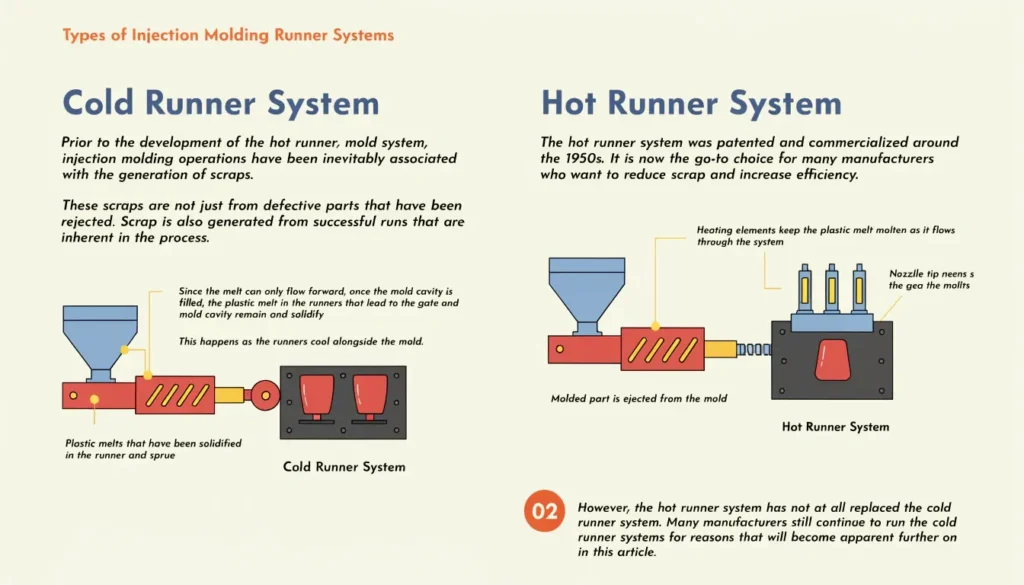
Prior to the development of the hot runner mold system, injection molding operations have been inevitably associated with the generation of scraps. These are not just scraps from defective parts that have been rejected. These are scraps from even successful runs that are inherent in the process. They are from the plastic melts that have been solidified in the runner and sprue. Since the melt can only flow forward, once the mold cavity is filled the plastic melt in the runners that lead to the gate and mold cavity remain and solidify1 as the runners cool alongside the mold. This is the cold runner system and has been the conventional and only method for injection molding since its invention up until around the 1950s when the hot runner system became patented and commercialized2.
The hot runner system has not at all replaced the cold runner system. Many manufacturers still continue to run the cold runner systems for reasons that will become apparent further on in this article.
While not a complete alternative to conventional cold runner systems, the hot runner mold comes with some technological advancement and advantages over the cold runner system. The rest of this article explains the hot runner molds and the key features. It also discussed the pros and cons of the hot runner mold, when you should choose a hot runner mold and the state of the art in hot runner molds in the current industry. By the end of the article you should be able to decide if the hot runner mold is well suited for your next project. If you still need more expert assistance in deciding contact our experts.
Hot Runner Molds Explained
Also commonly referred to as “sprueless molding”, hot runner molding has been developed since as far back as the early 1930s by American engineers. The main objectives were to automate the injection molding process, eliminate need for postprocessing operations to detach sprues from molded parts, and to reduce cost by improving efficiency of the molding process.
The advent of the hot runner mold re-shaped the link between the injection unit and the mold cavity of the injection molding process. Whereas in the conventional cold runner system the runners cool alongside the part in the mold, in the hot runner system, the runners remain hot as the part cools inside the mold. Achieving this requires complex heat transfer and temperature control systems. The pay back comes from not requiring additional time for ejecting runners and additional postprocessing for detaching sprues from the part.
The hot runner system requires optimized insulation of the mold from the runner. The challenge here is having a mold that’s cooling in close proximity to a heated runner that must remain hot.
Hot runner molds have facilitated the development of other systems of injection molding such as multi-color injection molding, stack molding, cascade molding with shut-off nozzles, family molds and more. These require hot runner molds.
Other Considerations
Hot runner molds may require use of copper parts for optimal conductivity. However it has been found that copper can serve as a catalyst in the degradation of polypropylene (PP) and polyoxymethylene (POM) and possibly other polymers. For this reason protective coating is necessary when using these metal parts.
Strategic placement of thermocouples near the heat source to measure the maximum temperatures helps reduce the chance of degradation of the plastic.
Staff need to be specifically trained on hot runner mold systems as these are significantly more complex requiring expert skills.
Features of Hot Runner Molds
Hot runner molds are made up of several components. The quality of each component, the functioning and compatibility with the other components determines the success of the operation. These components are listed below.
- Manifold
- Insulation
- Heater
- Risers
- Clamping plate
- Disc spring
- Fixed and moveable cavity plates
- Distributor bushing
- Melt channel
- Straight flow heated nozzle
- Filter cartridge
- Antitwist device
- Air insulation
- Needle valve
- locking screw
- Gate
- Piston
- Air insulation
- Nozzle torpedo
- O-ring
- Melt chamber bush
- Spacer disc
- Reflector plate
- Valve pin
- Cooling channel
- Cylinder
- Thermal conductive torpedor
- Thermal conductive heater
- Thermocouple
- Thermal insulating plate
- Turnaround plug
The specifics of these components will vary for different designs of hot runner moulds. There might also be additional features for convenience or to improve efficiency. Nonetheless these are the parts to expect in a hot runner mold.
Pros and Cons
The pros of a hot runner mold includes:
- Reduced cycle time
- No postprocessing stage required to detach sprue from part
- Less volume of plastic gets processed reducing the work done by the machine
- Reduced regrind (which could lead to reduced material quality)
- Cost of energy to recycle and process runner and sprues is eliminated
- More flexibility for gate design and placement with hot runner molds
- Since the runners will not be cooled, lower pressures and lower flow rates can be used in the clamping zone
The cons of the hot runner molds include:
- Increased chance of thermal degradation as the plastic in the runner gets exposed to heat for longer
- Higher capital cost to install a hot runner system
- Increased operational complexity
- Hot runner molds cost more
- Higher energy cost as runner needs to be kept hot
Over the years various versions of the hot runner molds have been developed to address the limitations of hot runner molds. BASF developed the clamping nozzle, DuPont developed the insulated runner while Hoechst developed the indirectly heated thermally conductive torpedo hot runner molds.
When to Go for Hot Runners
Hot runner mold becomes beneficial for large scale automated operations where the economics of scale can play out and make the process more economically feasible. At smaller scales, the few seconds saved in cycle time or the reduced runners scrap may not contribute much to cost reduction. However at larger scale the few seconds add up to hours saved and the scraps saved per cycle can add up to several tonnes of materials saved within reasonable period. Therefore go for hot runner molds if you’re running large scale automated injection molding operations.
In summary go for hot runners if:
- Your production exceeds 200,000 shots per year
- You are not working with heat sensitive resins like POM. This are prone to thermal degradation in the runner
- You are not working with high temperature engineering plastics like PEEK. These will cost more to keep the hot runner hot
- You don’t require frequent material or color switching
- You’re working with commodity plastics like PE, PA, PC, ABS and others
- You absolutely need to maintain surfaces with no sprue marks
Switching Existing Injection Molding Operations to Hot Runners
You might already have an existing operation that runs cold runner mold and you are considering switching over to the hot runner system. This is very possible. The good news is that the injection molding unit requires little or no alterations in many cases. The main part that needs major alteration is the clamping unit since this is the part that makes the main difference between the cold and hot runner mold systems.
A temperature controller must be added to the existing injection molding machine. This is wired to supply to the manifold and nozzles and connect to the thermocouples and heaters on the hot runner mold. The existing cold runner plates can be machined to accommodate the heated manifolds and other components of the hot runner mold, hence converting it to a hot runner. This conversion requires the right level of mold making expertise with extensive knowledge of hot runner injection molding.
Designing a hot runner mold or incorporating one into an existing injection molding operation requires the joint collaboration between the mold maker, product designer, machine operator, the hot runner supplier and the resin producer. This is because for a successful operation, the material properties, system settings, product design and the overall machine operation must be synchronized. Therefore multiple expertise is required.
State of the Art Hot Runner Molds
As manufacturers seek to make hot runner molds more efficient, sustainable and flexible, new technologies have been developed to advance hot runner mold injection molding operations. New innovations have led to more energy efficient heating technologies aimed at reducing energy use and lower carbon emission. Materials engineers have developed advanced materials for hot runner components to address challenges such as heat resistance, corrosion and durability. Components making use of alloys and ceramics rather than conventional metals have been introduced.
Integrated systems where features such as hot probes, temperature controllers, and valve gates are incorporated into the hot runner molds to simplify installation, operation, and maintenance of the hot runner molds by allowing it to run as a single unit.
Mold makers have also made use of additive manufacturing to produce hot runner mold components. This allows for rapid prototype development and production of components with intricate designs.
Hot runner systems that make use of smart control systems allow for more efficient control of parameters and design of hot runner molds. They are used to set up optimum maintenance shedule preventing unexpected downtime. Operating at optimum parameters also extends the lifespan of the hot runner molds. These make use of wireless integrated diagnostics systems with smart controlers for live monitoring of parameters such as temperature, pressure and positioning of the valve pin.
The iflow Manifolds technology developed by Mold Master uses 3D printed flow channels of brazed flow channels that eliminate the risk of plastic melt degradation. It also helps make color changes occur faster. New hot runner systems achieve more even heat distribution across multiple cavities through implementation of advanced thermal balancing. Hot runner molds implementing servo-electric valve gates achieve improved precision, smoother gate surfaces and eliminate wearing of the pin.
These state of the art systems pursue the original goal of hot runners which is to eliminate material waste, shorten cycle times and achieve more consistency in production.
Conclusion
Running a hot runner mold comes with significant benefits over the conventional cold runner system. However manufacturers can only reap these benefits if the hot runner mold is being used for the right operation. New technologies such as flow manifolds, servo electric valve gates and smart controllers have further advanced hot runner molds towards achieving higher efficiency through reduced material use and shorter cycle times and improved sustainability through lower energy consumption and reduced carbon footprint.
The existing cold runner system can be converted into a hot runner system by connecting a temperature control system for the runners and re-machining the existing cold runner mold to accommodate the components of a hot runner mold. However such a conversion requires the right expertise. Collaboration amongst mold makers, product designers, material engineers and machine operators allows for successful installation, operation and maintenance of hot runner molds.
By Ololade Olatunji
13 August, 2026
"Importance of Melt Flow Direction during Injection Molding on … – PMC", https://pmc.ncbi.nlm.nih.gov/articles/PMC8067716/. In conventional injection molding, thermoplastic melt flows from the injection unit through the sprue and runner system into mold cavities, where both the part and the runner system solidify during the cooling phase. Evidence role: mechanism; source type: education. Supports: the unidirectional flow of polymer melt and subsequent solidification in runner channels during the injection molding cycle. ↩
"Injection moulding – Wikipedia", https://en.wikipedia.org/wiki/Injection_moulding. Hot runner technology emerged in the mid-20th century as an alternative to traditional cold runner systems, with early patents and commercial implementations appearing during this period. Evidence role: historical_context; source type: encyclopedia. Supports: the approximate decade when hot runner systems were first patented and became commercially available. Scope note: Sources may provide varying dates for initial patents versus widespread commercial adoption, as the technology evolved gradually through multiple innovations. ↩