
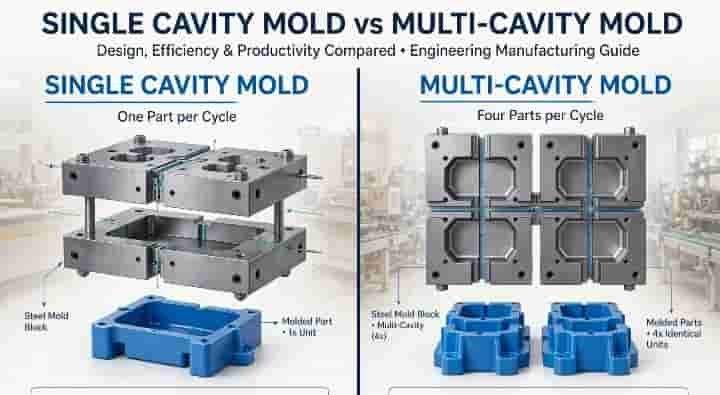
Injection molding has grown to become a relatively versatile manufacturing technology. Fromthe type of materials, the orientation of the injection, the power source to the mold type, youhave a lot of decision making to do as a manufacturer. This can often seem overwhelming.A single-cavity mold in injection molding refers to a mold that is designed to produce onepart per cycle.In the multi-cavity mold a mold piece is designed in such a way that it has two or moreimpressions of a product machined into it. It is designed to produce more than one part percycle. When it comes to choosing between single and multi-cavity molds, the decision has a directimpact on capital and the operating cost as well as the production output and profitability.While there are some specific products that could strictly limit you to single-cavity molds, inmost cases you have both options available to you as far as product design andperformance goes. Most product categories don’t limit you to single-cavity or multi-cavitymolds. So whether you are designing a product for medical, automotive, aerospace,consumer goods, sporting apparels or others, you almost always have the option of either.The question then comes down a lot to productivity and cost.It might seem straightforward at first instance to go for as many cavities as possible for fasterproduction. However as the article goes into more details on both types of mold we’ll delveinto why the decision is not quite as simple as that.
Key determinants of cavity count
Cavity count depends mainly on the following:
Required Output
Multi-cavity molds allow manufacturers to achieve more parts per cycle hence increasedproduction output. The full advantage of this is reaped where the cycles occur seamlessly.Ejection for all multiple cavities occurs within the same cycle time as it would for asingle-cavity mold of the same product and the cooling is efficient such that the cooling of allthe multiple cavities occur within the same time as it would take to cool a single-cavity. Thisrequires that the cooling channels are well designed to remove heat from each cavity asefficiently as it would be designed for a single-cavity mold of the same product.A single-cavity mold suffices for low inconsistent demand whereas mult-cavity is bettersuited to meet the tight delivery schedules and higher volume production.
Cycle time
Many experts in the field state that the cycle time for single-cavity mold and multi-cavity moldare comparable but not always the same. This can be attributed to factors such as differencein surface area for heat exchange per part and other factors. Therefore for example whencomparing the production output for a single-cavity mold to a multi-cavity mold with 10cavities for the same product, the productivity does not simply increase by 10. It would beincreased, but not necessarily in direct correlation with the number of cavities. The cycletime, yield, OEE and downtime all contribute to the actual production output.
Available Production Hours
Multi-cavity molds may work better where there are limited production hours in order toproduce as many parts per cycle as possible. This will need to be balanced with ensuringmachine capabilities can meet the production output and investing in tooling to optimizeoperations. There should also be planned downtime to ensure no unexpected or unplannedshutdown that could eat into production hours resulting in missed delivery targets.
Expected yield
The yield is directly affected by the number of cavities as this determines how manyacceptable parts are produced per given time. Ideally a mold should have a high yield andlow defect rate. If a 6 cavity mold is producing 3 defective parts per cycle then it is just asgood as a 3-cavity mold operating at a higher efficiency producing 3 parts per cycle.
Machine Capacity
The amount of melt the machine can process in one cycle will be the limit for the number ofcavities that can be installed. The clamping force, the plasticizing rate and shot capacity areall factors dependent on machine capacity and hence affect cavity count.
Part Design
The size, wall thickness, geometry and complexity of the part affects factors such as moldfilling, temperature distribution, cooling, mold layout and ejection. Multi-cavity moulds arebetter suited for simple compact parts. While more complex, large parts with thin walls areeasier to produce with fewer cavities or single-cavity mold.
Tooling Investment
While multi-cavity mold may reduce the unit cost of production, the initial investment tends tobe higher for multi-cavity mold. Therefore manufacturers with limited budget may be limitedto single-cavity molds. As will be discussed further on in the article, tooling investment canbe more strategically compared between single-cavity and multi-cavity molds.
Formula for calculating cavity count
Companies use different methods for estimating cavity time. Researchers at KaunasUniversity of Technology in Lithuania and Ilmenau Technical University in Germany presented an equation for calculating cavity number using a knowledge-based method. The equation is as follows:
Number of Cavities Required = (Defect Factor x Mold cycle time x Production volume) / PartProduction volume delivery time to customer
The inefficiencies and uncertainties are quantitatively accounted for by the defect factor. Adimensionless parameter that is obtained from experiments or trial runs with all the otherknown parameters. It incorporates the overall equipment effectiveness (OEE) and yield. It can also be obtained from simulation. It is specific for a given machineor injection molding operation. The equation provides an estimated valuefor cavity number. Actual value used must also take into account other factors such as the mold plate area, thepart mass and clamping force.
Worked Example
A factory acquired a contract to deliver 50,000 molded HDPE parts. The machine runs on amold cycle time of 15 seconds and a known defect factor of 414.72 obtained from previous runs and calibration. The agreed deliverydate is in 6 months. Estimate the number of cavities that would be required to meet theproduction output. The parameters from the formula above are as follows:Mold cycle time: 15 sProduction volume 50 000 partsPart production volume delivery time to customer: 6 x 30days x 24hrs x 60minutes x 60sDefect Factor: 414.72Inserting these parameters into the equation gives the number of cavities required as 20.Therefore for the given machine with known operating parameters a multi-cavity moldproducing 20 parts per cycle should meet the production volume and deadline. Note that this is based on assumption that the equipment runs 24 hours a day. When the calculation is adjusted for a more realistic 8 hours a day shift, the number of cavities required will be 60 based on the above equation.
Estimating Tooling Investment Break-Even Point
Productivity ultimately leads to a profitable operation. When investing in new tooling,manufacturers should know at what point the investment pays off and then begin to makeprofit.In general business terms, the break even point serves as a turning point from where aninvestment has earned back the cost invested. Break even can be quantified as break evenrevenue or as break even quantity or volume. The break even revenue represents how muchincome must be generated from sales to break-even. Break-even volume represents howmany products need to be produced to break-even.In injection molding for comparing single-cavity and multi-cavity molds, break even volume isoften used however in a slightly different definition. Within the concept of mold cavitynumber, the break-even point is the production volume where the cost of using asingle-cavity mold is the same as the cost of using a multi-cavity mold. It is the minimumquantity an equipment needs to be producing in order to pay back for the additional cost ofinvesting in additional tooling to switch from one mode of operation to the other.Break-even volume between single-cavity and multi-cavity mold is calculated using thefollowing formula:
**Break even volume = (multi-cavity tooling cost – single-cavity tooling cost) / (single-cavity unitcost – multicavity unit cost)
The formula presented is an estimate. Actual costs depend on the part, resin. Mold designand machine selected. Nonetheless, this formula comes in handy when you need a quickestimate for comparison or to give a rough idea of how much difference the choice betweenmulti-cavity and single-cavity mold can make for your process. This equation is based on theassumption that the cost of tooling for the multi-cavity mold is higher than that of thesingle-cavity mold. The decision as to whether to go for the single-cavity or the multi-cavitymold will be made based on the required production volume.
Worked Example
Take a scenario where a manufacturer is comparing between a single-cavity mold and a 6cavity mold. The single-cavity will cost 10,000USD to install while the 6-cavity mold will cost40,000 USD. The unit cost for the single-cavity mold is 1.20 USD while for the 6-cavity moldit is 0.6 USD. Using the formula above the break even volume can be estimated as follows:
**
Break even volume = (40,000 -10,000) / (1.20 – 0.6)= 50, 000
This suggests that the production volume needs to be higher than 50,000 parts for theinvestment in tooling for a multi-cavity mold system to be a better choice than a single-cavitysystem in terms of return on investment.An online tooling investment break-even calculator is availablehere .
Evaluating Machine compatibility
It is important that the machine is compatible with the mold design and number of cavities.Their total part must match with the runner’s shot weight. The shot weight must be sufficientto cover all the cavities, runner and sprues.Shot capacity and plasticizing capacity must also match. The plasticizing capacity of thescrew and barrel must be sufficient to match the shot capacity.The molds and the machine should be able to withstand the pressure required to meet therequired injection rate. Likewise the pressure should be set to achieve the required injectionrate to fill the molds effectively while avoiding problems such as short shots or flash.Other factors to be considered include total projected area, clamp-force requirement, moldsize, platen size, tie-bar spacing, mold thickness, opening stroke and ejection requirements
Quality checks and validation
To ensure consistency in part quality across all cavities quality checks and validation mustbe carried out regularly. There should be balanced filling, packing, cooling and ejection tominimize the chances of defects and dimensional inconsistencies. Implementing traceabilityand individual cavity identification codes will make verification of cavity-to-cavity dimensionalconsistency and help trace any issues to a specific cavity. Comparing part weights by cavityhelps detect where there is unbalanced filling while process capability studies confirm thatcritical dimensions meet the specifications set. Adequate maintenance schedule should beset, spare inserts should also be available and cavity shut-off should be implemented in thedesign and planning to minimize delays where parts fail or repairs are required.These factors should be put into consideration when determining cavity count to ensurequality standards, and operation efficiencies are not compromised and all risks are wellmanaged.
Cold runner vs hot runner systems
Runner waste is determined mainly by the runner design, runner-to-part weight ratio andwhether the system is cold or hot. Such that the choice of single or multi-cavity molds is nota key factor affecting runner waste. Cold runner will mostly incur lower tooling costcompared to hot runner and this should be considered alongside other factors discussedthus far when weighing the investments, maintenance requirement and material savingswhen choosing between single-cavity and multi-cavity molds.
Decision table for product developers and equipment manufacturers
Here we look at some factors to consider in deciding between single-cavity and multi-cavitymolds. A table is included to serve as a decision map to assist you in choosing between thetwo based on your requirements.
Decision table: Single-cavity mold vs. multi-cavity mold|
| Decision factor | Single-cavity mold favored when | Multi-cavity mold favored when | Primary reason |
|---|---|---|---|
| 1. Design maturity | The design is new, evolving, or undergoing frequent engineering changes. | The design is frozen, validated, and unlikely to change. | Multi-cavity tooling increases the cost and complexity of design changes. |
| 2. Peak demand | Peak demand is low, sporadic, or manageable with extendedproduction hours. | Peak demand is high or must be fulfilledwithin a short delivery window. | Multiple cavitiesincrease output per molding cycle. |
| 3. Annual volume | Annual demand is low or uncertain, or the product may bediscontinued soon. | Annual demand is high and predictableover the tooling’s useful life. | Higher volumespreads the additional tooling investment across more parts. |
| 4. Tolerances | Very tight tolerances require simpler process development, orcavity-to-cavity variation has not been validated. | Tight tolerances can be achieved consistently across all cavities through balanced filling, cooling, tooling precision, andprocess control. | More cavities introduce additional opportunities for dimensional variation. |
| 5. Part size | Parts are large and require substantial projected clamping area orinjection capacity. | Parts are small enough to fit multiple cavitieswithin the machine’s shot capacity, platen dimensions, and clamping-force limits. | Large parts restrict the number of cavities that can fit within machine capacity. |
| 6. Machine availability | Only a small machine is available, or a suitable machine formulti-cavity tooling is unavailable. | A suitable machine has sufficientinjection capacity, clamping force, tie-bar spacing, and platen size. | Multi-cavity molds may require larger or more capable machines. |
| 7. Tooling budget | Initial capital is limited, and a lower-cost, simpler tool is preferred. | Capital is available for higher tooling costs in exchange for greater long-term productionefficiency. | Multi-cavity molds generally have higher upfront costs. |
| 8. Unit-cost target | Demand is low, tooling amortization is difficult, or flexibility mattersmore than achieving the lowest possible unit cost. | The unit-cost target is aggressive, andexpected volume is sufficient to recover the additional tooling investment. | Multi-cavity tooling can reduce machine time and conversion cost per part. |
| 9. Acceptable downtime risk | Simpler tooling, easier maintenance, or greater operational flexibility is preferred. | High output is essential, and the businesscan manage common-tool downtime through maintenance, spare tooling, inventory, orbackup capacity. | A single multi-cavity mold can become a common point of failure affectingseveral parts per cycle. |
Conclusion
The single-cavity mold offers simplicity and low budget start up but comes with higher unitcost and lower production output. While the multi-cavity offers higher production output andefficiency at a higher capital, operational and maintenance budget.Whether you go for single-cavity mold or multi-cavity mold depends a lot on your capitalbudget, production target, profit margin and product size. It is therefore up to you, theproducer, to determine which of the factors discussed within this article is more important orto weigh the different factors together.
References and External links
Rutkauskas Z, Bargelis A, LinB G (2006) Knowledge-based method for cavity numberdefinition in injection mold design,. Mechanika. 6(62) ISSN 1392-1207https://doi.org/10.5755/j02.mech.14769
Plastic knowledge. Online calculatorhttps://kunststoff-profi.de/en/market/calculators/tooling-break-even
Thomas J and Wasserstein AJ (2024) A primer on breakeven analysis. Yale School ofManagement Yale Case Series.
Article by Ololade OlatunjiAuthor: "Reenvisioning Plastics Role in The Global Society"https://www.springerprofessional.de/en/re-envisioning-plastics-role-in-the-global-society/26581214
Ololade Olatunji has worked in the plastic and polymers field for nearly a decade in academia and industry. She has worked as a senior research officer at the Federal Institute of Industrial Research 2013–2016, university lecturer at the University of Lagos, Nigeria, 2016–2021, and as Scientific Consultant for Geo Calibrations. She writes articles on injection molding for Cavity mold and produces online educational materials on plastic processing and related areas. Her work has focused on the processing and applications of plastics and polymers. She is also the author/editor of the following books published by Springer: Plastics and Polymers Industry by Region: Production, consumption and waste management in the African Continent (2022), Aquatic Biopolymers (2020), and Natural Polymers: Industry Techniques and Applications (2016).Technically reviewed byJerry ZouCavitymold