
Picking the wrong clear material can ruin a whole project. I have seen molds fail because someone confused acrylic, Plexiglass, and PMMA. The names sound different. The confusion costs time and money. Let me clear it up for you right now.
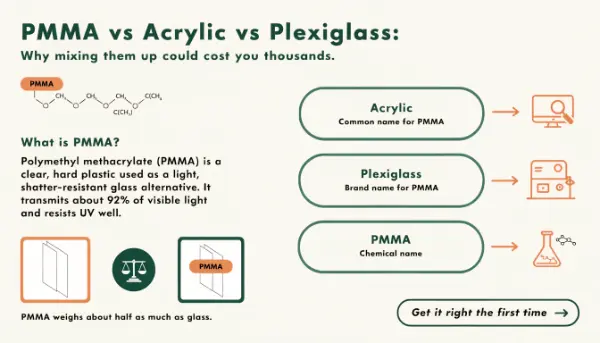
PMMA stands for polymethyl methacrylate. It is a clear, hard plastic used as a light, shatter-resistant glass alternative. Acrylic and Plexiglass are common and brand names for this same material. PMMA transmits about 92% of visible light, resists UV well, and weighs about half as much as glass.
I work with this material almost every day at CavityMold. Many clients ask me the same questions about names, strength, and weak points. So I wrote this guide to answer all of them in plain words. Let me walk you through it step by step.
Is PMMA the same as plexiglass?
A client once asked me to quote "Plexiglass molds" and then "acrylic molds" in two emails. He thought they were different. They were not. This mix-up happens all the time, and it can slow down a project.
Yes, PMMA and Plexiglass are basically the same material. PMMA is the technical chemical name. Plexiglass is a brand name for acrylic sheets made from PMMA. So all Plexiglass is PMMA, but not every PMMA product carries the Plexiglass brand.
Why so many names exist
PMMA is the science name. It comes from a building block called methyl methacrylate, or MMA. These small parts join into long chains. The chains give the material its strength.
Then come the everyday names. People call it acrylic. Companies sell it under brands like Plexiglas, Lucite, Acrylite, and Perspex. These are like brand names for the same drink.
How to read a catalog
When I see "acrylic sheet," "PMMA," or "Plexiglass" in a supplier list, I treat them as the same family. But I still check two things.
| What to check | Why it matters |
|---|---|
| Brand | Affects quality control and price |
| Cast or extruded | Affects machining and clarity |
So the word on the label tells me the brand. The process tells me how the sheet will behave. I always ask for both before I quote a job. This saves my clients from surprises later.
Is acrylic and PMMA the same thing?
I once received a drawing that said "acrylic" in one note and "PMMA" in another. The engineer worried they had two materials. They had one. This small worry can stall a whole design review.
Yes, acrylic and PMMA are the same thing. "Acrylic" is the common, generic name. "PMMA" is the full chemical name, polymethyl methacrylate. Both point to the same clear thermoplastic. The only real differences come from brand, grade, and how the sheet is made.
Generic name versus chemical name
Think of it like sugar. "Sugar" is the everyday word. "Sucrose" is the science word. Same stuff, two labels. Acrylic and PMMA work the same way.
So when a client says acrylic, I know they mean PMMA. I do not need to ask twice. But I do need to ask about the grade and the making process.
Cast versus extruded acrylic
This is where real differences show up. PMMA sheets come in two main types.
| Type | Strengths | Weak points |
|---|---|---|
| Cast acrylic | Better clarity, easier to machine, less internal stress | Costs more |
| Extruded acrylic | Cheaper, tighter thickness control | More stress, harder to machine cleanly |
Cast acrylic forms inside a mold. It has longer chains and less built-in stress. I pick it for thick parts and high optical quality. Many Plexiglass-branded sheets are cast, which is why they feel stiff and clear.
Extruded acrylic is melted and pushed through a die. It is cheaper and very even in thickness. But it can crack or melt oddly during cutting. I choose between them based on the job, not the name.
Is PMMA stronger than acrylic?
A buyer once asked me if he should pay more for "stronger PMMA" instead of "regular acrylic." He thought one was tougher. I had to slow him down and explain the truth.
No, PMMA is not stronger than acrylic, because they are the same material. Strength differences come from the grade and process, not the name. Cast acrylic is usually stiffer and more scratch-resistant than extruded acrylic. PMMA is much tougher than glass but weaker than polycarbonate.
Comparing PMMA to other clear materials
People want to know how PMMA stacks up against glass and polycarbonate. I use this simple table with my clients.
| Aspect | PMMA (Acrylic/Plexiglass) | Polycarbonate | Glass |
|---|---|---|---|
| Clarity | Very high, ~92% light | High, slightly less | High |
| Impact | 10–17× glass, can still crack | Much higher | Baseline |
| Weight | About half of glass | Similar to PMMA | Heavier |
| UV/weather | Very good, resists yellowing | Can yellow without UV grade | Varies |
| Cost | Moderate | Higher | Varies |
So PMMA beats glass on weight and impact. It loses to polycarbonate on pure toughness. But PMMA wins on clarity, UV strength, and price. For signs, displays, and light guides, I often pick PMMA.
What "stronger" really means
Strength has many parts. There is impact strength. There is scratch resistance. There is heat resistance. PMMA scratches more easily than glass. It softens with heat, around 150–260°C. So I match the grade to the use. A cast sheet for a clear cover. An extruded sheet for a budget panel. The name on the box does not decide this. The grade and process do.
What are the disadvantages of using PMMA?
I love this material. But I never hide its weak points from clients. One customer used PMMA near strong cleaning chemicals. The part cracked fast. A little warning would have saved that batch.
The main disadvantages of PMMA are easy scratching, poor heat resistance, and weakness against some solvents. It can crack or craze when it meets ketones, esters, or chlorinated chemicals. It also brittle-fractures under sharp impact and is recycled less often than other plastics.
The biggest weak points
Let me list the problems I watch for on every job.
| Weak point | What happens | My fix |
|---|---|---|
| Scratching | Surface marks easily | Add hard coatings |
| Heat | Softens at 150–260°C | Avoid hot areas |
| Solvents | Cracks or crazes | Check chemical contact |
| Brittleness | Can fracture on sharp hits | Use polycarbonate instead |
Scratching is the most common complaint. PMMA marks more easily than glass. So I suggest a scratch-resistant coating for surfaces people touch.
Chemical and recycling concerns
PMMA resists water, detergents, and dilute acids well. But it hates strong solvents. Ketones and chlorinated chemicals make it craze and crack. I always ask clients what liquids the part will meet.
Recycling is another small downside. PMMA can be recycled. But it is collected less often than common plastics. So I tell clients to plan for reuse where they can. Knowing these limits up front helps me design a part that lasts. That is the real value of working with a partner who knows the material.
Conclusion
PMMA, acrylic, and Plexiglass all name the same clear plastic. Differences come from brand, grade, and process, not the name. PMMA is light, clear, and weather-tough, but it scratches and dislikes heat and harsh solvents. Know these traits, and you will pick the right material every time.