
Are you stuck choosing between acrylic and plexiglass for your next project? The wrong pick can mean cracked parts, scratched surfaces, and blown budgets. I have seen teams waste weeks on this. Let me clear up the confusion fast.
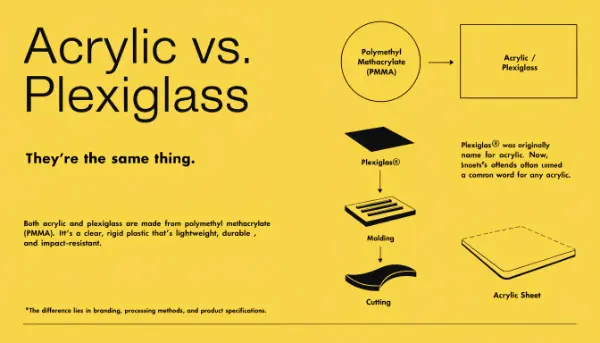
Acrylic and plexiglass are the same material. Both are polymethyl methacrylate (PMMA), a clear, rigid plastic. "Plexiglas®" started as a brand name for acrylic sheets. Today people use "plexiglass" as a common word for any acrylic. So the real choice is about grade, process, and supplier, not the name.
I have spent years sourcing molds and sheets for production. The acrylic vs plexiglass debate comes up in almost every project. People think they are picking two different plastics. They are not. Let me walk you through the questions I hear most, so you can spec parts with confidence.
How does plexiglass compare to acrylic?
Worried that "plexiglass" is a cheaper or weaker version of acrylic? You are not alone. This naming mix-up causes real ordering mistakes. Let me set the record straight before it costs you money.
Plexiglass and acrylic are chemically the same plastic (PMMA). Plexiglas® is a registered brand of cast acrylic. All Plexiglas® is acrylic, but not all acrylic is Plexiglas®. The base material is identical. What changes is the grade, the brand, and how the sheet is made.
One material, many names
Acrylic is the generic name. You will see it sold under many trade names. Plexiglas®, Lucite®, Acrylite®, and Perspex® are all acrylic. Think of it like "Band-Aid." People say Band-Aid when they mean any bandage. People say plexiglass when they mean any acrylic sheet.
The difference that matters: cast vs extruded
The real split is not acrylic vs plexiglass. It is cast vs extruded acrylic. This is where performance changes.
| Feature | Extruded Acrylic | Cast Acrylic (often Plexiglas®) |
|---|---|---|
| Cost | Lower | Higher |
| Thickness tolerance | Looser | Tighter |
| Optical clarity | Good | Better |
| Scratch resistance | Lower | Higher |
| Machining behavior | More internal stress | More stable |
When someone tells me "plexiglass is better," they usually mean a premium cast sheet beats a cheap extruded one. That is true. But it is not about the name. It is about the process. So put "cast" or "extruded" on your drawing, not just "acrylic."
What is better than Plexiglas?
You picked plexiglass, but now parts crack on the line. Is there something tougher out there? Yes. But "better" depends on what you need. Let me break it down.
Polycarbonate is better than Plexiglas when you need extreme impact strength. It is much tougher and resists cracking. Tempered glass is better for scratch resistance and chemical contact. But acrylic still wins on clarity, weight, and cost for most everyday transparent uses.
Compare by what your part must do
No single material wins everything. I always match the material to the job. Here is how the three main options stack up.
| Property | Acrylic / Plexiglas | Polycarbonate | Glass |
|---|---|---|---|
| Impact strength | Good | Excellent | Poor |
| Optical clarity | Excellent (~92%) | Good | Good |
| Scratch resistance | Moderate | Low | High |
| Weight | Light | Light | Heavy |
| Cost | Medium | Higher | Low-Medium |
| UV resistance | Excellent | Needs coating | Excellent |
My rule of thumb
I reach for polycarbonate when safety guards must take hard hits. I reach for acrylic when clarity and cost matter most. Acrylic transmits about 92% of light. That beats standard glass, which has a slight green tint. Acrylic is also half the weight of glass. That cuts my shipping and install costs. So "better" is never absolute. It is about your specific need.
Can a bullet go through acrylic?
You hear the phrase "bulletproof acrylic" and wonder if a standard sheet can stop a bullet. This matters for security applications. Getting it wrong is dangerous. Here is the honest answer.
Yes, a bullet can go through standard acrylic. Thin acrylic sheets offer no real ballistic protection. True "bulletproof" panels are thick, multi-layer laminates, often combining acrylic with polycarbonate. They can be several inches thick. A normal acrylic sheet will shatter or be pierced by a bullet.
Why thin acrylic does not stop bullets
Acrylic is more impact-resistant than glass. But it is still brittle compared to polycarbonate. A bullet carries huge energy in a tiny spot. A thin sheet cannot absorb that. It cracks or breaks.
How real bullet-resistant glazing works
True ballistic panels are engineered systems. They are not one sheet. Here is what makes them stop bullets.
| Factor | Standard Acrylic | Bullet-Resistant Panel |
|---|---|---|
| Thickness | 3–12 mm | 25–75+ mm |
| Layers | Single | Multiple, laminated |
| Material mix | Pure acrylic | Acrylic + polycarbonate |
| Rating | None | UL 752 levels |
If you build security products, never trust a plain sheet. Always specify a tested, rated laminate with a clear UL 752 level. The rating tells you which rounds it stops. I always ask suppliers for test data, not marketing words. Safety claims need proof.
Which company’s acrylic is best?
Suppliers all claim they have the best acrylic. But quality varies a lot. Pick the wrong one and you get warped, scratched, hazy sheets. Let me tell you what to actually look for.
There is no single "best" acrylic company. The best supplier depends on your grade needs. For premium cast acrylic, established brands like Plexiglas®, Acrylite®, and Lucite® lead. For custom molded parts, choose a partner who controls process, tolerance, and certification, not just one with a famous name.
Judge the spec, not the logo
A famous brand name does not guarantee fit for your part. I judge suppliers on what they put on the certificate. Here are the spec items I always demand.
My supplier checklist
| Spec to Request | Why It Matters |
|---|---|
| Cast vs extruded | Drives clarity and tolerance |
| Thickness tolerance | Affects machining and fit |
| Light transmission | Sets optical performance |
| UV resistance grade | Stops yellowing outdoors |
| Surface finish | Gloss, matte, or anti-glare |
| Flammability rating | Meets building codes |
What I value in a real partner
For premium display and optical work, I trust well-known cast brands. They give uniform thickness and fewer defects. But for custom molded or machined parts, I value a manufacturer who controls the full process. They keep tolerances tight. They cut scrap. They deliver on time. At CavityMold, this is exactly how we work. We match the right acrylic grade to your application. We do not just chase the cheapest sheet. We also offer recyclable acrylic options for teams focused on sustainability. The best company is the one that hits your spec every single time.
Conclusion
Acrylic and plexiglass are the same plastic. The real choice is cast vs extruded, plus the right grade and supplier. Spec clearly, match material to the job, and demand proof on safety claims. Do this, and you master molding right.