
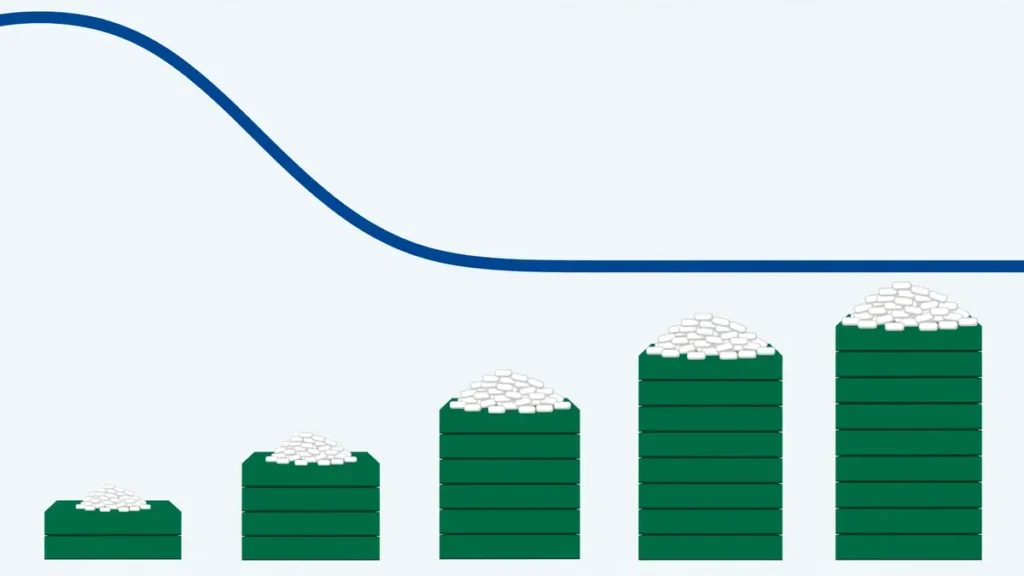
You have a part, a mold, and a forecast — and a simple question: how many should you order? Order too few and each part carries the full weight of setup and tooling. Order too many and you own a warehouse of parts for a design that may change next quarter.
Unit price falls steeply at first, because the fixed costs — tooling amortisation and setup — are spread over more parts. Then it flattens at a floor set by resin, machine time, and inspection, and no larger order can push it below that floor. The trick is to quote batch size and annual volume as two separate numbers, because they move the price through different costs.
This guide explains what a part price is made of, where the curve bends, and what to put in an RFQ so two suppliers can be compared fairly.
What a part price is made of
Every molded-part price is built from the same five blocks. Only two of them move much with quantity — and knowing which two is the whole decision:
| Cost block | What it pays for | How it behaves as quantity rises |
|---|---|---|
| Tooling amortisation | The mold, spread over every part it will ever make | Falls per part as lifetime volume rises; fixed once the mold exists |
| Setup per batch | Installing the mold, purging and heating, first-off checks, colour or material change | Charged once per batch, so it falls per part as the batch grows |
| Resin | Pellets, masterbatch or compound, including the runner and scrap allowance | Roughly flat per part; falls only with bulk resin lots or less scrap |
| Machine time | The press running your cycle, including operator time | Roughly flat per part; falls only with a shorter cycle or more cavities |
| Inspection, packaging, secondary work | Measurement, appearance checks, assembly, packing, freight | Roughly flat per part; changes with the inspection level, not the batch |
Two consequences follow. First, the tooling block is decided by the lifetime volume of the mold, while the setup block is decided by the batch size of each individual run. Second, once both fixed blocks are spread thin, the price stops falling — the resin, machine time and inspection underneath it do not shrink with quantity.
Our mold cost guide explains what sets the tooling block itself. Our ROI model answers the related question of whether an expensive mold pays for itself over its lifetime. This article is about the per-part price at a given quantity — a different question, with a different answer.
Batch size and annual volume are two different decisions
Buyers often quote one number — "10,000 parts a year" — and expect a unit price. That number is not enough, because it hides the batch pattern, and the batch pattern is what decides the setup block.
Consider two buyers, both at 10,000 parts a year:
- Buyer A orders 10,000 parts in a single batch. The mold is set up once, the material is purged once, and the first-off inspection is done once. The setup block is spread over 10,000 parts and nearly disappears.
- Buyer B orders 500 parts twenty times a year. The mold is set up twenty times, the material is purged twenty times, and the first-off inspection is done twenty times. The same annual volume carries twenty times the setup cost per part.
Same annual volume, different part price — and neither buyer is wrong. Buyer B may need small batches because the design changes, the warehouse is small, or cash is tight. The point is that the batch pattern must be stated in the RFQ, or the quote is priced against a batch pattern the buyer never intended.
The same logic applies to the tooling block. A mold priced for a 100,000-part lifetime carries a smaller per-part tooling charge than the same mold priced for 10,000 parts — but only if the lifetime volume actually happens. A buyer who quotes a large lifetime volume and then orders a tenth of it has not saved money; the tooling charge was spread over parts that were never made.
Where the price falls fast — and where it stops falling
The shape of the curve is the same for almost every molded part: steep at first, then flat. The example below is illustrative, with its assumptions stated; it is not a quotation, and your numbers will differ.
Assume a mold cost of $12,000 spread over a 100,000-part lifetime ($0.12 per part), a setup cost of $150 per batch, and resin, machine time and inspection of $0.60 per part:
| Parts per batch | Setup per part | Tooling per part | Resin + machine + inspection | Illustrative unit price |
|---|---|---|---|---|
| 100 | $1.50 | $0.12 | $0.60 | $2.22 |
| 500 | $0.30 | $0.12 | $0.60 | $1.02 |
| 1,000 | $0.15 | $0.12 | $0.60 | $0.87 |
| 5,000 | $0.03 | $0.12 | $0.60 | $0.75 |
| 10,000 | $0.02 | $0.12 | $0.60 | $0.74 |
Three readings. First, moving from 100 to 500 parts per batch more than halves the price — the setup block dominates at small batches. Second, moving from 5,000 to 10,000 barely moves it — the price has nearly reached its floor. Third, that floor is about $0.72 ($0.12 tooling + $0.60 resin, machine and inspection), and no batch size can go below it. A supplier who promises a price well under the floor is either quoting a different scope or a different part.
Published reference points show the same shape in real services. Protolabs Network’s injection molding guide puts the recommended minimum production volume at 500 units, "at this point economies of scale factor in"; a pilot run of 500–10,000 parts in an aluminum mold (about $3,000–$5,000, lasting 5,000–10,000 cycles) typically costs $1–$5 per part, while scaling up to 10,000–100,000+ parts in a tool-steel mold brings the typical unit cost to a few cents to $1. See the Hubs / Protolabs Network injection molding guide. Protolabs itself starts mold pricing at $1,495, charges no minimum order quantity, and notes that set-up fees apply to each run — which is exactly why batch size matters. See Protolabs’ injection molding services.
What else moves the price at your quantity
Quantity is not the only lever, and at larger volumes the other levers matter more than another thousand parts:
| Lever | How it moves the price | What to ask |
|---|---|---|
| Cavity count | More cavities cut machine time per part, but add tooling cost and need balanced filling and cooling | Which cavity count matches the forecast — and what happens if the forecast halves? |
| Colour changes | Each colour change is a purge and a setup; small batches in many colours pay it repeatedly | Can colours be grouped into fewer runs, or is a natural-colour part with secondary colouring cheaper? |
| Resin lot | A full resin lot is cheaper per kilogram and more consistent than a partial lot | Is the quoted resin price for a full lot, and what happens if the order needs a second lot? |
| Inspection level | 100% dimensional inspection costs far more per part than a sampling plan | Which dimensions are actually inspected, at what frequency, and what does the report contain? |
| Packaging | Individual bagging, labelling, and export packing add a fixed per-part cost | Is packaging priced per part or per carton, and can it be simplified? |
| Design stability | A design that changes between batches re-opens DFM, trials, and first-off approval | Is the design frozen, and what does a change cost if it is not? |
At small quantities, the setup block swamps all of these. At large quantities, they are the price. A buyer who negotiates only on quantity at 50,000 parts is negotiating over the smallest remaining slice.
When ordering more is the wrong move
A lower unit price is not always a lower total cost. Ordering more than you need buys a cheaper part and a more expensive problem:
- Inventory cost. Parts in a warehouse tie up cash, need storage, and risk damage. A 10% unit saving that sits in stock for a year is rarely a saving.
- Design change. If the part is still being revised, a large batch is a large pile of obsolete parts. Small batches are the price of a design that is still moving.
- Obsolescence. A product line that ends, a regulation that changes, or a customer who switches supplier can strand a whole batch. The tooling block is already spent; the resin and machine time in unsold parts is spent too.
- Quality drift across a long run. A very large single batch can hide a slow drift — mold wear, material-lot change, or a process shift — that a smaller batch with a fresh first-off check would have caught. Our budget guide shows how to carry these risks as cost blocks rather than discovering them later.
- Cash flow. A mold plus a large first order is a large single payment. Spreading production into batches spreads the payment too.
The right order size is the one where the setup saving from a bigger batch is still larger than the inventory, obsolescence and cash cost of holding the parts. That balance point is different for every product — which is why it belongs in the RFQ discussion, not in a rule of thumb.
How to ask for quotes that can actually be compared
Two quotes at different quantities are not two prices for the same thing. To compare suppliers fairly, give every supplier the same quantity picture:
| RFQ line | State it as | Why it matters |
|---|---|---|
| Batch size | Parts per production run, not just the annual total | Decides the setup block per part |
| Annual volume | Expected parts per year, with a range if the forecast is uncertain | Decides the tooling amortisation and the resin lot |
| Delivery schedule | How often batches ship, and the lead time each batch needs | Decides warehousing, scheduling, and whether small batches are practical |
| Lifetime volume | Total parts the mold is expected to make | Decides whether the tooling charge is realistic |
| Colours | Number of colours and how they split across batches | Each colour change is a setup |
| Inspection level | Sampling plan or 100% inspection, and which dimensions | Inspection is a per-part cost that varies widely |
| Packaging | Per-part or per-carton, export packing or standard | Packaging can be a visible share of a small part’s price |
| Design status | Frozen, or still changing — and what a change costs | An unfrozen design cannot be quoted as a fixed price |
Ask each supplier to break the quote into the same five blocks from the first table: tooling, setup per batch, resin, machine time, and inspection/packaging. A quote that shows only a single unit price cannot be compared with another single unit price — the two may be priced on different batch sizes, different tooling lifetimes, or different inspection levels. A supplier that will not break the price down is telling you something about the quote, not about the part.
Frequently asked questions
Is there a minimum order quantity for injection molded parts?
There is no universal minimum. A supplier with aluminum tooling and no MOQ can run a few hundred parts; a production tool-steel mold only makes economic sense at larger volumes. Ask what batch size the quote assumes, rather than asking for a single MOQ number.
Will doubling my order halve the unit price?
No. Doubling a small batch can cut the price sharply, because setup is halved per part. Doubling a large batch barely moves it, because the price is already near its floor of resin, machine time and inspection. The illustrative table above shows the shape.
Should I order a year’s supply at once to get the best price?
Only if the design is frozen, the product will sell, and the inventory cost is smaller than the setup saving. Otherwise the cheaper unit price is paid for with cash in a warehouse and parts that may never ship.
Send the quantities with the part files
The fastest way to a comparable quote is to send the part files with the quantity picture already stated: batch size and annual volume as separate numbers, delivery schedule, colours, inspection level, and packaging. Use our contact page and include the STEP file, the 2D drawing with revision, the resin grade, the batch size, the annual volume, the delivery schedule, the critical tolerances, the surface finish, and your target timing — and we will quote against those quantities rather than assuming them.