
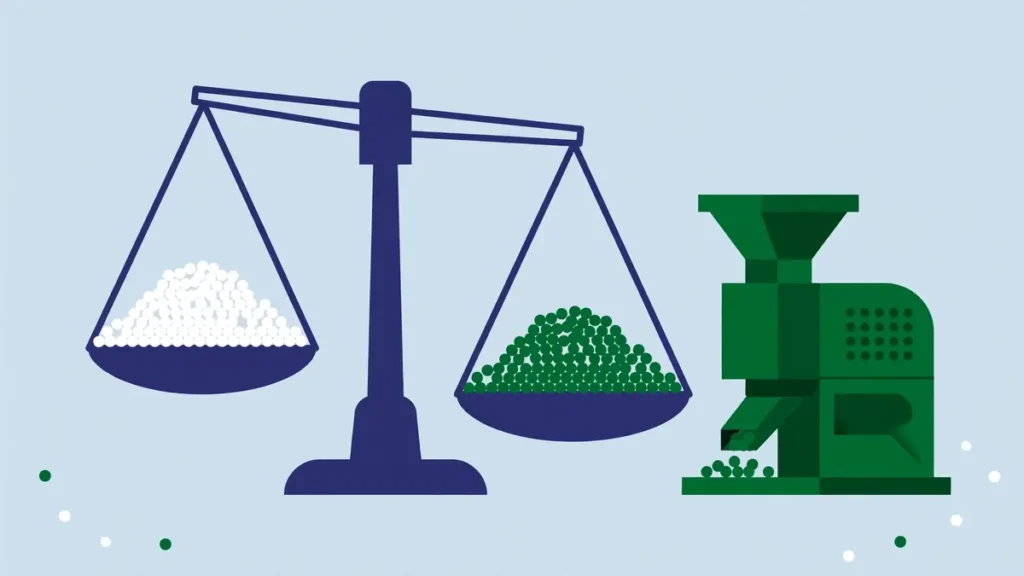
Your molder asks a simple question before production: "Can we use regrind?" The answer decides more than material cost. It decides whether your parts keep their strength, hold their colour, and pass the tests your customer or regulator expects.
There is no single safe percentage. Agree a written regrind policy before production: a maximum percentage for your exact resin grade, a defined source, dosing by weight, re-drying where the material needs it, lot traceability, and a test that proves the agreed blend performs. For food-contact, medical, optical, or safety-critical parts, the right answer is usually zero.
This guide explains what regrind does to a material, what to put in the agreement, and how to check that the agreement is actually being followed.
What "regrind" means — and which kind this guide covers
Regrind is plastic that has already been through a molding cycle and is ground up for reuse. Two very different streams hide under that one word:
- In-house production regrind (closed loop). Runners, sprues, and rejected parts from your own job, ground and blended back into virgin material of the same grade. The source is known, the material identity is known, and the number of heat cycles is countable. This is the subject of this guide.
- Post-consumer recycled resin. Material collected after use, sorted, washed, and re-pelletized by a third party. Its history is mixed, its properties vary by lot, and it is bought as a separate grade with its own data sheet. That is a material-selection decision, not a shop-floor policy. If you are considering it, start with our material selection guide and the recycled-content discussion in our sustainable products guide.
Keep the two apart in every conversation with a supplier. A molder who says "we use recycled material" may mean either one, and the evidence you need for each is different.
What regrind does to the material
Every pass through the granulator and the heated barrel changes the plastic. The effects are real, measurable, and material-dependent:
- Shorter polymer chains. Heat and shear break long molecules into shorter ones. Melt viscosity falls, and with it impact strength and elongation. The first regrind pass usually costs a few percent of properties; repeated regrinding of the same material costs more, which is why closed-loop regrind of one job is safer than a mixed bin of everything the shop ground that week.
- Moisture pickup. Ground material has far more surface area than pellets and absorbs water quickly. Hygroscopic resins such as PC and PA that were dried as virgin pellets are not dry as regrind unless they are dried again — and a dryer set for pellet residence time may not do the job. Silver streaks on a PC part with regrind are often a drying problem wearing a regrind disguise.
- Contamination and fines. Dust, foreign pellets, degraded particles, and fines below about 1 mm can scorch at the screw and appear as black specks on light-coloured parts. Fines are almost impossible to polish out of a textured surface.
- Shorter fibres in filled grades. In glass-fibre-reinforced resins, grinding shortens the fibres, so stiffness and strength fall faster than in an unfilled grade. Our glass-fibre molding guide makes the same point: define whether regrind is permitted, how it is controlled, and what quality tests are required.
- Colour and gloss drift. Each heat cycle adds yellowing, which matters on clear or white parts, and gloss differences show first on textured surfaces.
None of this means regrind is unusable. It means the limit must be agreed per grade, per part, and per application — not copied from another job.
What the evidence says about regrind blends
Two published sources show the range of what is possible when regrind is controlled rather than assumed:
- Protolabs compared a recycled ABS/PC grade (Gebablend 85 Black) with its virgin counterpart (Bayblend T65 XF Black) and found them close on paper: heat deflection 128 °C against 122 °C, the same tensile modulus of 2,400 MPa, and a shrink range of 0.45–0.8% against 0.5–0.7%. Their conclusion is worth quoting in spirit: many parts never challenge the full mechanical properties of the material, so a recycled grade can work — but only the grade data and the part’s real loads decide. See Protolabs’ comparison of recycled and traditional materials.
- A 2025 peer-reviewed study tested a 50/50 blend of virgin and regrind glass-fibre-reinforced polyamide. With adaptive process control active, the blend’s impact strength (9.73 kJ/m²) stayed close to virgin material run under the same control (10.78 kJ/m²). Without that control, the blend measured 9.26 kJ/m². The lesson is not "50% is safe" — it is that the blend, the process control, and the test result belong together. See the study on regrind blends and adaptive process control.
Treat any percentage you read online as a starting point for discussion, never as a specification. The resin supplier’s data sheet for your exact grade, and a trial in your actual mold, are the authorities.
When the answer should be zero
Some applications leave no room for negotiation. Prohibit regrind — in writing, on the drawing or purchase order — when any of these apply:
| Situation | Why zero is the right call |
|---|---|
| Food-contact parts | Traceability and migration rules usually require virgin, food-grade resin with a known compliance statement |
| Medical or diagnostic parts | Validation is built on a defined material; a blend change can invalidate it |
| Optical or clear parts | Yellowing, haze, and specks are visible and cannot be inspected away |
| Safety-critical structural parts | Impact and fatigue margins are the reason the grade was chosen |
| Tight colour match (brand colour, Pantone) | Colour drift between lots becomes a customer complaint |
| A grade locked by your customer’s specification | The specification, not the molder, decides |
If your customer has not stated a position, ask before production — not after the first shipment. A regrind dispute discovered at incoming inspection is far more expensive than a question asked at the RFQ stage.
The regrind agreement: what to put in writing
A verbal "a little regrind is fine" cannot be inspected. Put these nine points in the purchase order, the quality agreement, or the drawing notes — whichever document your supplier actually works from:
| Decision point | Agree in writing | Why it matters |
|---|---|---|
| Maximum percentage | The highest regrind share allowed, as a percentage of total shot weight, for this grade and part | "20% regrind" means one part ground material to four parts virgin — state the basis, not just the number |
| Source | Only closed-loop regrind from this job and this grade — or a named, approved source | A mixed bin is a different material with unknown history |
| Number of heat cycles | How many times the same material may be reground (commonly once) | Properties fall with each cycle; uncounted cycles are uncontrolled |
| Dosing method | Dosing by weight, or by a calibrated volumetric feeder — not by eye into the hopper | An unmeasured blend is not a blend, it is a guess |
| Drying | Re-drying of ground material to the same specification as virgin pellets, with the method and time stated | Ground material picks up moisture far faster than pellets |
| Grinding and handling | Granulator screen size, fines removal, clean storage, no floor sweepings | Fines scorch; contamination shows as specks |
| Traceability | Lot identity for virgin and regrind, blend records per production lot | Without records, a failure cannot be traced to a cause |
| Testing | Which tests, on which samples, at which frequency — for example melt flow comparison and a mechanical test on molded parts from the agreed blend | A percentage on paper proves nothing; a test on parts does |
| Change control | No change to the agreed percentage, source, or supplier without written approval and, where needed, a new trial | A quiet change is how a validated part stops being validated |
Keep the agreement short enough that a production supervisor can actually follow it. Nine lines on one page beat a ten-page procedure nobody reads.
An illustrative example: why the percentage also decides your scrap balance
Regrind policy is not only a quality decision. It decides how much scrap your job can absorb — and how much piles up. The calculation below is illustrative, with its assumptions stated; it is not a quotation and your numbers will differ.
Assume a part weighing 40 g, a cold runner weighing 12 g per shot, and a run of 10,000 shots:
- Shot weight: 40 g + 12 g = 52 g.
- Regrind generated: 12 g per shot × 10,000 shots = 120 kg of runner material.
- At an illustrative cap of 20% regrind (20% of the 52 g shot = 10.4 g per shot), the job can consume 10.4 g × 10,000 = 104 kg.
- Surplus: 120 kg generated − 104 kg consumed = 16 kg of regrind left over after the run.
At a 15% cap the picture is worse: 7.8 g per shot consumed, 78 kg used, 42 kg surplus. The point is not the exact kilogram figure — it is that a low cap on a runner-heavy job guarantees a growing pile of ground material, and somebody has to decide what happens to it: store it for the next run of the same grade, sell it, or dispose of it. Agree that too, before production, and never let surplus from one job drift into another job’s hopper.
How to check the agreement is being followed
A policy is only as good as its evidence. Ask for, and file, these items for each production lot:
- Blend records — the regrind percentage actually dosed, by weight, per lot.
- Material identity — virgin lot number and regrind source lot, so a problem can be traced.
- Drying records — time and temperature for the ground material, against the agreed specification.
- Melt flow comparison — the agreed blend measured against virgin material under the same test conditions; a drift is an early warning, not a pass/fail on its own.
- Part-level tests — the mechanical or appearance tests your part actually needs, run on molded parts from the agreed blend, not on virgin-only samples.
- Appearance samples — a retained sample from the agreed blend, so the next lot has something to be compared against.
Our quality control and inspection page describes the stage checkpoints — incoming material, first-off, in-process, and final — where this evidence is collected. If your supplier cannot produce blend records, the percentage in the agreement is a wish, not a control.
Frequently asked questions
Does regrind always make parts weaker?
Not always, and not equally. The effect depends on the resin, the number of heat cycles, and the property you care about. Impact strength and elongation usually fall first; stiffness often changes little. That is why the agreement should name the test that matters for your part, rather than debating regrind in general.
Can I allow regrind in one part of an assembly and prohibit it in another?
Yes — and that is often the right answer. A non-visible bracket and a visible cover in the same product can carry different limits. Put the limit on each part’s drawing or purchase order, not in a single company-wide rule.
My supplier says they already use regrind and "it has never been a problem." What should I ask?
Ask for the percentage, the source, the dosing method, and the last test result on a part like yours. "Never a problem" is a claim about the past; the four answers are evidence about your job.
Start the conversation before production
Regrind is a normal part of injection molding — but only when it is agreed, measured, and tested. Send us your part files and tell us the regrind limit your application needs, or that it must be zero, and we will quote against that requirement rather than assuming one. Use our contact page and include the STEP file, the 2D drawing with revision, the resin grade, the critical tolerances, the appearance standard, your regrind limit or prohibition, the annual volume, and your target timing.