
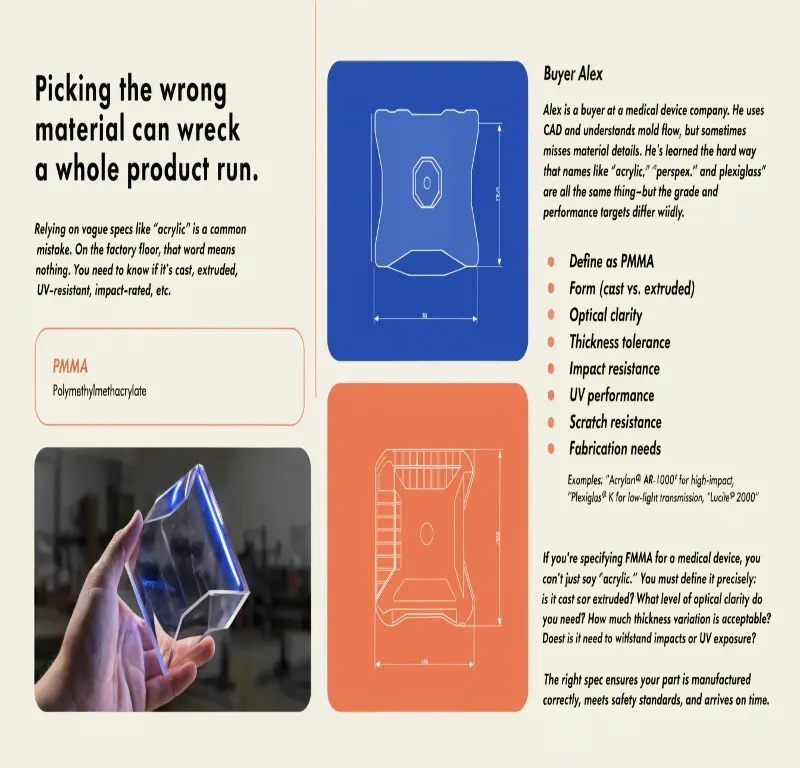
Picking the wrong material can wreck a whole product run. I have seen molds fail because a spec just said "acrylic." That word alone means nothing on a factory floor. Let me show you how to specify it right, so your parts come out clear, strong, and on time.
To specify acrylic or plexiglass, define the material as PMMA and set clear values for form (cast or extruded1), optical clarity, thickness tolerance, impact resistance, UV performance, scratch resistance, and fabrication needs. Do not rely on the name alone. The grade and performance targets matter far more than the label on the sheet.
I work with buyers like Alex every week. He knows CAD and mold flow, but even smart engineers get tripped up here. The names sound different but the material is the same.2 So let me break down the real questions, one by one, so your next order goes smoothly.
Is acrylic and plexiglass the same material?
You may think you are choosing between two products. You are not. This confusion costs teams time and money during sourcing.
Yes, acrylic and plexiglass are the same base material. Both are made from PMMA (polymethyl methacrylate). "Plexiglass" is just a brand name that became common in everyday speech. The real choice is not the name. It is the grade, the form, and the performance level you need for your product.
Why the name does not matter
When I quote a job, I ignore the word "plexiglass." I look for PMMA and the grade. Two sheets can both be called plexiglass but perform very differently. One might yellow in the sun. One might not. So I always ask for data, not names.
Cast vs extruded is the real question
Here is the split that actually matters:
| Feature | Cast Acrylic | Extruded Acrylic |
|---|---|---|
| Clarity | Higher | Good |
| Cost | Higher | Lower |
| Thickness range | Wider, thicker | Limited |
| Edge finishing | Better | Fair |
| Scratch resistance | Better | Fair |
| Best for | Premium look, outdoor | Simple, cheap parts |
I tell buyers to pick cast when appearance and durability matter. I tell them to pick extruded when cost rules and the part is simple. That single decision shapes your price and your quality more than any brand name ever will.
What material category is acrylic?
You need to place acrylic in the right family before you can spec it. If you file it wrong, your whole material logic falls apart.
Acrylic belongs to the thermoplastic family. Its full name is PMMA (polymethyl methacrylate). A thermoplastic softens when heated and hardens when cooled, and this cycle can repeat. This trait lets you thermoform, bend, and shape acrylic easily, which makes it a favorite for displays, signage, and clear protective parts.
Where acrylic sits among plastics
Acrylic is a rigid, clear thermoplastic. It sits near polycarbonate and PET in use, but each behaves in its own way. I like to line them up so buyers see the trade-offs fast.
| Plastic | Clarity | Impact | Cost |
|---|---|---|---|
| Acrylic (PMMA) | Excellent | Low | Medium |
| Polycarbonate | Very good | High | Higher |
| PET | Good | Medium | Low |
Why this category helps you
Because acrylic is a thermoplastic, you can cut it, drill it, and heat-bend it. My shop shapes complex parts with it every day. But the same softness means it scratches and burns. It is combustible, so I warn clients in fire-prone settings to add treatment or switch material. Knowing the category tells you both the powers and the limits before you commit. That saves you from surprises after production starts.
What is an identifying characteristic of acrylic plastics?
You want to know acrylic when you see it. A strong ID trait helps you check that a supplier sent the right stock.
The key identifying characteristic of acrylic is its high optical clarity and excellent light transmission. Acrylic can pass over 90% of visible light, which beats most other plastics. This glass-like clearness, paired with its light weight and shiny surface, is the fastest way to spot true PMMA and separate it from cheaper look-alikes.
The clarity test
I hold a sheet up to light. Real acrylic looks almost like glass, with no cloudy haze. I check the edges too. Cast acrylic gives clean, clear edges. If I see a green tint or fog, I know the grade is low or it is not real PMMA.
Other traits to confirm
Clarity is the headline, but I also check these:
| Trait | What I look for |
|---|---|
| Weight | Light, about half of glass |
| Surface | Glossy, smooth |
| UV resistance | No yellowing over time |
| Sound | Sharper tap than soft plastics |
The trade-off to remember
Acrylic is clear and pretty, but it scratches easily. On a store display, fingerprints and scuffs show fast. So I often spec a hard coat or protective film. That small add-on keeps a product looking new for years. Clarity draws people in, but protection keeps it selling.
What are the criteria for plastic material selection?
This is the heart of it. A vague spec leads to wrong parts, rework, and blown deadlines. I have watched projects slip weeks over this.
The main criteria for plastic material selection are optical clarity, mechanical strength, impact resistance, UV and weather resistance, thickness and tolerance, fabrication needs, chemical resistance, fire rating, and cost. You should also weigh scratch resistance and recycling options. Rank these by your product’s real use, then write them into a clear, measurable spec sheet.
Build your spec around use
I always start with the job the part must do. An outdoor sign needs UV resistance. A safety guard needs impact strength, so I might steer a client to polycarbonate instead. A display needs top clarity. The use decides the ranking.
A spec that leaves no gaps
Here is the checklist I hand to buyers like Alex:
| Criteria | What to define |
|---|---|
| Material family | PMMA |
| Form | Cast or extruded |
| Optical | Light transmission, haze |
| Thickness | Nominal + tolerance |
| Impact | Especially for guards, displays |
| UV | For sun exposure |
| Scratch | Coatings if needed |
| Fabrication | Cut, bend, bond, print |
| Color/finish | Clear, frosted, tinted |
| Fire rating | Treatment for risky sites |
A sample spec you can copy
I write requirements like this: "Clear PMMA sheet, cast acrylic, 4 mm thick ±0.2 mm, high optical clarity, UV-stable for indoor and outdoor use, polished edges, suitable for laser cutting and thermoforming, with low haze and no visible flow lines." That one line removes guesswork. My team knows exactly what to make. Before I approve any supplier, I also confirm cast or extruded, transmission data, UV performance, flatness, and process fit. A tight spec is your best defense against a bad batch.
Conclusion
Acrylic and plexiglass are the same PMMA base. The name does not matter. The grade, form, and performance do. Spec by clarity, strength, UV, thickness, and fabrication needs. Write it clear and measurable. Do that, and your products come out right the first time.
"Cast Acrylic vs. Extruded Acrylic: A comprehensive comparison", https://www.simplyplastics.com/na/ideas-and-advice/cast-acrylic-vs-extruded-acrylic-a-comprehensive-comparison. PMMA sheets are produced through two primary methods: cell casting, which polymerizes monomer between glass plates producing higher molecular weight material, and continuous extrusion, which melts polymer pellets through a die, with each process yielding different optical and mechanical characteristics. Evidence role: mechanism; source type: research. Supports: That PMMA is manufactured through distinct cast and extruded processes with different resulting material properties. Scope note: This describes the manufacturing distinction but does not quantify specific property differences for specification purposes. ↩
"Poly(methyl methacrylate)", https://en.wikipedia.org/wiki/Poly(methyl_methacrylate). Polymethyl methacrylate (PMMA) is marketed under various trade names including acrylic, plexiglass, and lucite, all referring to the same thermoplastic polymer. Evidence role: definition; source type: encyclopedia. Supports: That acrylic and plexiglass are both common names for polymethyl methacrylate (PMMA). ↩