
Nylon is everywhere, yet many buyers still worry about safety, chemicals, and fire risk. I get these questions all the time. The good news? The next wave of nylon is cleaner, smarter, and far safer than what we used before.
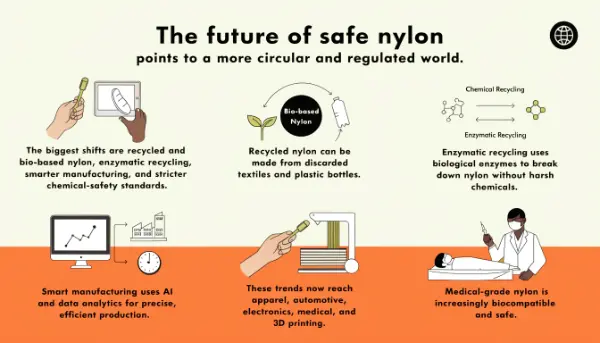
The future of safe nylon points to a more circular and regulated world. The biggest shifts are recycled and bio-based nylon, enzymatic recycling, smarter manufacturing, and stricter chemical-safety standards. These trends now reach apparel, automotive, electronics, medical, and 3D printing.
I have spent years at CavityMold watching nylon change. It used to be a simple, tough plastic. Now it is becoming a high-tech, responsible material. Let me walk you through what is coming and why it matters for your projects.
What new applications are driving safer nylon?
Nylon used to mean gears, ropes, and cheap parts. Today it moves into smart and safety-critical roles. That shift excites me, and it should excite you too.
New nylon applications now include recycled performance textiles, bio-based automotive parts, 3D-printed end-use components, and smart films that can generate electricity. Each use focuses on safety, strength, and sustainability instead of just low cost.
Where I see the biggest growth
I work with clients who once used nylon only for basic parts. Now they ask for advanced grades. Recycled nylon is moving into apparel and sportswear through closed-loop systems. Bio-based nylon is entering cars, medical tools, and technical fabrics because it keeps the strength and heat resistance we love.
Additive manufacturing is another big one. Nylon is no longer just for prototypes. We now print tooling, fixtures, and final parts. Some clients even print regulated components.
| Sector | New Nylon Use | Main Benefit |
|---|---|---|
| Apparel | Recycled fibers | Lower waste |
| Automotive/EV | Bio-based parts | Lighter, greener |
| Electronics | Battery housings | Heat resistance |
| Medical | Skin-contact devices | Biocompatibility |
| 3D Printing | End-use parts | Fast, flexible |
Smart nylon is the part that surprises people most. Researchers made nylon films that produce small amounts of electricity. That means wearables, sensors, and smart surfaces could use nylon as a power source. This is the kind of work that keeps me curious every day.
Which technologies make nylon safer and cleaner?
Old nylon production wasted energy and created hard-to-recycle waste. That bothered many of my customers. New technology now fixes these old problems in smart ways.
The key technologies are enzymatic recycling, advanced composites and nanotechnology, AI-driven manufacturing, and bio-based monomer production. Together they cut waste, improve strength, and make nylon easier to reuse and certify as safe.
How these tools change my daily work
Enzymatic recycling is my favorite near-term tool. It breaks down used nylon into pure building blocks using gentle conditions. That uses less heat and energy than old methods. It also turns trash into fresh raw material.
Nanotechnology and composites push performance higher. We can now boost heat resistance, chemical resistance, and antimicrobial properties. For medical and food parts, that matters a lot.
AI and Industry 4.0 tools help me on the factory floor. Sensors track each step in real time. We catch defects early. We reduce scrap. We keep safety features consistent across every batch.
| Technology | What It Does | Why It Matters |
|---|---|---|
| Enzymatic recycling | Recovers monomers | True circularity |
| Nanotech additives | Adds barriers | Better hygiene |
| AI control | Live monitoring | Fewer defects |
| Bio-based monomers | Plant feedstock | Less fossil use |
I tell my clients that these tools are not just hype. They lower long-term cost, reduce risk, and help meet tough rules. That combination is hard to ignore.
What safety standards should you know about?
Many buyers feel lost in the maze of certifications. I understand that pain. The wrong choice can block a shipment or harm your brand. So let me make it simple.
The main safety standards for nylon are OEKO-TEX STANDARD 100 for textiles, REACH for EU chemicals, and FDA rules for food, packaging, and medical devices. These check for harmful substances, restrict chemicals, and confirm safe skin contact.
Breaking down the rules I follow
OEKO-TEX STANDARD 100 is a big one for fabrics. It tests products for harmful substances. New rules now exclude PFAS from certified items. That is a strong signal toward cleaner chemistry.
REACH rules guide the EU market. They control how chemicals get registered and restricted. This affects nylon production, the raw inputs, and the finished goods. If you sell in Europe, you must respect REACH.
In the United States, the FDA steps in for food contact, packaging, and medical devices. For skin-contact uses, nylon often counts as low-risk when we know its full material history.
| Standard | Region | Focus |
|---|---|---|
| OEKO-TEX 100 | Global | Harmful substances |
| REACH | EU | Chemical control |
| FDA | USA | Food & medical safety |
My advice is simple. Pick a supplier who knows these rules well. At CavityMold, we plan for them from the start. That saves you stress at the finish line.
What trends should you watch next?
Standards and markets keep moving. If you stand still, you risk falling behind. I have seen companies lose deals because they ignored new rules. You do not want that.
Watch for growth in recycled and bio-based nylon, plus tighter rules on PFAS, traceability, and recycled-content claims. The main challenges remain scale, cost, contamination, and proving that safety and recycled claims are true.
Where I think things are heading
The strongest growth areas are clear to me. Recycled and bio-based nylon will lead in apparel, EV parts, cable management, battery housings, and outdoor goods. These markets want durability and a green story at the same time.
Rules will keep getting tighter. Expect more pressure on PFAS removal. Expect demands for full traceability. Buyers will want proof of recycled content, not just a label. End-of-life handling will also matter more as circular thinking spreads.
But challenges remain real. Scaling new methods is hard. Costs are still high. Contamination in recycled streams causes headaches. Verifying claims takes effort and honesty.
| Trend | Opportunity | Challenge |
|---|---|---|
| Recycled nylon | Green demand | Contamination |
| Bio-based nylon | EV growth | High cost |
| PFAS rules | Cleaner products | Reformulation |
| Traceability | Buyer trust | Verification |
A simple way to think about it is this. Performance nylon stays. But the winning versions will be safer, recycled, bio-based, traceable, and easy to certify. That is the path I steer my clients toward.
Conclusion
Safe nylon is heading into a circular, regulated, and high-tech future. Recycled and bio-based grades, enzymatic recycling, smart manufacturing, and stricter standards lead the way. I help clients choose materials that are strong, clean, and ready for tomorrow. Master molding right with smarter nylon choices.