
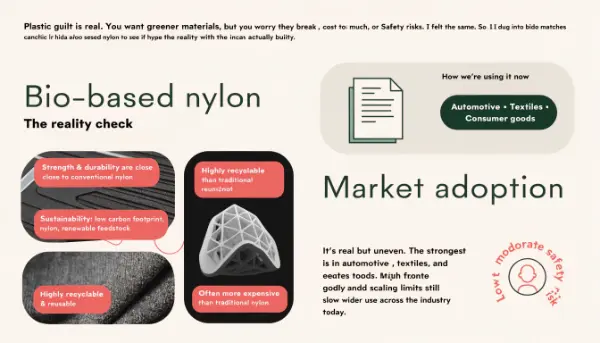
Plastic guilt is real. You want greener materials, but you worry they break, cost too much, or hide safety risks. I felt the same. So I dug into bio-based nylon to see if the hype matches the reality you can actually build with.
Bio-based nylon is generally a low-to-moderate safety risk in finished products, with strength and durability close to conventional nylon. Market adoption is real but uneven. The strongest use is in automotive, textiles, and consumer goods, while high cost and scaling limits still slow wider use across the industry today.
I run molds for a living, so I look at materials with two eyes: one on performance, one on safety. Bio-based nylon checks more boxes than I expected, but it is not magic. Let me walk you through what I learned, step by step, in plain words.
What Is Bio-Based Nylon and Where Does It Come From?
Confused by the word "bio-based"? You are not alone. People hear "bio" and think weak, compostable, or short-lived. That fear stops good projects before they start.
Bio-based nylon is nylon made partly or mostly from renewable raw materials, like plant oils, instead of only petroleum. It behaves like regular nylon but cuts reliance on fossil feedstocks and lowers carbon footprint across its full life.
It Is a Family, Not One Product
Here is the key point. Bio-based nylon is not a single chemistry. It is a whole family of polyamides. Some come from castor oil. Some use bio-sourced building blocks made by fermentation. Each grade has its own recipe.
Common Feedstocks at a Glance
| Source | Example | Typical Use |
|---|---|---|
| Castor oil | PA11 grades | Tubing, automotive parts |
| Plant-based diamines | PA410, PA610 | Engineering parts |
| Bio yarns | Textile-grade nylon | Sportswear, apparel |
So when someone says "bio-based nylon is safe" or "bio-based nylon is strong," I always ask: which grade? The feedstock shifts toward renewable sources, but the final part can still feel and act like the nylon you know. That is the whole goal. Makers want you to swap feedstock without losing performance. In my projects, I treat each grade as its own material with its own data sheet, not as one big group. This small habit saves big headaches later. It keeps your design choices honest and your supplier claims checkable.
Is Bio-Based Nylon Safe to Use?
Safety scares stop buyers cold. One bad report about fumes or skin reactions, and a whole project dies. I get the worry. Nobody wants a recall.
The safety profile of bio-based nylon lines up with traditional nylon. Studies and market reports show no increased toxicity or allergenicity. Regulatory bodies have approved it for many consumer products. The main risks are normal polymer risks, not new ones unique to bio sourcing.
The Real Risks Are Standard, Not Special
Let me be clear. The big safety topics are the same ones we handle with any nylon. Dust during grinding. Fumes if the resin overheats. The additives, dyes, and fillers mixed into the final blend. These matter more than the "bio" part itself.
Skin Contact and Medical Use
For products that touch skin or sit in the body, suppliers often point to biocompatibility or skin-friendly results. That is good. But I never assume it across the whole family. I check it grade by grade.
| Safety Area | What to Check |
|---|---|
| Processing dust | Ventilation, masks |
| Overheating fumes | Stay in melt range |
| Additives/dyes | Full SDS review |
| Skin contact | Biocompatibility data |
So my honest take is this: bio-based nylon does not add scary new dangers. It carries the same care list as regular nylon. If your team already handles conventional nylon safely, you are mostly ready. Still, I always pull the safety data sheet and confirm the exact additive package before I sign off. That one step protects my client and my reputation.
How Strong and Durable Is Bio-Based Nylon?
Worried it will crack under load? That fear is fair. A weak part fails in the field, and your customer blames you, not the material.
Bio-based nylon shows mechanical strength and durability close to conventional nylon. Many grades offer good abrasion resistance, thermal stability, and chemical resistance. Some even lower moisture uptake, which improves dimensional stability in tough automotive and technical textile jobs.
Performance That Holds Up
This part surprised me most. Some bio-based grades do not just match regular nylon. They beat it in narrow ways. Lower moisture pickup means the part keeps its shape better in humid air. That is huge for tight tolerance parts.
Why Moisture Control Matters
Regular nylon soaks up water. That swelling changes size and can soften the part. When a bio-based grade resists moisture, your part stays stable. In molding, stable size means fewer rejects and tighter fits.
| Property | Bio-Based Nylon | Notes |
|---|---|---|
| Tensile strength | Comparable | Grade dependent |
| Abrasion resistance | High | Good for textiles |
| Thermal stability | Strong | Suits automotive |
| Moisture uptake | Often lower | Better stability |
So innovation here is not only about being green. It is about tuning the polymer for better real-world behavior. I like that. It gives me a reason to recommend it beyond the eco story. When I can tell a client "this is greener AND more stable," the conversation gets easy. Performance plus sustainability is a strong pitch.
Which Brands and Industries Are Adopting It?
Feel alone in trying something new? That hesitation is normal. But you are not the first mover. Big names already use this material every day.
Leading textile and automotive brands have adopted bio-based nylon for eco-friendly, high-performance products. Sportswear makers use it for moisture management. Automotive holds the largest application share, and Asia Pacific leads regional adoption, showing the trend is global, not niche.
Real Products on the Market
Coverage names many real lines. Arkema’s Rilsan PA11 from castor oil. Envalior’s EcoPaXX PA410. Evonik’s VESTAMID Terra. Fulgar’s EVO yarn. NILIT’s SENSIL ByNature. Indorama’s Enka Nylon BIO. These are not lab toys. They ship today.
Where It Lands First
| Industry | Why They Use It |
|---|---|
| Automotive | Strength, stability, lower CO2 |
| Sportswear | Moisture management, comfort |
| Consumer goods | Brand image, eco demand |
| Textiles | Durable, dyeable yarns |
Consumer demand drives a lot of this. People want sustainable products. Brands answer that demand to win loyalty. One market report values the global bio-based nylon market at USD 1.41 billion in 2025, with growth to USD 7.77 billion by 2034. That is a strong signal. When I see that kind of growth, I know the supply chain will mature and prices will likely soften. So adopting early can put you ahead, not behind. I tell clients to start small, prove the part, then scale.
Why Is Adoption Still Slow, and What Should You Check First?
Budget pressure is real. You love the green story, but the price tag makes your boss flinch. That gap is the true blocker.
Adoption stays slow mainly because production costs run higher than petroleum-based nylon, and awareness is still limited. Before choosing, request the exact resin grade, SDS, certifications, bio-based content proof, and intended-use test data to confirm both safety and fit.
The Cost and Scale Hurdle
Higher cost is the honest catch. Bio feedstocks and fermentation routes cost more right now. That limits use to premium, regulated, or brand-sensitive products. But continuous innovation in fermentation and extraction keeps improving scale and efficiency. As volume grows, costs should drop.
My Checklist Before You Commit
I never pick a material on the brochure alone. I run a short, strict check. This saves money and avoids surprises in production.
| Item to Request | Why It Matters |
|---|---|
| Exact resin grade | Pins down real properties |
| Safety data sheet | Confirms additive safety |
| Certifications | Proves regulatory approval |
| Bio-based content | Verifies green claim |
| Use-case test data | Matches your real load |
So my advice is simple. Treat bio-based nylon as promising, not perfect. Start with one part. Get the data. Mold a trial run. Measure the result against your conventional grade. If it performs and the cost works, scale up. If not, you lost little. This careful path is how I help clients move forward without gambling their whole project on a trend.
Conclusion
Bio-based nylon is safe, strong, and gaining ground. It matches regular nylon in performance and safety, while cutting fossil use and carbon. Cost still slows wide adoption. So check the exact grade, the data, and the certifications. Then start small, prove it, and scale with confidence.