

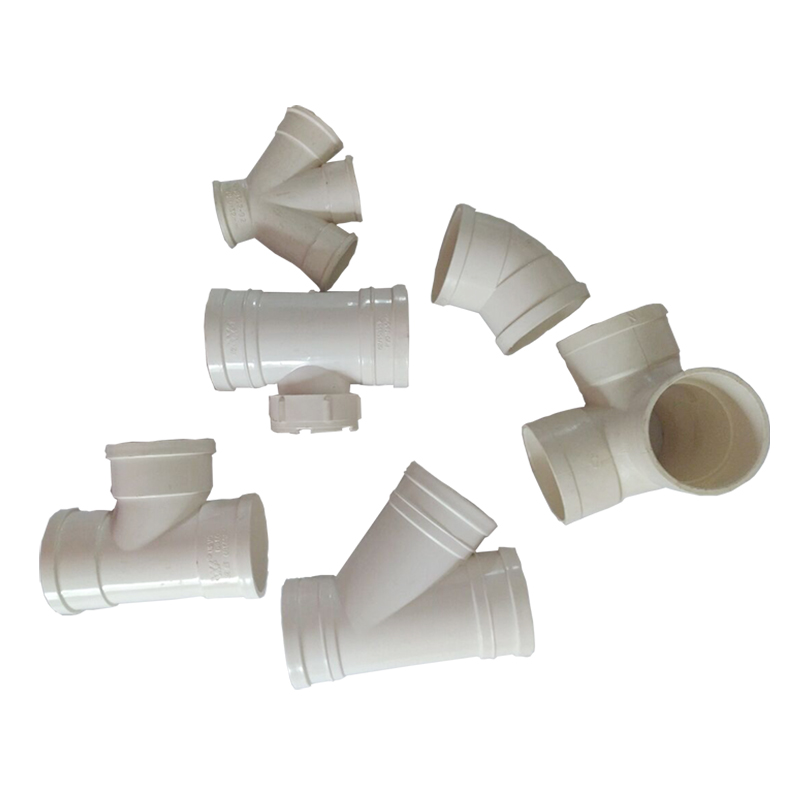
PVC pipe fitting injection molding turns a compounded rigid PVC formulation into elbows, tees, couplings, adapters, and other shapes that are difficult to make by continuous extrusion. The process is more sensitive to formulation, heat history, venting, cooling, and dimensional inspection than a generic thermoplastic job. The exact compound supplier data sheet must control the processing window.
Why injection mold PVC fittings?
Extrusion is efficient for continuous profiles such as straight pipe. Injection molding is better suited to discrete fittings with sockets, branches, bends, threads, sealing features, and changing flow paths. The mold must reproduce the functional geometry while controlling weld lines, shrinkage, flash, socket dimensions, and sealing surfaces.
Rigid PVC is not handled like every other commodity resin. The compound contains a resin and a stabilizer/lubricant package selected for the application. Excessive heat, shear, residence time, or contamination can cause discoloration and degradation. See Teknor Apex’s rigid PVC injection molding guide for an example of why the compound and equipment recommendations must be treated as a system.
From PVC pellets to a molded fitting
- Define the fitting: specify pressure class or application requirement, connection dimensions, sealing method, temperature, chemical exposure, color, and inspection points.
- Confirm the compound: select the exact rigid PVC grade or formulation, storage condition, color concentrate, and any regrind rule. Do not substitute a generic PVC pellet without approval.
- Review DFM: check wall transitions, sockets, threads, cores, draft, parting line, slides, lifters, shutoffs, vents, and ejection before steel release.
- Design the flow path: gate location should fill the fitting without putting a critical sealing face in an unacceptable weld-line or gate-vestige location.
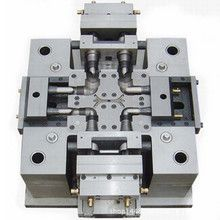
- Control the mold: cooling must keep socket and body dimensions stable. Venting must remove air from the end of fill and from deep core features.
- Validate the process: measure dimensions, flash, appearance, fit, pressure or leak performance where required, and cavity-to-cavity variation.
Design details that affect fitting quality
Wall thickness and flow transitions
Fittings often combine thick hubs with thinner arms or sockets. Abrupt transitions can create uneven cooling, sink, voids, warpage, or a weld line in a stressed area. Core out heavy sections where the function permits, use radii, and make the flow path predictable. A design that looks symmetrical in CAD can still fill asymmetrically because of cores, inserts, or gate position.
Threads, sockets, and sealing surfaces
Define the functional datum and inspect it separately from general appearance. Draft, ejection, shrinkage, and parting-line flash can affect assembly torque or sealing. Threads may require unscrewing, collapsible tooling, split cores, or a design that permits demolding in the opening direction. Do not quote a tight tolerance without identifying the measurement temperature and conditioning state.
Common PVC fitting defects
| Symptom | Potential causes | Useful checks |
|---|---|---|
| Brown or dark discoloration | Excessive thermal history, residence time, shear, contamination, or an unsuitable compound | Material lot, purge, barrel residence, screw and nozzle condition, temperature record |
| Short shot or incomplete socket | Restricted gate, poor venting, cold flow front, low fill energy, or an unbalanced runner | Gate and vent layout, fill profile, cavity pressure trend, material condition |
| Flash at parting line | Insufficient shutoff support, clamp or alignment issue, excessive pressure, or worn steel | Shutoff condition, mold alignment, flash location, pressure profile |
| Leak or poor fit | Socket ovality, warpage, weld-line weakness, dimensional drift, or inconsistent cooling | Gauge method, sealing test, cooling balance, part temperature and conditioning |
For production planning, connect the fitting design to Cavity Mold’s engineering review, mold-making service, and injection molding service. Contact the team with the fitting drawing, compound, annual volume, connection standard, and inspection requirements.
Map the fitting’s functional dimensions
Inspect a PVC fitting by function rather than a generic outer-diameter check. Mark socket depth, interference or clearance, sealing land, thread or locking feature, branch alignment, wall thickness, and every mating interface. Each measurement needs a datum and a conditioning state when the application requires it.
- Confirm compound, stabilizer package, color, and supplier limits before setting the tool.
- Review gate and vent locations so weld lines, trapped gas, and vestige do not weaken or interfere with the connection.
- Control residence time, shear, contamination, and heat history; rigid PVC compounds are not generic resins.
- Use gauges or mating parts that represent the actual assembly, not only a visual check.
Cooling balance matters where sockets, sealing surfaces, or branch intersections have different wall mass. If the fitting is pressure-related, define the applicable product requirement and validation method rather than claiming a capability from the mold alone. Send CAD, mating dimensions, compound data, volume, and inspection plan through the engineering request.