
PEEK injection molding is possible on suitable equipment, but the resin’s high processing temperature, crystallization behavior, shrinkage, and thermal history require a tighter engineering plan than many commodity thermoplastics. The exact grade—unfilled, glass-filled, carbon-filled, or another compound—sets the material data and processing window. Use the supplier’s guide for actual temperatures and drying conditions.

Why mold PEEK?
PEEK is a high-performance engineering thermoplastic used where a part needs a demanding combination of mechanical performance, chemical resistance, wear resistance, or temperature capability. Its value is application-specific: a general-purpose resin may be more economical when the environment does not require PEEK’s performance. Selection should consider load, temperature, chemicals, wear, sterilization or cleaning exposure where relevant, electrical behavior, and dimensional requirements.
Victrex provides a dedicated PEEK injection molding processing guide and explains that standard reciprocating-screw machines can mold unfilled and filled grades when the equipment and process are suitable. The guide should be the reference for the selected Victrex grade; other manufacturers’ grades may have different recommendations.
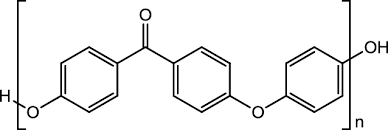
Material preparation and thermal control
PEEK pellets must be prepared according to the grade supplier’s instructions. Moisture or contamination can reduce reliability, while excessive residence time or uncontrolled heat history can degrade the material. Record drying conditions, hopper handling, barrel-zone settings, screw recovery, residence time, and purge practice. A process window that is not recorded is difficult to reproduce after a shutdown or material-lot change.
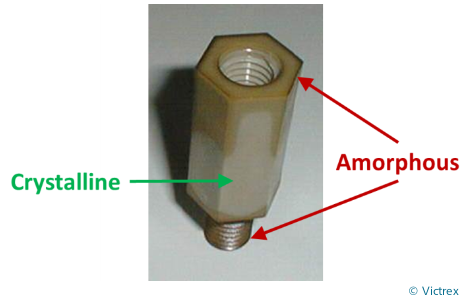
The mold temperature affects crystallinity, shrinkage, surface quality, and dimensional behavior. Cooling too aggressively can produce a different structure from the qualified process; cooling too slowly can increase cycle time or allow distortion. The selected mold-temperature system must therefore be part of the tool and machine review, not an afterthought.
Part and mold design for PEEK
Wall thickness, radii, and shrinkage
Keep walls as uniform as the function allows and core out heavy areas. Use generous radii at corners to reduce stress concentration and support flow. Filled grades can shrink differently in the flow and transverse directions, so orientation and fiber direction may affect dimensions and warpage. Define critical dimensions relative to the actual grade and process rather than using a generic plastic tolerance.
Gate, venting, and steel
Gate design must provide enough flow area without creating damaging shear or an unacceptable vestige. Venting should be sufficient at the end of fill and around difficult features. Abrasive reinforced grades may require a steel and wear strategy suited to the material. The toolmaker should also review thermal expansion, heater and cooling layout, ejector loads, and access for maintenance.
PEEK molding process and inspection workflow
- Confirm grade, reinforcement, data sheet, drying requirements, end-use environment, and critical dimensions.
- Review DFM, flow length, wall variation, gate, vents, parting line, cooling, ejection, and steel before machining.
- Set up machine, barrel, nozzle, mold-temperature control, and material handling to the grade supplier’s guidance.
- Use T1 trials to record fill behavior, part weight, dimensions, crystallinity-related behavior, surface, flash, and ejection.
- Validate functional and dimensional performance after the required conditioning or thermal history.

Do not assume that one acceptable PEEK shot proves a stable process. Repeatability across cavities, material lots, startup, and normal stoppages is the real qualification target. For an engineering review, see Cavity Mold engineering, mold making, and injection molding. Contact the team with the exact PEEK grade, CAD, volume, and inspection requirements.
PEEK tooling decisions must include thermal capacity
Review PEEK as a thermal system: machine and screw capacity, mold-temperature condition, crystallinity, and inspection state all affect the result. Unfilled, glass-filled, carbon-filled, and specialty compounds are not interchangeable. The selected supplier’s processing guide and data sheet control actual limits.
- Confirm dryer capability, material exposure, hopper practice, and contamination control.
- Check mold-temperature equipment, seals, hoses, and instrumentation.
- Review gate, venting, wall transitions, insert support, and shrinkage for the compound.
- Define whether dimensions are measured immediately, after conditioning, or after stabilization.
For demanding applications, link dimensions to the functional test that matters: load, wear, chemical exposure, electrical behavior, or temperature cycling. Use material selection support to compare alternatives and the mold-making team to review thermal and maintenance implications.