
TPE Overmolding on PP: Bonding, Design, and Process Guide
Answer in one sentence: TPE-on-PP success depends on grade compatibility, surface and geometry, mechanical retention, thermal history, mold design, and process validation rather than a material name alone.
How to use this guide: The design decision here is not simply whether TPE sticks to PP; it is how the soft layer carries loads, survives cleaning, and stays attached through the product life. Use the controls and evidence below to compare the actual part, resin, mold, machine, and production requirement.

What TPE-on-PP overmolding must accomplish
A PP substrate supplies structure while a TPE layer adds grip, sealing, cushioning, or tactile contrast. The overmold must locate the substrate, fill the intended skin, and resist peel, shear, twisting, cleaning, and repeated handling. Adhesion is only one part of that system.
- Select the TPE and PP grades as a pair; published compatibility is a starting point, not a finished validation.
- Use a mechanical interlock when the application cannot tolerate a bond-only failure mode.
- Define the exposed edge, parting line, and transition so the soft material is not unintentionally peeled from the substrate.
Bonding versus mechanical retention
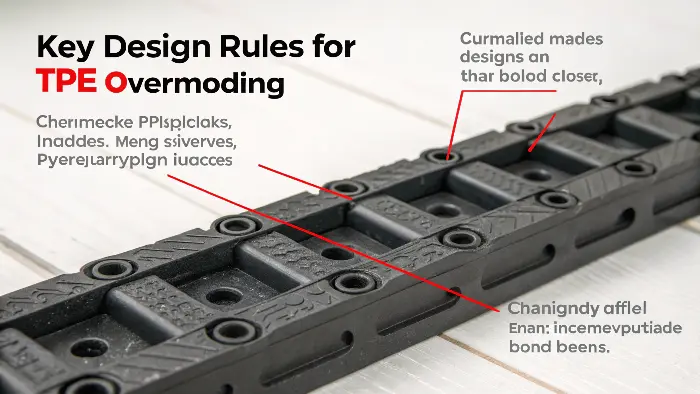
Some TPE/PP combinations can develop useful interfacial adhesion, while others rely mainly on geometry. Ribs, holes, undercuts designed for molding, dovetails, and wraparound features can create a mechanical load path. Avoid sharp transitions that concentrate peel stress at the edge of the overmold.
- Place retention features where they do not create sink, read-through, or unacceptable cosmetic marks on the grip surface.
- Consider the direction of demolding and the direction of service loads together.
- Test dry, wet, warm, cold, and cleaned conditions when the product will see those environments.
Substrate and overmold design
The PP insert must be dimensionally stable enough to locate in the second operation or mold sequence. TPE thickness, flow length, gates, vents, and cooling affect both feel and distortion. Large differences in shrinkage can cup or warp the substrate, especially around sharp corners and abrupt thickness changes.
- Keep the soft layer as uniform as the function allows and radius corners.
- Provide positive locating features and account for PP shrinkage before the second shot.
- Protect sealing surfaces and functional datum faces from flash and parting-line movement.
- Use texture deliberately: texture can improve grip but also changes release, fill, and perceived hardness.
Validation for kitchen handles and containers
A handle or container grip is often exposed to oils, detergents, heat, moisture, and repeated flexing. Build a test plan around the real use case: adhesion or retention, odor and staining, cleanability, dimensional fit, and migration or regulatory needs where applicable. Do not claim food-contact suitability from a generic TPE label.
- Confirm the exact resin grades, colorants, and processing aids with supplier documentation.
- Inspect the bond line and edge after accelerated use testing, not only immediately after molding.
- Define acceptable flash, soft-layer position, durometer, color, and cosmetic limits before tool release.
Frequently Asked Questions
Will TPE always bond chemically to polypropylene?
No. Compatibility varies by grade and process. A robust design may combine compatible materials with mechanical retention, and the final combination should be tested on the real substrate and under the intended use conditions.
What is the safest way to prevent an overmold from peeling?
Design a load path that resists peel, add suitable molded-in retention, avoid exposed overmold edges in high-stress areas, and validate the assembly after thermal, chemical, and cyclic exposure.
How thick should the TPE layer be?
There is no single thickness for every durometer and product. Start from the grip, seal, or cushioning requirement, then check flow length, cooling, shrinkage, flash, texture, and the stability of the PP substrate.
Is a TPE-over-PP kitchen product automatically food safe?
No. Food-contact status depends on the exact formulation, colorant, processing history, and market requirements. Obtain grade-specific compliance documentation and validate the finished product and cleaning conditions.
Related Cavity Mold Services
For design review, mold engineering, tooling, and production planning, see our mold engineering service, mold-making service, and injection molding service.
Need a part-specific recommendation? Contact Cavity Mold with the part drawing, resin, annual volume, tolerances, and target application.