
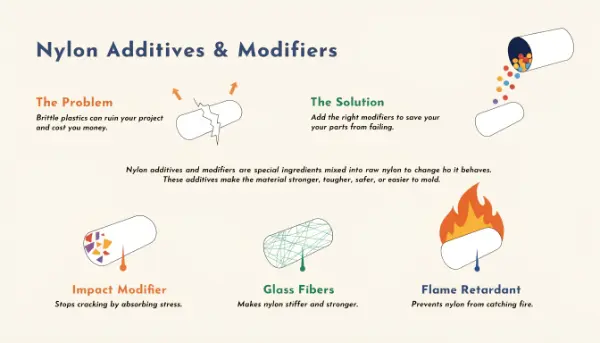
Are your nylon parts cracking under pressure? Dealing with brittle plastics can ruin a project and cost you money. Adding the right modifiers can save your parts from failing. Let me show you how these helpful additives work.
Nylon additives and modifiers are special ingredients mixed into raw nylon to change how the plastic behaves. They make the material stronger, tougher, safer, or easier to mold. Common additives include impact modifiers to stop cracking, glass fibers for stiffness, and flame retardants for fire safety.
When I started making molds over ten years ago, I thought nylon was just one simple plastic. But it is not. You have to tune it like a car engine. Let us look at how different additives change the rules of the game.
What is the impact modifier used for?
Do your plastic parts break when dropped? A fragile part can cause big safety risks for users. Impact modifiers solve this problem by making plastics much tougher and ready for hard hits.
An impact modifier is a special chemical rubber added to plastics to absorb shock and stop cracks. It is used to make brittle materials tougher. This lets the plastic survive drops, heavy weights, and cold weather without breaking into pieces.
How These Rubber Additives Work
Impact modifiers act like tiny rubber balls hidden inside the hard plastic. When something hits the part, these rubber balls soak up the energy. This stops the hit from breaking the main plastic. We use them all the time at CavityMold. They are very important for tool handles, car parts, and phone cases. I once designed an electronic case that failed its first drop test. The case broke easily. We added an impact modifier. Then it passed the test perfectly.
Balancing the Plastic Mix
There is always a trade-off in plastic design. If you add rubber, the part gets softer. It might lose some of its natural stiffness. Sometimes, fillers like glass fibers are added to get the stiffness back. Let me show you a simple table to explain what different modifiers do.
Common Modifiers and Their Jobs
| Modifier Type | What It Does | Example Use |
|---|---|---|
| Impact Modifiers | Stops cracking and breaking | Phone cases, tool handles |
| Glass Fibers | Makes the part stiff and strong | Car engine parts |
| Plasticizers | Makes the plastic flexible | Hoses, soft cables |
| UV Stabilizers | Stops sun damage | Outdoor chairs |
Molding Tough Plastics
When we design a mold, we must know what additive is inside. Rubber makes the plastic flow differently. We have to change the heat and pressure in the injection machine. If we do not change the settings, the part will have ugly marks. We always test the plastic flow first. This keeps our molds running perfectly and our customers happy. Additives are powerful tools. You must use them the right way to get good results.
What is the impact modifier for nylon?
Is your standard nylon failing in extreme cold? Regular nylon gets very stiff and snaps easily when the temperature drops. Adding a nylon-specific impact modifier stops this cold-weather failure completely.
The impact modifier for nylon is usually a special kind of rubber called EPDM or a maleic anhydride grafted polymer. These modifiers mix perfectly with nylon. They act like tiny shock absorbers inside the nylon, making it highly resistant to cracking even under freezing temperatures.
The Right Match for Nylon
Nylon is a great plastic. It is strong and resists rubbing. But it has a weak spot. It can be very dry and brittle right after molding. It needs a specific type of rubber to become tough. You cannot just throw any rubber into nylon. The chemicals must match perfectly. We use special rubber blends that lock onto the nylon molecules. This creates a very strong bond.
Avoiding Bad Plastic Mixes
If the chemical bond is weak, the plastic will peel apart like an onion. This is called delamination. I saw this happen early in my career. A cheap modifier was used in the mix. The parts just fell apart in my hands. We had to throw the whole batch away. It was a costly lesson for everyone.
Why We Modify Nylon
| Feature | Standard Nylon | Modified Nylon |
|---|---|---|
| Toughness | Low (when dry) | Very High |
| Cold Weather | Breaks easily | Stays strong |
| Flexibility | Rigid | More bendable |
| Molding Flow | Very easy | A bit harder |
Heat and Chemical Rules
Another important thing is heat. Nylon melts at a high heat. The impact modifier must survive this heat. If the modifier burns, it will ruin the plastic. It can also release bad gases. At CavityMold, we check the heat limits of all additives carefully. Heat stabilizers are often added with the rubber. This keeps the nylon strong under high heat without losing its shape. The goal is to make the plastic tough without breaking down during the molding process. Lubricants are also added to help the modified nylon flow into the mold easily.
What is PA6 impact modified?
Do you need a plastic that is both strong and cheap? Picking the wrong grade of plastic will ruin your budget and your product. Impact modified PA6 gives you high performance without spending too much money.
PA6 impact modified is a specific type of Nylon 6 that has rubber additives mixed in. Standard PA6 is strong but can crack easily when dry. By adding impact modifiers, PA6 becomes incredibly tough, making it perfect for power tools, sports gear, and car parts.
Understanding Nylon 6
Let us talk about PA6. PA6 stands for Polyamide 6. It is one of the most common nylons in the world. It is easy to mold and has good strength. But it absorbs water from the air. When it is completely dry, right out of the mold, it is very brittle. Impact modified PA6 solves this dry-brittle problem immediately. You do not have to wait for the plastic to absorb water to become tough.
Fast Results and Good Looks
The rubber inside does the job from day one. I love using impact modified PA6 for consumer electronics. It gives the product a solid and tough feel. Users like products that feel safe in their hands.
Comparing PA6 Types
| Property | Standard PA6 | Impact Modified PA6 |
|---|---|---|
| Dry Toughness | Poor | Excellent |
| Stiffness | Very High | Medium |
| Cost | Low | Slightly Higher |
| Shrinkage | Normal | Can vary |
Finding the Best Balance
You must be careful with additives. When you add rubber to PA6, you lose some stiffness. Sometimes, we fix this by adding glass fibers. But adding glass fibers can make it brittle again. It is a tricky balance. You have to find the perfect mix. Colorants also act differently in modified PA6. The rubber can make the colors look less bright. At CavityMold, we test every color batch. We want the parts to look great and work perfectly. We always look at the main job of the part first. Then, we pick the smallest amount of additives needed. This keeps the cost down and the quality very high.
Is nylon a hazardous material?
Are you worried about toxic chemicals in your plastic parts? Failing safety rules can get your product banned and harm your customers. Let us look closely at nylon safety to keep your projects fully compliant and safe.
Standard nylon is not a hazardous material. It is safe, non-toxic, and widely used. However, the additives mixed into nylon, like certain flame retardants or plasticizers, can sometimes contain restricted chemicals. You must check the specific additives to ensure the final material meets safety rules.
Safe Base Plastics
Pure nylon is very safe. We even use it for cooking tools and medical gear. But pure nylon is rarely used alone. We almost always add things to it. This is where safety gets complicated. The additives can be hazardous if you choose the wrong ones. For example, flame retardants are great for stopping fires. They reduce smoke and keep people safe.
Chemical Rules and Bans
But some old flame retardants are toxic. They are now banned in many places. When I design products for Europe, I have to be very careful. We must follow strict rules like RoHS and REACH. These rules limit bad chemicals. If our plastic fails these tests, the product cannot be sold at all.
Nylon Safety Checklist
| Additive Type | Safety Risk Level | Things to Watch Out For |
|---|---|---|
| Base Nylon | Very Low | Safe for normal use |
| Flame Retardants | Medium to High | Must check for banned chemicals |
| Colorants | Low to Medium | Some old colors have heavy metals |
| Antimicrobials | Medium | Must follow health rules closely |
Medical and Clean Parts
Antimicrobial additives are another good example. They stop bacteria from growing on the plastic. This is wonderful for hospital tools. But they are chemicals that kill germs. We must prove they are safe for humans to touch. You have to ask your plastic supplier for testing papers. Good suppliers provide full documents. We always read these papers at CavityMold before we cut any steel for a new mold. The safest way is to know exactly what is inside your plastic. Define the property you need first. Then pick the safest additive package to get there.
Conclusion
Additives turn plain nylon into an amazing, tough, and safe material. By choosing the right impact modifiers and checking for safety, you can build parts that last forever. Always balance strength, flexibility, and chemical rules to make the best product possible.