
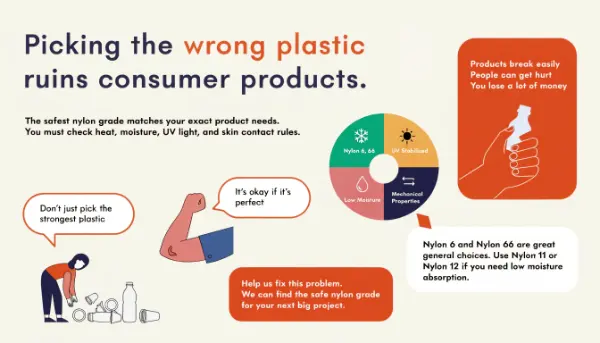
Picking the wrong plastic ruins consumer products. Products break easily. People can get hurt. You lose a lot of money. I want to help you fix this problem. We can find the safe nylon grade for your next big project.
The safest nylon grade matches your exact product needs. You must check heat, moisture, UV light, and skin contact rules. Nylon 6 and Nylon 66 are great general choices. You should use Nylon 11 or Nylon 12 if you need low moisture absorption. Do not just pick the strongest plastic.
I see many designers make bad choices with plastic. They do not know the rules. You can learn these simple rules today.
What is the best grade of nylon?
Many people ask me for the absolute best nylon. There is no single magic plastic for everything. A wrong choice causes bad product failures. I will show you how to find the exact best grade for your part.
The best grade of nylon depends entirely on your product environment. Nylon 6 and Nylon 66 work best for general strength and low cost. Nylon 11 and Nylon 12 work best for wet places. Flame-retardant nylon is best for electronics. The best nylon matches your safety needs.
Let us talk about safety factors first. I see many project managers make a big mistake. They just pick the hardest nylon. That is a bad idea. Nylon absorbs water from the air. We call this being hygroscopic. A hard nylon gear can swell up in a wet room. It loses its stiffness. Then the gear gets stuck. This happens often with tight parts. You must think about the environment. If your part stays in the sun, normal nylon breaks down. You need UV-stabilized nylon. If your part gets hot, you need heat-stabilized nylon. If you make a plastic box for wires, you need flame-retardant nylon.
At CavityMold, we help clients pick the right grade. We look at where the product lives. Here is how I choose the best grade for different needs.
Common Nylon Needs
| Product Need | Best Nylon Choice | Reason Why |
|---|---|---|
| Basic strong parts | PA 6 or PA 66 | They are strong, cheap, and easy to mold. |
| Wet or outdoor parts | PA 11 or PA 12 | They do not absorb much water. They keep their shape. |
| Sliding parts | Filled nylon | They do not wear out fast. They have low friction. |
| Hot parts | Heat-stabilized nylon | They stay strong when the temperature goes up. |
| Electrical boxes | Flame-retardant nylon | They stop fires. They pass safety tests. |
You can see that the best grade changes every time. I always tell my team to check the heat and the water first. Then we check the UV light. Then we check the chemicals. Nylon handles oils very well. It does not handle strong acids well. You must know these rules to make safe consumer products. We want to avoid product returns. We want to keep users safe. You must think about these things early. If you pick the wrong plastic, the mold might not work later. The mold is made of hard steel. It is very hard to change.
Which is better, nylon 6 or nylon 66?
You might feel stuck between these two popular plastics. Making the wrong pick here wastes time. Your mold might even need expensive changes. Let us look at the real differences between them.
Nylon 66 is slightly better for high heat and high stiffness. Nylon 6 is better for a nice surface finish and impact strength. Nylon 66 absorbs less water than Nylon 6. Both plastics are very strong. Your choice depends on whether you need heat resistance or a smooth look.
People ask me this question every week. I have made molds for both materials for many years. Let me tell you a story. A few years ago, a client wanted a very shiny consumer product. They chose Nylon 66. They thought it was stronger. We injected the plastic into the mold. The part came out strong. But the surface looked a little dull. Nylon 66 does not always flow perfectly for shiny parts. We switched the material to Nylon 6. The new parts looked beautiful. Nylon 6 flows better in the mold. It makes a nicer surface.
Key Differences Between the Two
| Feature | Nylon 6 | Nylon 66 |
|---|---|---|
| Heat Resistance | Lower | Higher |
| Surface Finish | Excellent | Good |
| Impact Strength | Higher | Lower |
| Water Absorption | Higher | Lower |
| Mold Flow | Very good | Good |
Nylon 66 melts at a higher temperature. This makes it good for hot car parts. It also handles friction a bit better. If you make a gear, Nylon 66 is usually a better idea. Nylon 6 is softer. It can absorb shocks better. If you drop a Nylon 6 part, it might not crack as fast. Nylon 6 is also a bit easier to mold. It fills the small corners of the mold better. This is very good for small consumer electronics. You want those parts to look perfect.
You also need to think about moisture. Both materials absorb water. Nylon 6 absorbs a little more water than Nylon 66. If you have a very tight space, the Nylon 6 part might grow too big on a humid day. I always check the exact sizes before I cut the steel for the mold. I want to make sure the mold is right for the specific shrinkage of the nylon. Choose Nylon 66 for hot, stiff parts. Choose Nylon 6 for nice, tough parts.
Is nylon 6 6 FDA approved?
Food safety is a huge deal. A bad plastic can poison food. You could face a massive lawsuit. Let us see if you can safely use this nylon for food items.
Standard Nylon 66 is not automatically FDA approved. You must buy a specific FDA-compliant grade of Nylon 66. The plastic maker must certify that their exact formula is safe for food contact. Food-safe grades do not have toxic chemicals. Always ask your supplier for the official FDA certificate.
You must be very careful with food and skin contact. Do not assume all nylon is safe. Standard nylon has many additives in it. It might have color chemicals. It might have mold-release oils. These things can leak into food. The FDA has strict rules for this. I remember a project for a kitchen spoon. The client brought a standard cheap nylon to us. I had to stop the project. I told them we could not use that plastic. We had to buy a special food-grade nylon.
Making Food-Safe Parts
If you want to use Nylon 66 for food, you must do these things:
| Step | Action | Why it matters |
|---|---|---|
| 1. Find the right grade | Look for "FDA compliant" on the data sheet. | Regular grades have unsafe chemicals. |
| 2. Check the color | Only use food-safe colors. | Many cheap colors are toxic. |
| 3. Clean the mold | Wash all machine oil off the mold. | Machine oil can get on the plastic. |
| 4. Test the part | Send the final product to a lab. | The lab proves the part is really safe. |
Low-VOC nylon grades are also important here. VOC means volatile organic compounds. Low-VOC plastics do not give off bad smells. They do not release bad gases. This is very good for indoor consumer products. It is very good for food products. You also need to think about hygiene. Some consumer products get touched a lot. A toothbrush handle is a good example. You can buy antimicrobial nylon. This nylon kills germs. It keeps the product clean. I always tell buyers to read the safety papers. Only use grades certified for the exact contact. Do not guess. Guessing is dangerous. I always tell my customers to keep the paperwork safe. The FDA might ask to see it. Your store buyers might ask to see it. You must prove the product is safe.
What is the ASTM standard for nylon?
Buying plastic is confusing. Suppliers use many strange numbers. You might buy the wrong material by mistake. You need to know the basic standard numbers to stay safe.
The main ASTM standard for nylon injection molding materials is ASTM D6779. This standard classifies different polyamides like Nylon 6 and Nylon 66. It tells you the exact physical properties the plastic must have. Using this standard ensures you get the correct material quality from your supplier.
ASTM stands for American Society for Testing and Materials. They write the rules for materials. When you buy nylon, you do not just say "I want strong nylon." You give the supplier an ASTM number. This number tells them exactly what you need. ASTM D6779 is the big rule book for nylon. It lists all the tests. It tests how strong the plastic is. It tests how much water the plastic absorbs. It tests how the plastic melts.
Why Standards Matter
I use these standards every day. Let me explain why they help you.
| Benefit | Explanation |
|---|---|
| Exact Quality | You know the plastic will act a certain way. |
| Easy Buying | All suppliers understand the ASTM numbers. |
| Safety Proof | The standard proves the material is tested. |
| Easy Changes | You can switch suppliers easily. |
If your product needs high strength, you might use reinforced nylon grades. These grades have glass fibers inside them. The ASTM standard tells you exactly how much glass is in the plastic. Glass fibers make the nylon very hard. They stop the part from breaking under high stress. Sometimes you need transparent nylon. You want people to see inside the part. There are standards for clear nylon too.
You must always check the data sheet. The data sheet lists the ASTM tests. It shows the test results. I look at the data sheet before I design any mold. I look at the shrink rate. The shrink rate tells me how much the plastic will shrink when it cools down. I cut the steel mold a little bit bigger to fix the shrinking. The ASTM standards give me the right numbers. They make my job possible. They keep your products safe. If you do not use the standard, you might get bad plastic. Bad plastic breaks easily. It can hurt people. Always ask your supplier for the test data.
Conclusion
The safest nylon matches your product needs. You must think about water, heat, and safety rules. Nylon 6 and Nylon 66 are great starting points. Always use certified