
Choosing the wrong plastic for your project is a nightmare. You face broken parts, safety recalls, and wasted money, all because the material couldn’t handle the real-world stress. The sheer number of ABS options makes this decision overwhelming for even experienced engineers.
Selecting the right ABS grade requires balancing three critical factors: impact resistance, heat deflection, and flow rate. Standard ABS works for general housing, while high-heat grades are necessary for automotive interiors. For medical devices, biocompatible grades are mandatory. Always match the material’s yield strength and flame retardancy rating (like UL94) to your specific application requirements.
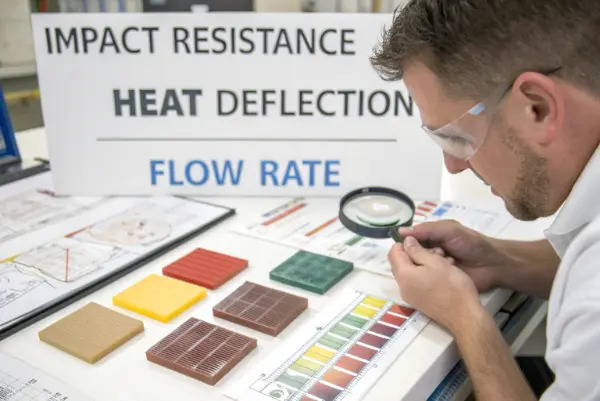
I have seen many projects stall because the initial material choice was just "generic ABS." It works fine in a CAD simulation, but when you actually mold it, the results are different. Let’s break down exactly how to navigate these choices so your production runs smoothly.
What is an ABS grade really?
You might think all ABS plastic is the same, but that is a dangerous assumption. Ignoring the specific chemical formulation can lead to parts that warp in the sun or snap during assembly. You need to understand that "ABS" is a family of materials, not a single product.
An ABS grade is a specific formulation of Acrylonitrile Butadiene Styrene that has been modified to enhance certain properties. Manufacturers adjust the ratio of the three monomers—Acrylonitrile (chemical resistance/stability), Butadiene (toughness/impact strength), and Styrene (rigidity/processability)—to create grades suited for high heat, high flow, or flame retardancy.
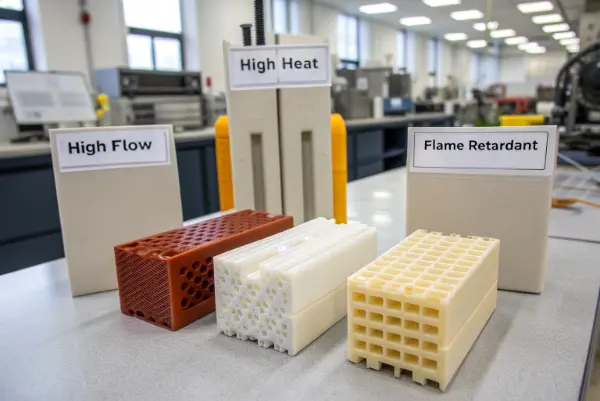
Let’s dig a little deeper into what this actually means for your daily work. When you look at a material datasheet, you aren’t just looking at random numbers. You are looking at a recipe.
Think of it like baking. You have flour, sugar, and eggs. If you add more sugar, you get a sweeter cake. If you add more flour, it gets denser. In ABS, if a supplier increases the Butadiene rubber content, the impact strength goes up significantly. This is great for a protective case that might get dropped. However, that usually lowers the tensile strength and makes the material softer.
If they increase the Acrylonitrile, you get better chemical resistance and heat stability. This is why you cannot just specify "ABS" on a drawing. You need to specify the grade based on the environment.
Here is a simple breakdown of how the ratio changes performance:
| Monomer Component | Primary Benefit | Trade-off if Increased |
|---|---|---|
| Acrylonitrile | Chemical resistance, heat stability, aging resistance | Can make processing slightly harder |
| Butadiene | Impact strength (toughness), low-temperature performance | Lowers tensile strength, reduces gloss |
| Styrene | Glossy finish, rigidity, easy processing (flow) | Lowers impact resistance |
At CavityMold, we often ask clients about the "end-use environment" first. If the part is an outdoor housing, we need a grade with UV stabilizers added to the base ABS, because standard ABS degrades in sunlight. If it is a medical device, we need a grade that is FDA compliant. The "grade" is the total package of the base polymer plus these additives.
What are the different grades of ABS available?
Sticking to one type of material for every project limits your design potential. You might miss out on cost savings or performance boosts because you aren’t aware of the specialized options available. Knowing the landscape of ABS grades helps you optimize your product from the start.
Common ABS grades include General Purpose (high gloss/high impact), High Heat (for automotive/electronics), Flame Retardant (UL94 rated), and Transparent grades. There are also Platable grades designed for chrome plating and Glass-filled grades that significantly increase stiffness and dimensional stability for structural components.
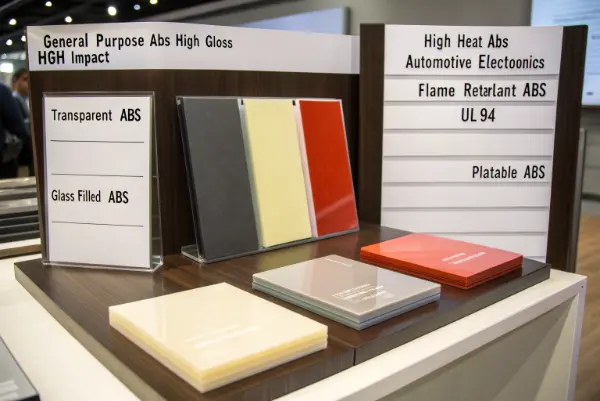
When we start a new mold design at CavityMold, we usually categorize the material selection into functional buckets. It helps to look at these grades not just by name, but by what problem they solve.
1. General Purpose Grades:
This is the workhorse material. It balances flow, toughness, and price. It is what you find in LEGO bricks or computer mouse bodies. It molds easily and looks good. If your product doesn’t have extreme requirements, start here.
2. High-Flow Grades:
If you have a very complex mold with thin walls, general ABS might freeze before it fills the cavity. High-flow grades have lower viscosity. They fill the mold faster and at lower pressures. This reduces cycle time and saves money, but you might lose a little impact strength.
3. Flame Retardant (FR) Grades:
This is non-negotiable for many consumer electronics. If your device plugs into a wall, you likely need a UL94 V-0 rating. Manufacturers add additives like halogen or phosphorus to the ABS. Be careful here: FR additives often make the material heavier and more brittle.
4. Heat Resistant Grades:
Standard ABS softens around 90°C to 100°C. High-heat grades can push this up to 110°C or more. This is crucial for car interiors that get baked in the sun.
Here is a quick reference for typical applications:
| Grade Type | Key Characteristic | Typical Application |
|---|---|---|
| General Purpose | Good impact, high gloss | Toys, Housings, Appliances |
| Flame Retardant | Self-extinguishing | Power strips, TV casings |
| Glass-Filled | High stiffness, low warp | Structural frames, support brackets |
| Transparent | See-through (mostly) | Appliance windows, refrigerator trays |
| Platable | Accepts metal plating | Showerheads, automotive trim |
Always ask for the Melt Flow Index (MFI). A low MFI means it is thick and tough (good for extrusion). A high MFI means it flows like water (good for injection molding intricate parts).
Specify the grade properly: ASTM D4673 and the cost of each grade
Writing "ABS" — or even "ABS Black" — on a drawing does not specify a material. The primary standard for specifying ABS plastic is ASTM D4673, which classifies the material with a line callout: group and class define the basic composition, grade specifies viscosity (flow rate), and the table requirements assign values to the properties that matter for the part — Izod impact strength, tensile strength, flexural modulus, and deflection temperature. Specifying "ABS per ASTM D4673" with the property limits listed removes the ambiguity that lets a supplier substitute a cheaper, inferior resin unnoticed. For a snap-fit joint, for example, the flexural modulus in the callout is the number that decides whether the snap holds or breaks.
The grade table in the section above gains a cost dimension when selection is a balance of cost, performance and safety:
| Grade type | Key characteristic | Typical application | Relative cost |
|---|---|---|---|
| General Purpose | Balanced impact strength and rigidity | Toys, consumer electronics housings, storage bins | Low |
| High Heat | Resists deformation at higher temperatures (up to 100 °C+) | Automotive interiors, coffee makers, hair dryers | Medium |
| Flame Retardant | Contains additives to self-extinguish; meets UL94 V-0 | Power strips, computer monitors, server casings | High |
| Platable | Optimised surface for electroplating adhesion | Showerheads, automotive grilles, decorative knobs | Medium–High |
| Transparent | Modified to allow light transmission (less clear than PC) | Vacuum cleaner dust bins, medical devices, displays | High |
Relative cost is as stated in the folded-in article — a ranking, not a price. Trade-offs run with the grade: flame-retardant additives that stop fire often make the plastic more brittle and lower impact strength, and high-heat grades need higher mold temperatures, which can lengthen cycle time and cost. Ask "what is the worst thing that can happen to this part?" — fire points to flame retardant, dropping points to general purpose or high impact — and do not pay for properties the part does not need.
What is the yield strength of ABS and why does it matter?
If you design a snap-fit joint without knowing the yield strength, it will likely break the first time someone uses it. Ignoring mechanical limits leads to field failures that damage your brand reputation. You need to know exactly how much force the material can take before it deforms permanently.
The yield strength of standard ABS typically ranges from 40 to 60 MPa (5800 to 8700 psi). This value represents the stress limit where the plastic stretches elastically and returns to shape; beyond this point, it permanently deforms. Glass-filled ABS grades can increase this strength significantly, sometimes exceeding 70-80 MPa.
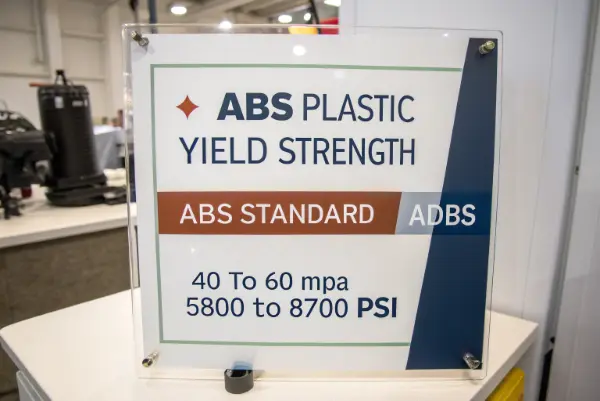
I remember a project where a client designed a beautiful handheld scanner. The snap-fits for the battery door were designed perfectly in CAD. But they used a generic yield strength value from Google. When we molded the first shots with the specific grade they chose, the clips were turning white (stress whitening) and staying bent after one use.
Why? They exceeded the yield strength.
Yield strength is the point of no return. In plastic design, especially for clips, springs, and load-bearing walls, you must stay well below this number. ABS has a distinct behavior compared to other plastics. It is "ductile." This means it stretches a lot before it actually snaps.
Critical factors regarding ABS Strength:
Tensile Yield vs. Ultimate Strength:
- Yield Strength: The point where it bends and stays bent.
- Ultimate Strength: The point where it rips apart.
- Insight: For design, Yield Strength is the number that matters. If your part yields, it has failed functionally, even if it hasn’t broken into two pieces.
The Impact of Temperature:
Yield strength is not constant. At 23°C (room temp), ABS is strong. At 50°C, the yield strength drops significantly. If your product is a dashboard component, you must calculate the strength based on the highest operating temperature, not room temperature.The "Creep" Factor:
ABS is subject to creep. If you put a constant load on it (like a screw tightened too hard), it will slowly deform over time even if the load is below the yield strength.
Here is how standard ABS compares to other common materials:
| Material | Approx. Yield Strength (MPa) | Flexibility | Best For |
|---|---|---|---|
| ABS | 40 – 50 | Medium | Housings, Covers |
| Polycarbonate (PC) | 60 – 70 | Medium-Stiff | Impact lenses, Safety gear |
| Nylon (PA6) | 70 – 85 | Stiff (dry) | Gears, Bearings |
| Polypropylene (PP) | 25 – 35 | High | Hinges, Containers |
If your stress analysis shows you are close to 45 MPa, do not risk it with standard ABS. Move to a PC/ABS blend or reinforce the geometry.
Melt Flow Index: matching flow to the mold
The Melt Flow Index (MFI) of ABS typically ranges from 1.5 to 40 g/10 min, depending on the grade. MFI measures how easily the molten plastic flows under pressure. A lower MFI means a thicker, more viscous material; a higher MFI means the material flows easily, which suits injection molding of complex, thin-walled parts.
| Part characteristic | Recommended MFI range | Why |
|---|---|---|
| Thick walls / extrusion | Low (1.0–5.0 g/10 min) | The material must hold its shape immediately; high viscosity prevents sagging |
| Standard parts | Medium (5.0–15.0 g/10 min) | The balance of strength and processability for most housings |
| Thin walls / complex geometry | High (20.0–40.0 g/10 min) | Material must fill tight spaces quickly before it cools and hardens |
The trade-off is that higher MFI usually means lower impact strength: easier flow comes from shorter polymer chains, and shorter chains are weaker. A part that is both very tough and very thin-walled is a difficult combination — thickening the walls so a tougher, lower-MFI material can be used is often the right answer. MFI also changes with regrind: regrind usually has a higher MFI because the plastic has already been degraded by heat once, so uncontrolled regrind makes the process unstable. Confirm the MFI on the grade data sheet for the exact grade; the ranges above are the folded-in article’s typical ranges, not specifications.
What is the difference between ABS M30 and PC ABS?
Confusing rapid prototyping materials with production materials can ruin your validation testing. You might approve a prototype that is stronger than the final part, or vice versa. Understanding the distinction between 3D printing grades and injection molding blends is vital for accurate testing.
ABS M30 is a proprietary 3D printing filament developed by Stratasys for FDM machines, boasting higher tensile strength than standard ABS. PC-ABS is an injection molding alloy that blends Polycarbonate and ABS to get the best of both: the processability of ABS and the high heat/impact resistance of Polycarbonate.
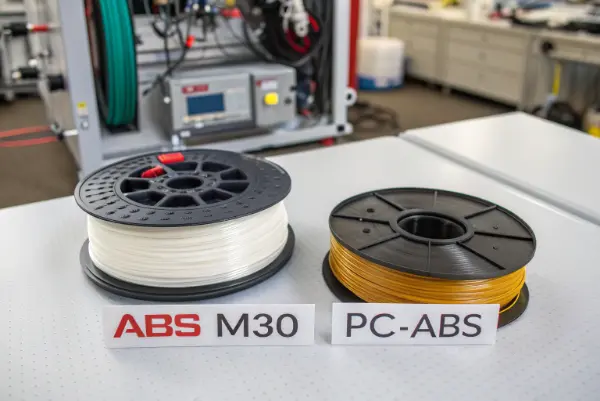
This is a question I get from Alex and other project managers constantly. You print a prototype in the lab using the Stratasys machine, and it says "ABS M30." Then you ask us to mold it in "PC-ABS." Are they the same? No.
ABS M30 (The Prototyping Hero):
This is specifically formulated for Layer bonding. In 3D printing (FDM), the weak point is always the Z-axis (vertical layers). M30 is chemically designed to bond those layers better than generic ABS filament.
- Pros: Great for functional prototypes, jigs, and fixtures.
- Cons: It is anisotropic (stronger in one direction than the other). It is not an injection molding grade.
PC-ABS (The Production Powerhouse):
This is a blend (alloy). We take PC (strong, high heat) and mix it with ABS (easy to mold, ductile).
- Why use it? Pure Polycarbonate is hard to mold; it is thick and requires high heat. Pure ABS isn’t strong enough for things like crash helmets or high-end laptop cases.
- The Result: PC-ABS gives you high flow for thin walls, excellent impact resistance (even at low temperatures), and better heat resistance than plain ABS.
Critical Comparison for Decision Making:
Thermal Performance:
- ABS M30: Heat Deflection Temperature (HDT) is around 96°C.
- PC-ABS: HDT can go up to 110°C – 135°C depending on the blend.
- Insight: If your part sits in a hot car, M30 might warp, while PC-ABS will hold its shape.
Surface Finish:
- ABS M30: Always has layer lines (unless vapor smoothed).
- PC-ABS: Injection molded parts come out with a Class A surface—smooth, glossy, or textured exactly as the mold is cut.
Cost:
- ABS M30: Very expensive per gram (filament cost).
- PC-ABS: Moderate cost per gram (pellet cost), but requires tooling investment.
If you are validating a design with M30, remember that the final PC-ABS molded part will likely be stronger and more isotropic (equal strength in all directions) than your prototype. This gives you a safety margin. However, PC-ABS shrinks differently in the mold than pure ABS. We have to design the mold tool specifically for the shrink rate of PC-ABS (usually around 0.5-0.7%), whereas ABS is slightly different. You cannot swap them easily once the mold is cut.
ABS and food contact: what "FDA approved" does and does not mean
Standard ABS plastic is generally not FDA approved for direct food contact. The raw resin may be safe, but the additives, stabilisers and colourants used during processing can leach chemicals such as styrene or acrylonitrile into food. Specific food-grade ABS blends exist that meet FDA 21 CFR 177.1020, but they must be explicitly sourced and certified for the batch.
- Indirect contact is the most common legitimate use: the motor housing of a mixer, where food touches the metal bowl and not the plastic housing. ABS is well suited here for toughness and appearance.
- Specific food grades: some suppliers produce special grades manufactured with stricter controls to minimise residual monomers. Ask for the FDA Compliance Letter specifically for that batch.
- Barrier layers: a part can be molded in ABS for strength and overmolded with a food-safe TPE or silicone, so the food touches the silicone and the ABS provides the structure.
If a product has direct, prolonged contact with liquid or hot food, consider switching materials: polypropylene is cheaper and safer for that use, polycarbonate is clearer. Use food-grade ABS only when its balance of impact resistance and paintability is genuinely needed. And treat a supplier’s bare claim of "food safe" with caution — for the US or European market, the supply chain must be traceable and the compliance document must cover the actual grade and batch.
The limits of ABS: what can go wrong, and the fix for each
ABS is generally safe for consumer products — non-toxic in its normal solid form, strong, and easy to mold — but safety depends on the grade and the use. Its limits are the other half of grade selection, and each one has a practical answer:
| Disadvantage | Real-world problem | How to fix it |
|---|---|---|
| Poor UV resistance | Turns yellow and brittle outdoors; colour shifts to yellow or brown and the plastic weakens | Add UV stabilisers, use a UV-stabilised grade, or paint/coat the part to protect it |
| Low heat limit | Softens and bends near ovens, engines or other high-heat sources | Keep away from high heat, or use polycarbonate or a high-heat ABS grade |
| Chemical weakness | Cracks when wiped with strong cleaners or exposed to alcohol and some solvents | Check chemical compatibility for the exact grade; clean with mild soap and water unless the grade is rated otherwise |
| Flammability | Burns and produces smoke | Buy a flame-retardant ABS grade rated to the required UL94 level |
ABS also has a low-shrinkage, dimensionally stable molding behaviour that mold makers value — parts hold size well after cooling and come out with a clean, glossy surface — but that does not remove the limits above. Test the product in its real use environment; do not rely on the data sheet alone.
ABS vs HDPE: which one for a consumer part?
The two plastics answer different questions. ABS is the choice for stiff, strong parts that need a good finish — TV cases, toys, hard cases, power-tool housings, computer mice. HDPE is the choice for parts that must hold chemicals or food, or survive outdoors and in water — milk jugs, shampoo bottles, pipes, chemical tanks, buckets.
| Feature | ABS | HDPE |
|---|---|---|
| Stiffness | Very stiff and hard | Softer and more flexible |
| Chemical resistance | Poor against some chemicals; melts with some cleaners/solvents | Excellent; holds harsh cleaners safely |
| Look and feel | Shiny, smooth, premium feel | Waxy, dull |
| Best uses | Electronics, toys, hard cases | Bottles, pipes, chemical tanks |
Safety checklist before using ABS in a sensitive product
- Check the grade: ask the supplier whether the grade is specifically certified for the intended use (food-grade, medical, or toy safety as applicable). Standard ABS is not automatically certified.
- Get the papers: obtain the Material Data Sheet / Safety Data Sheet and keep it on file; it is the evidence the grade is what the supplier claims.
- Test the heat: confirm the part does not soften or deform at the highest temperature it will see in use, including hot water or hot food where relevant.
- Check chemical exposure: confirm the cleaning agents, skin contact, and any food or liquid contact the part will see.
- Never use ABS inside the human body: ABS is for external housings and cases only, not implants.
- Test the finished part: do not trust the label alone — test the molded part for the use it will see, and confirm RoHS and REACH compliance where the market requires it.
Conclusion
Selecting the right ABS grade is about matching the material’s DNA to your product’s lifecycle. You must weigh the balance between toughness (Butadiene), rigidity (Styrene), and heat stability (Acrylonitrile). Whether you choose a high-flow grade for intricate electronics, a flame-retardant grade for safety, or a PC-ABS blend for superior strength, the decision dictates success. At CavityMold, we ensure that your material choice translates perfectly from design to final production.