
Struggling to choose the right plastic for your next injection molding project? You are not alone. Picking the wrong material can lead to product failure, safety recalls, and blown budgets. This guide cuts through the noise to help you balance cost, performance, and safety when selecting ABS.
This guide provides a comprehensive framework for selecting Acrylonitrile Butadiene Styrene (ABS) materials by examining critical factors like ASTM standards, Melt Flow Index (MFI), FDA compliance, and specific material grades. By understanding these technical specifications, project managers can optimize their manufacturing processes, reduce material waste, and ensure final products meet rigorous industry safety and performance benchmarks.
ABS is one of the most common thermoplastics we use here at CavityMold. I see it used in everything from LEGO bricks to car dashboards. But "ABS" isn’t just one single thing. It is a family of materials. If you don’t pick the specific type that matches your product’s needs, you might end up with a part that warps, breaks, or costs way too much. Let’s dive into the specifics so you can make the right call for your project.
What are the grades of ABS material?
Are you confused by the sheer number of ABS options available on the data sheets? It can be overwhelming. Standard, heat-resistant, or flame-retardant grades all look similar on paper, but they behave very differently in the mold. Choosing the wrong grade is the fastest way to ruin a production run.
ABS material grades are generally categorized into five main types: General Purpose (standard impact and stiffness), High Heat (for automotive or electrical parts), Flame Retardant (meeting UL94 standards), Platable (for chrome finishes), and Transparent (for clear applications). Selecting the correct grade depends entirely on the specific environmental and aesthetic requirements of your final product.
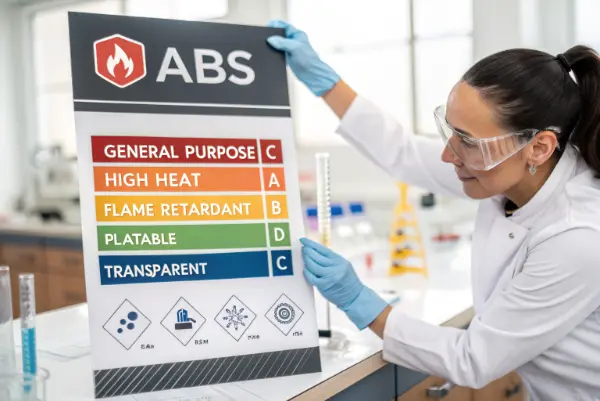
When I first started in this industry, I thought ABS was just ABS. I learned the hard way that this isn’t true. We had a client who needed a housing for an outdoor electrical sensor. We initially looked at a General Purpose grade because it was cheaper. But after running a few tests, we realized it wouldn’t hold up to the summer heat in Australia, where Alex, one of our typical clients, might be based. We had to switch to a High Heat grade.
It is crucial to break these grades down further to understand where they fit. You cannot just look at price; you must look at the application.
Common ABS Grades Breakdown
| Grade Type | Key Characteristic | Typical Application | Relative Cost |
|---|---|---|---|
| General Purpose | Balanced impact strength and rigidity. | Toys, consumer electronics housings, storage bins. | Low |
| High Heat | Resists deformation at higher temperatures (up to 100°C+). | Automotive interiors, coffee makers, hair dryers. | Medium |
| Flame Retardant | Contains additives to self-extinguish; meets UL94 V-0. | Power strips, computer monitors, server casings. | High |
| Platable | Optimized surface specifically for electroplating adhesion. | Showerheads, automotive grilles, decorative knobs. | Medium-High |
| Transparent | Modified to allow light transmission (though less clear than PC). | Vacuum cleaner dust bins, medical devices, displays. | High |
Critical Thinking for Selection:
When you select a grade, you are always making a trade-off. For example, if you choose Flame Retardant ABS, you often lose some impact strength. The additives that stop the fire also make the plastic a bit more brittle. If you choose High Heat ABS, it becomes harder to process because the material needs higher mold temperatures, which might increase your cycle time and cost.
At CavityMold, we always ask: "What is the worst thing that can happen to this part?" If the answer is "it catches fire," go with Flame Retardant. If the answer is "it shatters when dropped," stick to General Purpose or High Impact grades. Don’t pay for properties you don’t need.
What is the ASTM standard for ABS?
Do you know if your material actually meets the industry requirements for quality and consistency? Relying on a supplier’s word without verifying standards is a risk. Using ASTM standards ensures that the ABS you buy today has the same properties as the ABS you buy next year.
The primary standard for specifying ABS plastic is ASTM D4673. This classification system allows engineers to call out specific properties like impact strength, tensile stress, and deflection temperature using a "cell classification" system. This ensures that the material supplier delivers a resin that strictly meets the physical requirements defined in your engineering drawings.
I remember a project where a client simply wrote "ABS Black" on their drawing. That is a nightmare for a manufacturer. "ABS Black" could mean anything. It could be a high-quality virgin resin, or it could be cheap regrind that snaps like a twig. By referencing ASTM D4673, you remove the ambiguity.
This standard essentially creates a code. It tells the manufacturer exactly what the material must do. It stops suppliers from swapping in a cheaper, inferior material without you noticing.
Understanding the Callout
ASTM D4673 uses a line callout system. It looks like a long string of letters and numbers. Here is how you can decode what matters most:
- Group & Class: This defines the basic chemical composition.
- Grade: This specifies the viscosity or flow rate.
- Table Requirements: This is the most important part. It assigns a number (0-9) to specific properties.
Key Properties Defined by ASTM D4673:
- Izod Impact Strength: How much energy can the material absorb before breaking? This is vital for parts that might be dropped.
- Tensile Strength: How hard can you pull it before it stretches or snaps?
- Flexural Modulus: How stiff is the material?
- Deflection Temperature: At what temperature does it start to bend under a load?
Why this matters for your project:
If you are designing a snap-fit joint, you need a specific flexural modulus. If the material is too stiff, the snap breaks. If it is too soft, the snap won’t hold. By specifying the ASTM requirement for flexural modulus, you guarantee the snap works every time. At CavityMold, we encourage all our clients to be specific. Don’t just say ABS. Say "ABS per ASTM D4673," and list the property limits. It protects you legally and ensures quality.
What is the MFI of ABS material?
Are you experiencing defects like short shots or flash in your molded parts? The problem might not be the machine settings; it could be the flow rate of your material. Understanding Melt Flow Index (MFI) is critical for matching the material to the complexity of your mold design.
The Melt Flow Index (MFI) of ABS typically ranges from 1.5 to 40 g/10 min, depending on the grade. MFI measures how easily the molten plastic flows under pressure. A lower MFI indicates a thicker, more viscous material suitable for extrusion, while a higher MFI means the material flows easily, which is ideal for injection molding complex, thin-walled parts.
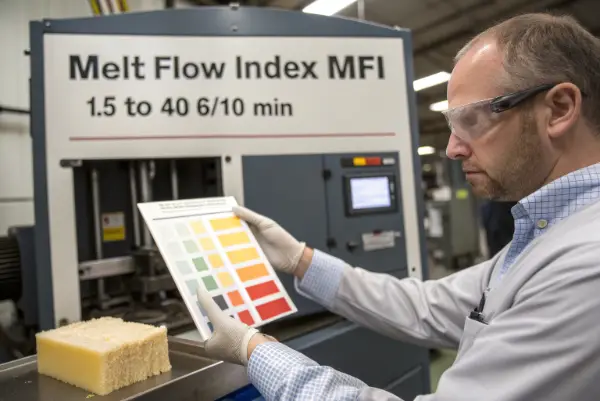
I often talk to project managers who ignore MFI until it is too late. We once had a mold with very thin ribs—maybe 0.8mm thick. The client specified a high-impact ABS, which usually has a very low MFI (it is thick and gooey). We could not fill the mold. The pressure required was so high it would have damaged the tool. We had to switch to a higher flow grade.
MFI is basically a measure of "runniness." Imagine the difference between water and honey. High MFI is like water; Low MFI is like honey.
MFI Selection Matrix
| Part Characteristic | Recommended MFI Range | Why? |
|---|---|---|
| Thick Walls / Extrusion | Low (1.0 – 5.0 g/10 min) | You need the material to hold its shape immediately. High viscosity prevents sagging. |
| Standard Parts | Medium (5.0 – 15.0 g/10 min) | The "sweet spot." Good balance of strength and processability for most housings. |
| Thin Walls / Complex Geometry | High (20.0 – 40.0 g/10 min) | Material must rush into tight spaces quickly before it cools and hardens. |
The Trade-off:
Here is the catch that many people miss: Higher MFI usually means lower impact strength.
When you make the plastic flow easier (High MFI), you are essentially using shorter polymer chains. Shorter chains are weaker. So, if you need a part that is incredibly tough and has very thin walls, you are in a difficult spot. You might need to change the design to thicken the walls so you can use a tougher, lower MFI material.
Also, MFI isn’t static. It changes if you use regrind (recycled material). Regrind usually has a higher MFI because the plastic has been degraded by heat once already. If your molder uses too much regrind, the flow changes, and your process becomes unstable. This is why at CavityMold, we strictly monitor regrind percentages to keep the MFI consistent.
Is ABS plastic FDA approved?
Are you planning to use ABS for a product that touches food or drinks? You need to be extremely careful with regulatory compliance. Assuming all plastic is safe for food contact is a dangerous misconception that can lead to health risks and legal liabilities.
Standard ABS plastic is generally NOT FDA approved for direct food contact. While the raw resin might be safe, the additives, stabilizers, and colorants used during processing often leach chemicals like styrene or acrylonitrile into food. However, specific "food-grade" ABS blends exist that meet FDA 21 CFR 177.1020 regulations, but these must be explicitly sourced and certified.
This is a very common question I get. A client wants to make a kitchen gadget, like a blender casing or a coffee machine part. They want the toughness of ABS. But when I ask if it touches the food, they hesitate.
Styrene is the issue here. It is a key component of ABS (Acrylonitrile Butadiene Styrene), and it can migrate into fats and oils, especially when hot. That is why you rarely see ABS used for Tupperware or water bottles. Those are usually Polypropylene (PP) or Tritan.
When can you use ABS in food environments?
You can use ABS in food applications, but you must follow strict rules. It is not about just picking any ABS off the shelf.
- Indirect Contact: This is the most common use. Think of the motor housing of a mixer. The food touches the metal bowl, not the plastic housing. ABS is perfect here because it is tough and looks good.
- Specific Food Grades: Some chemical suppliers, like INEOS or Trinseo, produce special grades. They manufacture these with stricter controls to minimize residual monomers. You must ask for the FDA Compliance Letter specifically for that batch.
- Barrier Layers: Sometimes, we mold a part in ABS for strength but overmold it with a food-safe TPE or silicone. The food touches the silicone, and the ABS provides the structure.
A Warning on Imports:
Be very careful sourcing generic ABS products from overseas for food use. Just because a supplier says it is "Food Safe" doesn’t mean it meets FDA or EU standards. I have seen test reports that were clearly faked. If you are building a product for the US or European market, you need a traceable supply chain.
If your product has direct, prolonged contact with liquid or hot food, I usually advise my clients to switch materials. Polypropylene is cheaper and safer. Polycarbonate is clearer. Only use Food Grade ABS if you absolutely need that specific balance of impact resistance and paintability that no other plastic can offer.
Conclusion
Choosing the right ABS is about balancing trade-offs. You must weigh the impact strength of ASTM grades against the flow rate (MFI) needed for your mold, all while ensuring safety compliance for FDA applications. By specifying the exact grade and standards, you ensure your product is manufacturable, cost-effective, and safe for the end-user.