
Certain applications such as aerospace, wearable electronics, protective gear, sporting gears and others, require parts to be strong yet lightweight. These materials can have impact strength 250 times that of glass yet be 50% lighter. A bike helmet for example needs to be strong enough to protect a person’s skull in the case of high impact, yet it must be light enough for comfort. A heavy helmet could actually do more harm than good if it causes neck strain or head whipping due to increased inertia. Similarly making an injection molded swimming fin. The material needs to be strong enough to resist bending forces from the water. Yet it must be light enough to be comfortable and float easily. Lightweighting has been particularly important in the automotive industries. Where manufacturers seek innovative ways to make vehicle components lighter in order to reduce energy consumption. Making parts strong yet lightweight requires a combination of factors some inherent in the material and others are down to the process.
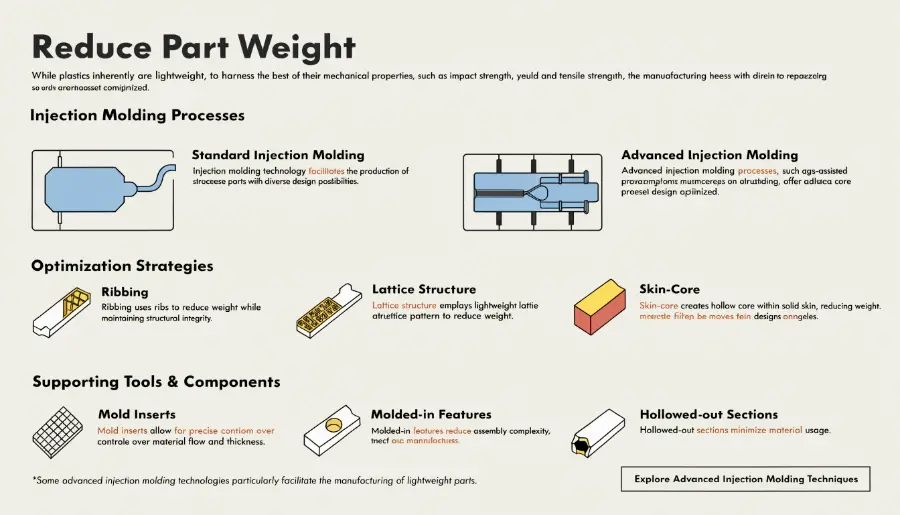
While plastics inherently are lightweight1, to harness the best of their mechanical properties such as impact strength, yield stress and tensile strength, the manufacturing process needs to more strategically optimize the production process. Part weight can be reduced by up to 50% or more using strategies for optimizing part weight compared to molding the part as a simple solid structure.2
Injection molding technology facilitates the production of lightweight strong parts with diverse design possibilities. This can be achieved through both standard and advanced injection molding processes. Some advanced injection molding technologies particularly facilitate the manufacturing of lightweight parts.
In this article we’ll explore the different strategies applied in plastic injection molding to achieve lightweight strong parts. We’ll discuss the specific injection molding processes used, the tools and components used to assist these processes as well as some other considerations for successful production.
Strategies for Lightweighting Plastic Parts
Plastics are relatively low density compared to materials like glass, metals, ceramics. Over the decades this has made them good options for production of light weight products for diverse industry applications. Kayaks, wearable electronics, outdoor furniture, implants, aerospace parts amongst others, are some of the applications of plastics where their light weight advantage plays a key role.
Even as they are inherently lightweight the application requirements or perhaps for the purpose of achieving optimal performance in the product, the part is required to be as light as possible beyond the inherent density of the plastic.
Three main strategies are used in injection molding to reduce the weight of a plastic part while still retaining the strength of the material. These are:
- Material selection
- Design features for weight optimization
*Advanced Injection moulding techniques
The following sections further expand on each of these strategies.
Material Selection
There are two aspects to this. One is to select the material whose density as well as mechanical properties match the performance requirement for the part.
High Performance Plastics
There’s a range of high performance plastics that are well established as lightweight yet strong. Examples include PEEK, Nylon, PPS and PEI.
The high tensile strength of these plastics as well as good processibility makes it possible to achieve parts with relatively complex geometry and thin walls that result in lightweight parts, without compromising on performance.
High performance plastics are typically priced higher than commodity plastics like PP and PE. Therefore they are used more in high end applications where the product pricing can account for the price of the feedstock. Lightweight products made using high performance plastics are sometimes as a result of the manufacturer optimizing the design in order to use less of the plastic in the product for cost reduction. The lightweight might not have been the main goal.
For example if the required impact strength of a shield can be achieved with a 1 mm thick layer of PEEK with some ribs, a manufacturer would opt for this rather than use a solid 3mm thick layer of PEEK. This means less of the PEEK will be used, the lighter weight is simply a consequence.
Compounded Plastics/ Composites
The other aspect of material selection for lightweight parts is use of compounded plastics. The weight per unit volume of the neat polymer can be reduced by blending with other polymers and or adding fibers and fillers to create a composite. These fillers and fibers serve as the dispersed phase. Fillers like silica, talc and calcium carbonate serve to reduce shrinkage and reduce the amount of the polymer used. Fibers like carbon fibers, glass fibers and natural plant fibers like hemp and jute, serve to improve the mechanical properties of the plastic.
In preparing compounded plastic pellets which are aimed at being more lightweight than neat plastic pellets for injection molding, additives play a significant role. Other than the fibers and fillers, additives like coupling agents are often required to improve compatibility between the plastics and the fillers or fiber in the compounded plastic. Poor compatibility between the plastic and the fillers or fibers will result in phase separation. A composite with a lighter weight yet improved mechanical properties highly depends on a well compounded composite. Thus making the additives key components. It is also important to use optimized parameters in the compounding process; temperature, screw speed, pressure and concentration of each component and additives are important ones.
Design Features for Weight Optimization
For a chosen material the weight of the final part can be significantly reduced by proper design. Other than selecting the optimal geometry that minimizes the part weight, certain design features can also be implemented to reduce part weight while still maintaining strength.
Ribs
While making a part solid can contribute to strength, in some cases it might be a waste of material if this far exceeds the performance requirement for the part. Making the part completely hollow on the other hand could result in structural weakness. Implementing ribs results in a part that isn’t solid but not completely hollow. The ribs provide the structural support required. For example a wide closed top, open bottom cylindrical stool that is intended for load bearing requires less material if designed with ribs than when designed completely solid. Whereas designing it completely hollow will introduce weakness at the centre.
Thin walls
The thickness of the wall significantly contributes to part weight. Therefore using the thinnest wall that the production process and the performance requirement allow can lead to eight reductions. It is important to optimize the injection molding pressure and speed accordingly. Other factors such as gate positioning and cooling channels should also be considered.
It is also important to consider that some plastics are more suited for thin wall injection molding than others. Avoid wall thickness below 0.5mm and go for plastics with higher melt flow index. Cooling channels should be optimized for even cooling to prevent warpage and related defects. Parts with uniform wall thickness are easier to work with.
Hollowing
Some parts of a product do not need to be filled with plastic and can be left hollow without affecting the performance or aesthetics of the product. This can be determined by detailed product analysis and evaluation. This can significantly reduce the amount of plastic, hence the total weight of the part.
The product designer should collaborate closely with the mold maker to ensure that the design being implemented in the product is practical and the product is designed for manufacturability.
Advanced Injection Molding Processes
Having selected the lightest and strongest material available and optimized the product design to ensure no unnecessary use of plastic material. Another option that exists is to employ injection molding technologies that have been specially developed to achieve lightweight parts without compromising on strength. In some cases these processes in fact enhance the strength of the part beyond what is achieved with the same material using standard injection molding processes.
Foam Injection molding
This process involves introducing void cavities into the material. These cavities can be filled with air or other foaming agents like nitrogen or carbon dioxide. A thin layer of the plastic would form on the surface of the foamed part. There are different variations of these which have been described in previous blogs on advanced injection molding. The well known ones are structural foam molding and the more advanced MuCell process. The latter achieves smaller microcellular cavities that are more uniform. The general idea being to introduce air or inert gas into the plastic melt within the mold cavity, distributed evenly in order to achieve up to 30% weight reduction. The air or inert gas is either introduced through an air inlet along the barrel into the molten plastic before it is injected into the mold. Alternatively blowing agents are fed into the feed along with the plastic pellets. These methods minimized warpage and achieved parts with improved dimensional stability.
Gas or water assisted injection molding
In this process after the plastic melt is injected into the mold cavity, a channel of inert gas or water is passed through the center at high pressure. This creates a part with a hollow center with very strong walls. Thus achieving a lightweight part with hollow core but strong shell.
This process requires designing the mold with a channel for air or water to pass through the cavity coming in contact with the plastic melt and then exiting the mould while allowing the part to cool evenly.
Overmolding and insert molding
This is another advanced injection molding technology that can be used to achieve lightweighting in injection molded plastic parts. Although this depends on the specific product. Overmolding can achieve overall weight reduction by molding the heavier plastic over a lighter polymer core. This is particularly applicable if the outer plastics have the desired properties to achieve the exterior texture or aesthetics and/or physical properties required for product performance while the properties of the core of the product isn’t critical to the performance.
Insert molding, where a hollow relatively light metal is placed in the mold over which the polymer melt is injected, may also achieve light weight parts if the metallic core serves some performance properties like conductivity and perhaps the plastic is required as a soft insulating layer. This is a less common approach yet remains an option.
Conclusion
Strong lightweight parts are required in a wide range of applications such as aerospace, sports and recreation, marine, electronics, biomedical devices and others. While many plastics are inherently lightweight compared to materials like metal and glass. In certain applications where a combination of strength and lightness is required, additional strategies are implemented to achieve lightweight parts that are also strong. Strategic material selection, optimized product design, and advanced injection molding techniques allow manufacturers to achieve lightweight parts that still have exceptional mechanical properties.
The particular strategy applied depends on the specific application. Therefore there needs to be effective communication between the manufacturer and engineers at every stage from product design, to prototyping, to production.
By Ololade Olatunji
29 July, 2026
"New lightweight material is stronger than steel", https://news.mit.edu/2022/polymer-lightweight-material-2d-0202. Common engineering plastics typically exhibit densities ranging from 0.9 to 1.4 g/cm³, substantially lower than metals such as aluminum (2.7 g/cm³) or steel (7.8 g/cm³), contributing to their lightweight characteristics. Evidence role: general_support; source type: encyclopedia. Supports: the relatively low density of common thermoplastics compared to metals and other structural materials. ↩
"Comparison of part weight in injection molding", https://dr.lib.iastate.edu/bitstreams/5284e5d4-830a-42fb-84ac-d325e27ca9a8/download. Studies on advanced injection molding techniques, including structural foam molding and gas-assist processes, have documented weight reductions in this range when compared to conventionally molded solid parts. Evidence role: statistic; source type: research. Supports: documented weight reduction percentages achieved through injection molding optimization techniques such as foam molding, gas-assist, or structural design modifications. Scope note: Actual weight reduction varies significantly depending on part geometry, material selection, wall thickness requirements, and the specific lightweighting technique employed. ↩