
You need a new mold. The local shop quotes high. The overseas shop quotes low. You pick the cheap one, and then the delays start. Shipping slips. Changes take weeks. I have seen this happen many times, and I want to help you avoid it.
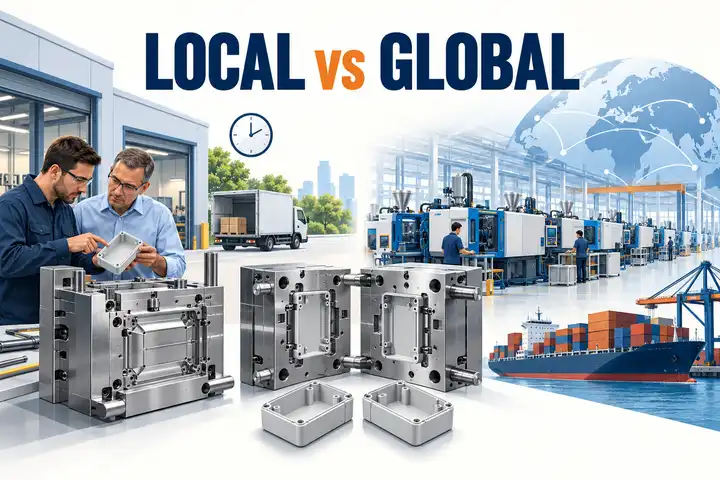
A local supplier usually wins on speed, flexibility, and easy quality checks. A global supplier usually wins on unit price, scale, and special skills. The best choice depends on your part. Use global suppliers for stable, high-volume, price-driven items. Use local suppliers for urgent, custom, or critical items. Many smart teams use both.
I run CavityMold. We build molds for clients in Europe, America, and beyond. So I see both sides of this choice every week. Some clients come to us after a bad local experience. Others come to us after a bad overseas experience. The truth is simple. No supplier type is always right. But there is a clear way to decide. Let me walk you through it, step by step.
What Are the Real Differences Between Local and Global Suppliers?
Many buyers only compare price. That is a trap. Price is one number. A supplier choice touches your schedule, your quality, your cash, and your risk. If you miss these, the cheap quote can cost you more.
The real differences fall into seven areas: unit price, lead time, logistics, flexibility, risk, capability, and inventory. Local suppliers are often faster and easier to manage. Global suppliers are often cheaper and can offer special skills or bigger capacity. Each side has strong points and weak points.
A Side-by-Side View
I like to put the facts in one table. It makes the picture clear.
| Factor | Local Supplier | Global Supplier |
|---|---|---|
| Unit price | Often higher | Often lower for high volume |
| Lead time | Short | Long, needs more planning |
| Logistics | Simple, less freight | Freight, customs, duties |
| Flexibility | Easy visits and quick changes | Time zones and language gaps |
| Risk | Less tariff and currency risk | More tariff, port, and political risk |
| Capability | May be limited | Can offer special skills and scale |
| Inventory | Smaller safety stock | More stock and cash tied up |
Why the Table Is Not the Whole Story
A table looks neat. But real life is messier. A "local" supplier in Australia may not have the tool steel or the machines you need. A "global" supplier may answer emails faster than your local shop. So I always tell clients to test each point. Do not assume.
One client of mine, a project manager in Sydney, once said to me, "My local shop is 20 minutes away, but they take three days to reply." That is a flexibility problem, even with a local partner. Distance helps, but people and systems matter more. So use the table as a starting map. Then check the real supplier in front of you.
How Much Does a Global Supplier Really Save You?
The overseas quote looks great on paper. It may be 30% or 40% lower. But then freight comes. Then duties. Then a rush air shipment when a part is late. Suddenly, the savings shrink. Some buyers find they saved nothing at all.
A global supplier can save you a lot on the unit price, mainly from lower labor and material costs. But you must compare the total cost of ownership, not just the quote. Add freight, duties, customs fees, currency swings, inventory costs, travel for quality checks, and the cost of delays. Only then do you see the true savings.
The Hidden Costs Most People Miss
I break total cost into small parts. This helps you see where money leaks out.
| Cost Item | What It Means | Who It Hits Most |
|---|---|---|
| Freight | Sea or air shipping | Global |
| Duties and tariffs | Import taxes | Global |
| Customs fees | Broker and paperwork | Global |
| Currency risk | Exchange rates change | Global |
| Inventory cost | Cash stuck in stock | Global |
| Quality travel | Trips to audit the factory | Global |
| Rework and delays | Fixing bad parts, lost time | Both |
A Simple Way to Compare
Here is what I do. I take the quote. Then I add every item from the table. I call this the "landed cost." I do the same for the local quote. Then I compare the two landed costs side by side.
For molds, there is one more cost. It is the cost of a late launch. If your product hits the market one month late, what do you lose? For consumer electronics, that loss can be huge. A cheap mold that arrives late is not cheap.
So yes, global suppliers can save money. Often they save a lot. But you only know the real number after you count everything.
When Does a Local Supplier Make More Sense?
Some projects cannot wait. A design changes late. A part fails a test. A customer moves the launch date. In these moments, a supplier across the ocean can feel very far away. That stress is real, and it hurts your schedule.
A local supplier makes more sense when speed, control, or supply continuity matters more than the lowest price. This is true for urgent jobs, custom parts, regulated products, short product life cycles, and parts that would stop your line if they run out. Being close also makes audits, quality checks, and quick fixes much easier.
Situations Where Local Wins
I have a short list I use. If your project fits two or more of these, local is a strong choice.
| Situation | Why Local Helps |
|---|---|
| Tight launch date | Short lead time |
| Many design changes | Fast face-to-face fixes |
| Prototype or low volume | Less shipping overhead |
| Regulated product | Easy audits and traceability |
| Critical part | Less risk of long delays |
| Short product life | No time to wait for ships |
The Power of Being in the Same Room
I remember a project where a gate position caused flow lines on a cosmetic part. The engineer and the toolmaker stood next to the mold. They fixed it in one afternoon. Over email, that same fix could take a week.
This is the hidden value of local. You can touch the steel. You can see the sample. You can talk without delay.
The Weak Spots of Local
Local is not perfect. Local shops may cost more. They may have fewer machines. They may not handle very large or very complex molds. And if you rely on one local shop, a strike or a flood can stop you. So local is great for speed, but it still needs a backup plan.
When Does a Global Supplier Make More Sense?
Some buyers feel scared of overseas suppliers. They worry about quality and communication. So they pay too much locally, even for simple, stable parts. That fear can quietly eat your margins year after year.
A global supplier makes more sense when your part is standard, your demand is easy to predict, your volume is high, and the supplier offers a clear cost or skill advantage. Global sourcing can unlock lower costs, special expertise, and bigger capacity. Some regions are known for deep skills, like precision engineering in Germany and Japan or large-scale mold making in China.
Signs Global Is the Right Fit
| Sign | Why Global Helps |
|---|---|
| High, steady volume | Lower cost per part adds up |
| Stable design | Few changes, less back-and-forth |
| Forecastable demand | You can plan shipping ahead |
| Need for special skills | Access to expert regions |
| Need for big capacity | Larger factories, more machines |
| Price-sensitive market | Every cent matters |
How to Lower the Risk of Going Global
The risk with global is real. But you can manage it. I tell clients to do four things. First, ask for DFM reports and mold flow analysis before steel cutting. Second, ask for weekly progress photos and videos. Third, set clear T1 sample rules. Fourth, choose a supplier with English-speaking engineers, not only sales staff.
At CavityMold, we built our process around these points. We know buyers like Alex need to trust what they cannot see. So we share data early and often. A good global supplier should make the distance feel small. If they do not, that is a warning sign.
Which Risks Should You Watch With Each Supplier Type?
Risk is the part nobody wants to talk about. Then a port closes. A tariff jumps overnight. A local shop shuts down after a fire. Suddenly your whole project is stuck. Ignoring risk is the most expensive mistake.
Global suppliers face more risk from tariffs, customs delays, currency changes, shipping problems, and politics. Local suppliers face less of these, but they carry risk from limited capacity and local shocks like weather, strikes, or a single shop closing. The real danger is relying on one supplier, no matter where it is.
A Risk Map for Both Sides
| Risk Type | Local Supplier | Global Supplier |
|---|---|---|
| Tariffs and trade rules | Low | High |
| Currency changes | Low | Medium to high |
| Shipping delays | Low | High |
| Political events | Low | Medium |
| Weather or local events | Medium | Medium |
| Capacity limits | Medium to high | Low |
| Single-supplier risk | High if only one | High if only one |
The Trend You Should Know
Trade rules are changing fast. Tariffs rise and fall. Many companies now look at "nearshoring." This means buying from a nearby region, not the far side of the world. For Australia, that may mean Southeast Asia. For the US, it may mean Mexico.
Some firms also move key parts back home. This is called "reshoring." They do it for safety, not just cost.
Do Not Forget Sustainability
Shorter shipping means a smaller carbon footprint. More customers now ask about this. More reports now require it. So local and nearby suppliers can help your ESG goals. This is a new kind of value. It does not show on the quote, but it matters more each year.
Is a Hybrid Approach the Best Answer?
Choosing only local or only global feels like a forced choice. You lose something either way. Many project managers feel stuck in that trap. But you do not have to pick just one side.
For most companies, a hybrid approach works best. Buy your stable, high-volume items from a lower-cost global supplier. Keep a local supplier for urgent, custom, or critical items, and as a backup for spikes or problems. For key parts, qualify at least two suppliers and plan how to switch between them.
A Simple Rule to Split Your Parts
| Part Type | Best Choice |
|---|---|
| Stable, high-volume, not urgent | Global |
| Price-sensitive standard parts | Global |
| Prototypes and urgent jobs | Local |
| Custom or regulated parts | Local |
| Critical parts for your line | Both |
A Checklist Before You Decide
I score each supplier on six points. You can do the same.
- Landed cost: price plus freight, duties, and inventory.
- Lead time: how fast you need it, and how much demand changes.
- Criticality: what happens if this part runs out.
- Quality needs: tolerance, compliance, and tech support.
- Supplier health: money, capacity, and location risk.
- Sustainability: traceability and carbon impact.
How This Looks in Real Life
One client of ours does this well. They prototype with a local shop for speed. Then they send the final production molds to us. We build them with full DFM and mold flow reports. The local shop stays as a backup for quick repairs. They get speed where it counts and savings where it counts.
The real question is not "local or global." The real question is which parts go where, and how much backup is worth paying for.
Conclusion
Local suppliers give you speed, control, and lower risk. Global suppliers give you lower cost, scale, and special skills. Always compare total cost, not just the quote. For most teams, a hybrid plan works best. Match each part to the right supplier, and keep a backup ready.