
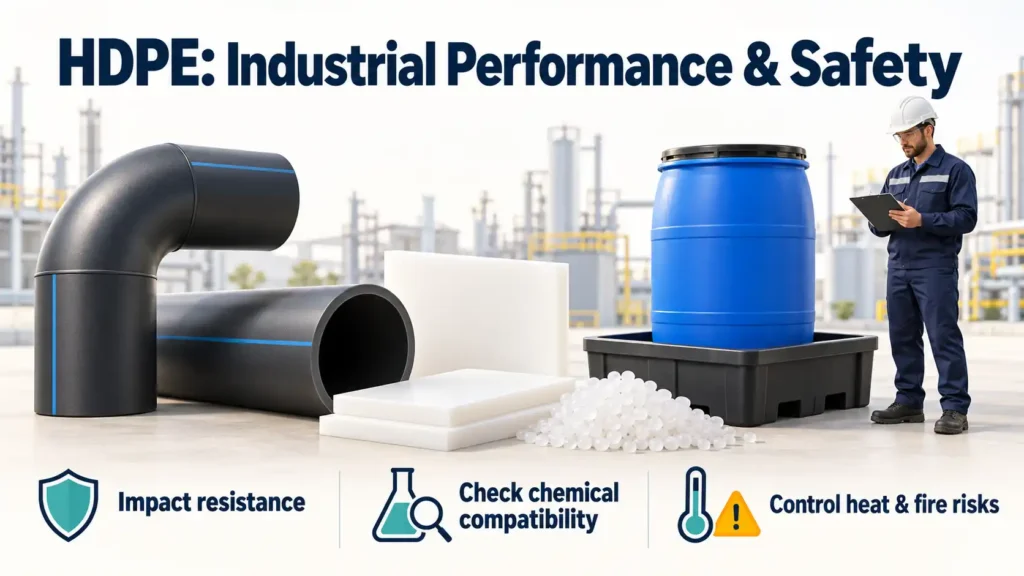
Michael, picking the wrong plastic for your plant floor can lead to sudden cracks, chemical spills, or even dangerous shop fires. You run a busy manufacturing business, and a single material failure stops production, wastes cash, and puts your crew in danger. But you do not have to gamble with material choices. High-Density Polyethylene (HDPE) gives you tough, reliable performance if you know its exact safety limits and operational properties.
HDPE material properties affect industrial safety by combining a high strength-to-density ratio (0.93–0.97 g/cm³) with unmatched resistance to water, acids, and bases. It remains stable under heavy impacts and does not leach toxic chemicals. However, you must manage its physical limits to keep your shop safe. HDPE softens above 80°C (176°F), melts near 130°C, and degrades above 300°C into hazardous vapors. It can catch fire, slip when wet, and react violently with fluorine gas. Proper ventilation, fire planning, and UV stabilizers guarantee safe industrial use.
I have worked with industrial plastics for decades, and HDPE is easily one of my favorite workhorses. But like any material on your production floor, it behaves best when you understand its personality. Let us look at what you need to know to keep your shop safe, your parts strong, and your costs down.
How Does the Strength-to-Density Ratio of HDPE Keep Industrial Parts Safe?
Heavy metal parts can exhaust your workers and strain your equipment. When metal parts fail or break under sudden shock, flying debris can hurt your team and ruin expensive tooling. It is frustrating to spend top dollar on steel parts that still corrode or shatter under load. HDPE solves this problem by giving you lightweight durability that absorbs shock without breaking your budget.
HDPE keeps industrial parts safe because it has an exceptional strength-to-density ratio, with a density ranging from 0.93 to 0.97 g/cm³. This light weight reduces worker fatigue during assembly and lowers structural stress on frames. Because HDPE absorbs shock and flexes under impact instead of shattering like brittle plastics or cast metals, it prevents catastrophic mechanical breaks. It provides high structural integrity for tanks, chutes, and pallets while cutting down shipping weight and handling hazards.
When I build tooling or run production at CKMOLD, clients often ask me why we choose HDPE over heavier engineering plastics. The answer comes down to mass and toughness. HDPE is very light. With a density between 0.93 and 0.97 g/cm³, it actually floats on water. But do not let that lightness fool you. The polymer chains in high-density polyethylene pack tightly together. This tight structure gives the plastic huge tensile strength without adding dead weight to your machines.
Why Density Matters on Your Shop Floor
Think about how your team moves parts around every day. If a worker drops a 40-pound steel shield, it can break a foot or smash a conveyor belt. If that shield is machined out of HDPE, it weighs less than one-seventh of the steel version. Your team can move it quickly and safely. That saves backs, hands, and assembly hours.
How HDPE Handles Sudden Impacts
Brittle plastics like polystyrene or acrylic will snap and throw sharp shards when hit with a forklift or a dropped wrench. HDPE does not do that. It stretches and yields. It absorbs the kinetic energy of an impact and springs back. Here is a simple comparison of how common materials behave under stress:
| Material | Density (g/cm³) | Impact Behavior | Risk to Workers |
|---|---|---|---|
| HDPE | 0.93 – 0.97 | Absorbs shock, yields, dents | Very Low (No sharp shards) |
| Acrylic (PMMA) | 1.18 – 1.20 | Shatters easily | High (Sharp flying fragments) |
| Mild Steel | 7.85 | Extremely rigid, heavy | Moderate (Pinch and crush hazard) |
| Rigid PVC | 1.35 – 1.45 | Cracks under cold shock | Moderate (Jagged cracked edges) |
Because HDPE bends before it breaks, it gives your team a clear warning sign. You will see a dent or a stretch mark long before a part gives out completely. This makes preventive maintenance simple, predictable, and safe.
What Are the Real Temperature Limits and Fire Hazards of HDPE?
Heat is the silent enemy of standard plastics. If you run HDPE near ovens, hot pipes, or boiling lines, your parts can warp, sag, or even catch fire without warning. A melted bracket can drop a chemical line, shut down your factory floor, and trigger massive OSHA fines. But you can easily prevent these thermal disasters once you know the exact heat boundaries of HDPE.
The safe continuous service temperature limit for HDPE is between 80°C and 90°C (176°F to 194°F). Its melting point sits between 120°C and 140°C (248°F to 284°F). HDPE will ignite if exposed to an open flame and continues to burn while releasing burning drips. If heated above 300°C (572°F), it degrades thermally and releases toxic gases, including carbon monoxide and irritating organic acids. Always isolate HDPE from open flames, maintain adequate factory ventilation, and install Class A fire suppression in your storage areas.
I always tell factory owners to treat plastic like a candle. It works great as long as you stay well away from its melting point. HDPE is a thermoplastic, which means heat softens it fast. In our mold trials and CNC operations, temperature control is everything. If you push HDPE beyond its comfort zone, it loses its structural strength very quickly.
Continuous Service vs. Peak Melting Point
You might see a spec sheet that says HDPE melts at 130°C. Do not let that number trick you into thinking you can run boiling water through an HDPE pipe all day. The safe continuous service temperature is only 80°C to 90°C. Once you climb above 90°C, the material loses its stiffness. A tank wall that held thousands of gallons at room temperature will bow outwards and fail when the liquid gets too hot.
What Happens Above 300°C?
When things go wrong in a plant fire, HDPE behaves differently than metals. At temperatures above 300°C, the plastic does not just melt; it breaks down chemically. This is called thermal degradation. It releases thick smoke, carbon monoxide, and acrid organic acids. These vapors can burn your eyes and throat instantly.
Fire Safety Rules for HDPE
Here are three rules I follow when designing HDPE components for high-risk spaces:
- Keep Clear of Heat Sources: Never mount HDPE parts directly against exhaust headers, steam lines, or welding bays.
- Plan for Flaming Droplets: When HDPE catches fire, it melts and drips. These flaming drops can spread fire to pallets below. Store your HDPE raw stock under fire sprinklers.
- Ensure Forced Air Ventilation: If you use hot-air welders or CNC cutters on HDPE, use local exhaust hoods to draw fumes away from your operators.
Which Chemicals Make HDPE Safe, and Which Cause Catastrophic Failures?
Chemical spills destroy plant equipment and put your operators at serious risk of chemical burns. Storing aggressive acids in the wrong plastic container leads to sudden wall cracking, dangerous leaks, and lost inventory. You cannot afford to guess which chemicals are safe inside your tanks and piping systems. The good news is that HDPE offers world-class chemical resistance, provided you avoid a few deadly chemical traps.
HDPE is safe for storing strong mineral acids (like hydrochloric and sulfuric acid), caustic bases (like sodium hydroxide), and water-based solutions. Its non-polar molecular structure resists corrosion and chemical attack. However, HDPE fails catastrophically when exposed to fluorine gas, which reacts violently and burns the polymer. It also degrades, softens, and cracks when exposed to strong aromatic hydrocarbons (like benzene and toluene) and halogenated solvents at elevated temperatures. Always verify your chemical blend before selecting HDPE storage tanks.
I have seen steel tanks rust through in six months while HDPE tanks holding the exact same acid look brand new after ten years. That is why the chemical industry loves this polymer. Its polymer backbone has no reactive groups, so most corrosive liquids just slide right off without reacting.
The Chemicals HDPE Loves
HDPE is the premier choice for pickling baths, chemical drums, and industrial wastewater piping. It resists:
- Strong Mineral Acids: Hydrochloric acid, diluted sulfuric acid, and phosphoric acid will not eat through it.
- Caustic Alkalis: Concentrated sodium hydroxide (lye) and potassium hydroxide leave HDPE completely untouched.
- Aqueous Salts: Salt spray and brine lines that destroy stainless steel have zero effect on HDPE.
The Hidden Chemical Traps
Even though HDPE is tough, it has clear weaknesses that can catch a shop owner off guard.
First is fluorine gas. Never bring pure fluorine near HDPE. The reaction is violent, produces intense heat, and can cause an immediate flash fire.
Second are aromatic and chlorinated solvents. Liquids like xylene, toluene, and trichloroethylene act like a slow poison to HDPE. They seep into the space between the polymer chains. The plastic begins to swell, turns spongy, and loses all strength. If your tank is under pressure, it will rupture.
| Chemical Group | Compatibility | Safety Recommendation |
|---|---|---|
| Mineral Acids (e.g., HCl) | Excellent | Safe for tanks, pumps, and valves |
| Strong Alkalis (e.g., NaOH) | Excellent | Ideal for caustic scrubbers and drains |
| Aromatic Solvents (e.g., Benzene) | Poor | Do not use; causes swelling and splits |
| Fluorine Gas | Severe Hazard | Strictly prohibited; causes violent fire |
| Alcohols & Glycols | Good | Safe for coolants and wash stations |
Whenever you design an injection molded fitting or a machined manifold, double-check your solvent mix. Even a tiny trace of an incompatible solvent can cause environmental stress cracking over time.
Why Do Food Contact Standards and Static Electricity Matter with HDPE?
Contamination recalls can bankrupt a growing production business overnight, while hidden static sparks can ignite fine dust or chemical fumes on your shop floor. It is terrifying when a safety inspector flags your line for chemical leaching or poor grounding. You need materials that satisfy health regulators while keeping your shop floor safe from invisible electrical sparks. Virgin HDPE delivers on food cleanliness, but you must actively manage its electrical charge.
Virgin HDPE is non-toxic, odorless, and fully compliant with FDA and USDA standards for direct food contact. It does not leach harmful plasticizers, phthalates, or heavy metals into food or pharmaceuticals under normal conditions. However, HDPE is an electrical insulator with high dielectric strength. Because it does not conduct electricity, it builds up high static charges when dry powders or liquids flow across its surface. In hazardous plant environments, this static buildup can cause dangerous spark discharges unless you use conductive additives or proper bonding and grounding lines.
In my work with food processing plants and medical packaging, virgin HDPE is always our first choice. When we run precision parts at CKMOLD under our "Master Molding Right" philosophy, we pay special attention to the grade of resin we put into the hopper. You never have to worry about BPA, plasticizers, or toxic heavy metals leaching out of virgin HDPE. It does not absorb moisture, so it does not harbor bacteria or mold. That makes cleaning and sanitizing simple and fast.
The Food Safety Advantage
Because HDPE does not stain easily and resists harsh cleaning chemicals like bleach and hot sanitizing sprays, it is the standard material for cutting boards, food chutes, conveyor guides, and beverage caps. It meets strict FDA 21 CFR 177.1520 rules. As long as you use virgin resin without non-compliant colorants, your products stay clean and compliant.
The Hidden Danger: Static Electricity
While HDPE is great for food and sanitary uses, its electrical properties demand respect on your shop floor. HDPE is an outstanding electrical insulator. That is great if you are building an insulating block for a control cabinet. But it is dangerous if you are conveying dry sugar, grain, flour, or plastic pellets through an HDPE pipe.
As these dry materials rub against the inside wall of the pipe, they generate triboelectric static charges. Because the plastic cannot bleed this charge to the ground, the voltage builds up until it jumps across an air gap as a hot spark. In an area with dust or solvent vapors, that spark can trigger a secondary explosion.
How to Handle Static Safely
- Specify Anti-Static Grades: For powder lines, buy HDPE compound blended with carbon black or conductive carbon fibers.
- Use Grounding Wires: If you run standard HDPE hoses, wrap them with a braided copper wire grounded to your factory earth ground.
- Control Factory Humidity: Keeping relative humidity around 50% helps bleed surface static naturally.
How Can You Stop UV Light and Slip Hazards from Ruining Your HDPE Parts?
Outdoor equipment that cracks under the summer sun creates dangerous structural failures, while slick plastic walkways put your employees at risk of severe slip-and-fall injuries. Every lost-time incident hurts your team morale and spikes your insurance rates. You cannot leave outdoor durability and walkway safety up to chance. With the right material formulations and surface finishes, you can eliminate sun rot and slick walking hazards completely.
You can prevent UV degradation in HDPE by specifying grades stabilized with 2% to 3% carbon black or specialized chemical UV stabilizers (HALS). Without stabilizers, solar ultraviolet radiation breaks the polymer chains, causing outdoor parts to fade, crack, and snap under load within months. To stop slip hazards caused by HDPE’s naturally low coefficient of friction, you must avoid smooth finishes on horizontal walking surfaces. Instead, specify embossed diamond tread plates, mechanically textured non-skid profiles, or anti-slip grit coatings for catwalks, decks, and step pads.
A customer once brought me an outdoor pump housing made from natural, milky-white HDPE that had failed after just eight months in the Texas sun. The plastic had turned chalky, covered in micro-cracks, and crumbled in my hand like a cracker. That is what happens when ultraviolet light attacks unstabilized polyethylene.
Stopping Sun Damage with Carbon Black
The sun’s UV rays hit the carbon-hydrogen bonds in HDPE and break them apart through photo-oxidation. This process makes the plastic brittle. If you use natural or improperly dyed HDPE outdoors, it will fail.
The cheapest and most effective fix is carbon black. When resin producers add 2% to 3% finely dispersed carbon black into the HDPE melt, the particles absorb the UV energy before it can damage the plastic chains. That is why municipal water pipes and highway drainage culverts are always jet black; they can sit in direct sunlight for 50 years without losing strength. If your part cannot be black, you must specify Hindered Amine Light Stabilizers (HALS) in your resin order.
Managing the Slip Hazard
HDPE has a very low coefficient of friction. In conveyor guides and machine wear strips, this slickness is a blessing because parts glide along without catching or wearing down your motors. But on a factory walkway, stairs, or wet deck, smooth HDPE turns into an ice rink.
If water, oil, or cutting fluid gets on a smooth HDPE surface, worker slips are guaranteed. When we machine or mold walking surfaces at CKMOLD (visit us at www.ckmold.com), we never leave HDPE smooth. We use mold texturing, CNC knurling, or raised checker patterns. These textured ridges give shoe soles the mechanical grip they need, keeping your workers safe even when the floor is wet.
HDPE is an incredible, cost-effective material that can solve tough problems across your manufacturing plant. It resists harsh chemicals, takes heavy hits without shattering, and keeps food and liquids completely pure. But like any engineering material, you have to respect its boundaries. Watch your operating temperatures, prevent static buildup, choose UV-stabilized resins for outdoor parts, and texture your walking surfaces. When you balance these properties correctly, your factory stays productive, profitable, and completely safe.