
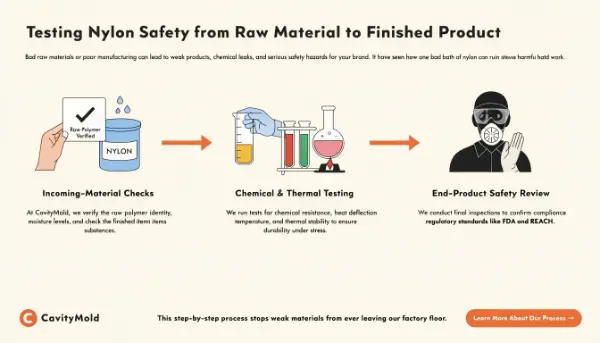
Are you worried that your nylon parts might break or fail in the hands of your customers? Bad raw materials or poor manufacturing can lead to weak products, chemical leaks, and serious safety hazards for your brand. I have seen how one bad batch of nylon can ruin months of hard work.
Testing nylon safety from raw material to finished product requires a mix of incoming-material checks, chemical and thermal testing, and end-product safety reviews. At CavityMold, we verify the raw polymer identity, test moisture levels, and check the finished items for harmful substances. This step-by-step process stops weak materials from ever leaving our factory floor.
If you want to keep your customers safe and protect your brand reputation, you must understand how we test nylon. Let me share my hands-on experience as a project manager to show you exactly how we do it.
What Are the Testing Methods for Nylon?
Do you know if your raw nylon is pure and free from dangerous recycled waste or cheap fillers? Using untested plastic resins can lead to weak parts that crack easily under stress, putting your customers at risk. We must find these hidden flaws before we start the injection molding machines.
We test raw nylon using FTIR spectroscopy for chemical identity, DSC and TGA for thermal stability, and moisture analysis to prevent processing defects. We also perform mechanical tests like tensile and impact tests on the molded parts. These methods ensure the plastic resin matches our exact safety and durability standards.
Chemical and Thermal Identity Tests
At CavityMold, we never trust labels blindly. When raw nylon pellets arrive at our warehouse, we run them through several key tests. First, we use FTIR testing to verify that the plastic is actually the correct grade of nylon, like Nylon 6 or Nylon 66. Next, we use Differential Scanning Calorimetry (DSC) and Thermogravimetric Analysis (TGA). These tools heat the plastic to check its melting points and see when it starts to break down. If the plastic melts at the wrong temperature, we know it has impurities.
Moisture and Mechanical Performance
Nylon is like a sponge. It absorbs water from the air very easily. If there is too much water inside the wet nylon pellets during molding, the plastic will get weak and bubbly. We use precise moisture analyzers to check the water levels before we start production. After molding, we also stretch and bend the nylon parts using mechanical testing machines. This proves that our finished plastic parts can handle real-world stress without snapping.
| Test Name | What It Measures | Why It Matters for Safety |
|---|---|---|
| FTIR Analysis | Chemical fingerprints | Catches cheap plastic fillers |
| DSC Testing | Melting point temperature | Verifies heat resistance |
| Moisture Analysis | Water weight percentage | Prevents weak and bubbly parts |
| Tensile Testing | Pulling strength limit | Ensures parts do not snap |
What Is the ASTM D4966 Test Method?
Will your nylon parts wear out, look ugly, or tear apart after just a few weeks of use? Frictional wear can destroy products quickly, especially in high-use items like backpacks, safety gear, or seat covers. If you do not test for abrasion resistance, your products will fail early in the hands of your users.
The ASTM D4966 test method measures the abrasion resistance of fabrics using the Martindale wear testing machine. This standard test rubs the nylon fabric against a known abrasive surface under a set weight. It helps us calculate how many rubs the material can survive before the fibers start to break down.
How the Martindale Test Works
I often use this test when our clients need heavy-duty nylon fabrics for protective gear or consumer electronics cases. The ASTM D4966 test is also called the Martindale test. The machine holds a circular sample of the nylon fabric flat. Then, it rubs the fabric against a standard wool fabric in a complex geometric pattern. This pattern mimics real-world wear from different directions. We check the sample at regular intervals to see if any fibers have broken.
Understanding the Wear Results
The test continues until the fabric shows clear signs of damage, like holes or broken threads. We record the total number of rubbing cycles. A higher number of cycles means the nylon fabric is highly durable and will last a long time. For safety gear, we want the nylon to withstand tens of thousands of rubs. This testing gives my team the data we need to guarantee that our finished products will remain safe and strong during daily wear and tear.
| Rub Cycles | Wear Rating | Best Use Case |
|---|---|---|
| Under 10,000 | Light duty | Indoor decorative items |
| 10,000 to 20,000 | Medium duty | General clothing and bags |
| Over 40,000 | Heavy duty | Industrial safety gear and workwear |
What Are the Methods of Fabric Testing?
Are you sure the nylon fabric touching your skin does not contain toxic chemicals or allergens? Harmful chemical dyes and heavy metals can leach out of cheap fabrics and cause severe skin rashes or long-term health issues. Without proper fabric testing, you might sell products that cause allergic reactions.
Fabric testing methods include chemical safety screening like OEKO-TEX® STANDARD 100, physical strength tests like tear resistance, and colorfastness tests. These methods check the finished textile for over 1,000 harmful substances. They also verify that the fabric will not tear easily or bleed colors during normal use.
Chemical Safety Screening
At CavityMold, we care deeply about consumer safety. This is why we rely on standards like the OEKO-TEX® STANDARD 100. This testing checks the entire finished fabric, including any threads, zippers, and buttons. The laboratory looks for dangerous chemical residues, formaldehyde, heavy metals, and toxic dyes. If the fabric passes, it means the product is safe for babies and adults to wear directly against their skin without any worry.
Physical Strength and Color Tests
We also perform physical tests on the fabric to ensure it does not fail under pressure. We use tear strength tests to see how much force is needed to rip the nylon. We also test for colorfastness, which means we check if the dye washes out when the fabric gets wet with water or sweat. These tests help us make sure that our nylon products keep their shape, strength, and color for years.
| Test Category | Specific Test Method | Safety Benefit |
|---|---|---|
| Chemical Safety | OEKO-TEX® STANDARD 100 | Proves the fabric has no toxic residues |
| Physical Strength | Tear and tensile force test | Prevents sudden fabric rips |
| Color Stability | Colorfastness to water/sweat | Keeps harmful dyes from staining skin |
Does Nylon Ignite Quickly or Slowly?
What happens if your product accidentally catches on fire near a heat source or electrical short? If your nylon parts burn too fast or melt into hot, dripping liquid, they can cause serious injuries or start a massive fire. You must know exactly how your nylon material behaves when it meets an open flame.
Nylon ignites slowly compared to natural fibers like cotton, and it tend to melt and shrink away from the flame. However, dripping molten nylon can still cause severe skin burns. To ensure safety, we add flame retardants and perform strict UL 94 flammability tests to make the nylon self-extinguish quickly.
How Untreated Nylon Burns
Pure nylon does not catch fire instantly. When you hold a match to it, the nylon will melt and shrink away from the heat. This is a good safety feature, but it has a major drawback. The melting nylon turns into hot, sticky liquid drops. If this liquid touches your skin, it will cause very deep and painful burns. Because of this risk, we must be careful when using pure nylon in high-heat areas like electronics or car engines.
Making Nylon Fire Safe
To make nylon safer for electrical parts, we mix special flame-retardant additives into the raw plastic resin. We then test these modified materials using the UL 94 standard. In this test, we hold a flame to a plastic bar and measure how many seconds it takes for the fire to go out. The best rating is V-0, which means the plastic stops burning in less than ten seconds and does not drop any flaming particles.
| Flammability Rating (UL 94) | Burn Behavior | Safety Level |
|---|---|---|
| HB (Horizontal Burn) | Burns slowly along the piece | Low fire safety |
| V-2 (Vertical Burn) | Stops burning quickly but drips | Medium fire safety |
| V-0 (Vertical Burn) | Stops burning in 10 seconds, no drips | High fire safety |
Conclusion
Testing nylon safety from raw material to the finished product is the only way to build high-quality, durable goods. By checking raw resins, running wear tests, and verifying chemical safety, we eliminate risks early. Contact CavityMold today to get certified, high-precision molds and safe plastic parts for your next project!