
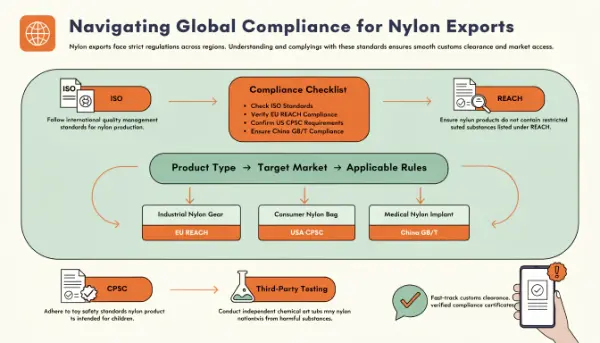
Selling nylon parts globally brings a big problem. Different countries have different safety rules. You might get your goods stuck at customs. I want to show you how to fix this fast.
Nylon exporters must follow different global safety rules to sell goods legally. You must check ISO standards, EU REACH laws, US CPSC rules, and China GB/T standards. You also need third-party lab tests to prove your nylon does not contain bad chemicals. A good plan maps your product type to the right local laws.
You might feel lost with so many rules. Let me break them down step by step so you can keep shipping without stress.
How Do You Map Nylon Products and Target Markets?
You have a great nylon product. But you do not know where it fits in the law. This confusion wastes time. Let us clear up exactly what you make and where it goes.
You map your nylon exports by defining the exact product type and the destination country. Nylon can be raw pellets, car parts, or clothing. Every region treats these forms differently. You must also assign the correct HS code for customs. This code tells border agents what rules apply to your exact item.
Let me share a quick story. At CavityMold, we make plastic injection molds. Once, we made a mold for a nylon electronic casing. We shipped it to Europe. We thought it was just a simple plastic part. Customs stopped it. We used the wrong product code. We lost a week fixing the paperwork.
Define Your Nylon Type
You cannot just call it "nylon." You must know its exact form. Is it raw material? Is it a finished consumer product? Is it an industrial part? The law changes based on the form. A nylon gear inside a machine has soft rules. A nylon spoon used for food has hard rules. You must write down exactly what your product does.
Know Your Buyers
You must know where your product will end up. Every country has a unique rulebook. You cannot use US rules in Europe. You must check local laws first. Environmental rules also change. Some countries have strict laws about nylon waste and recycling. You must know these rules before you ship.
Understand Customs Codes
Every product gets a number. We call this the HS code. Customs agents look at this number. They do not look at your product box. You pick the wrong number. You pay the wrong tax. You might also miss an important safety check.
| Product Type | Example | Risk Level |
|---|---|---|
| Raw Pellets | Raw nylon 6/6 | Low |
| Industrial Parts | Car engine cover | Medium |
| Consumer Goods | Phone case | High |
| Food Contact | Cooking spoon | Very High |
You must start by making a simple list. Write down your product, your target country, and your HS code. This stops problems before they start.
What Are the Chemical Rules for Nylon Exports?
Bad chemicals hide in cheap nylon. If you ship toxic nylon, customs will fine you. This ruins your brand trust. You must test for these hidden dangers right now.
Global rules focus mostly on the chemicals used inside nylon. The EU uses REACH to stop toxic heavy metals and plasticizers. The US uses CPSC rules to limit bad dyes and chemicals. Many buyers also want RoHS compliance to ensure no restricted metals exist. You must test your nylon in an approved lab.
Chemicals make nylon strong. They give nylon its color. But some chemicals hurt people. At CavityMold, we always check our plastic resins. We must know what is inside them. I learned this the hard way early in my career. We bought cheap nylon from a new supplier. We did not test it. The parts failed the European REACH test. We had to throw the whole batch away. It cost us a lot of money.
The EU REACH Law
Europe cares deeply about safe chemicals. They use a law called REACH. This law looks for toxic things. It checks for harmful dyes. It checks for heavy metals. Your nylon has these things. Europe bans it. You must show papers that prove your nylon is clean.
The US and China Rules
The United States has different chemical limits. California has a special law called Proposition 65. It requires a warning label if your nylon has certain chemicals. China uses GB/T standards. They test the quality and safety of the plastic. You must follow these local laws if you want to sell there. You must also watch for updates. Countries update their toxic substance lists often. These updates can change your compliance status over night.
| Region | Main Chemical Law | What They Look For |
|---|---|---|
| Europe | REACH / RoHS | Heavy metals, toxic dyes |
| USA | CPSC / Prop 65 | Lead, harmful additives |
| China | GB/T Standards | Material safety limits |
Medical and ISO Standards
Medical products need even cleaner nylon. The FDA controls this in the USA. You cannot use normal industrial nylon for a medical tool. The body might react badly to it. You must use special biocompatible nylon. You must prove it is safe with lab reports. You must also follow ISO 18064 to classify your nylon materials correctly. Always hire a third-party testing agency to check your chemicals. They give you a certificate. Buyers trust this certificate.
How Do You Meet Product-Specific Safety Rules?
Making products for kids or kitchens is scary. One mistake can cause a major injury. Recalls cost millions. We need to follow specific safety steps to protect the end user.
Nylon safety rules get stricter based on how people use the product. Children’s items need strict lead testing and safety certificates. Clothing needs flammability tests. Food-contact nylon must pass migration tests to prove chemicals do not leak into food. You must match your testing plan to the exact product use.
I work mostly with electronics at CavityMold. Sometimes a client asks for a wearable tech device. A wearable device touches the skin. This changes everything. We cannot just use normal nylon. The rules change when a product gets close to a human body. Regional variations in testing protocols mean you need a multi-tiered safety strategy.
Children and Toys
Kids put things in their mouths. Governments know this. The rules for kids are the toughest rules in the world. In the US, you need a Children’s Product Certificate. You must test the nylon for lead. You must test it for small parts that might break off. The lab must be approved by the government. You cannot use just any lab.
Flammability Rules
Nylon can catch fire. It melts and burns. This is very dangerous for clothing or home items. The US Consumer Product Safety Commission sets strict fire rules. You must test how fast the nylon burns. It burns too fast. You cannot sell it. We always check fire ratings when we pick nylon for electronic cases.
| Product Use | Key Safety Focus | Testing Needed |
|---|---|---|
| Children’s Toys | Choking hazards, Lead | Strict chemical and physical tests |
| Clothing | Catching fire | Flammability tests |
| Food Containers | Chemical leaking | Migration tests |
Food Contact Items
Nylon spoons and spatulas are very common. Heat makes chemicals move. You put a hot nylon spoon in soup. Chemicals might leak into the food. Governments call this migration. You must do migration tests. The lab heats the nylon in fake food to see what comes out. You must pass this test to sell kitchen items.
What Export-Control Rules Apply to Nylon?
Shipping boxes across borders involves hidden legal traps. You might sell to a banned buyer by accident. This brings huge fines. You need to screen your shipments to stay safe.
Exporters must follow trade rules even if the nylon is safe. You must check your buyer against denied-party lists. You must ensure the destination country does not have trade bans. Some advanced nylon types need special export licenses. You must also keep all your shipping records for at least five years.
Safety rules are just one part of the job. Trade rules are the other part. Ten years ago, I thought my only job was making a good plastic mold. I was wrong. I had to learn trade laws. You break trade laws. Your company goes out of business.
Check Your Buyers
You cannot sell to everyone. Governments keep lists of bad people and bad companies. You call these sanctioned parties. You must check the name of your buyer. You must check the name of their bank. You must check the shipping company. You sell nylon to a banned person. You break the law.
Advanced Nylon Materials
Most nylon is simple. It goes into clothes or consumer electronics. But some nylon is very strong. Military groups use ballistic nylon. Aerospace companies use high-performance nylon composites. These strong nylons often need special export licenses. Your government wants to know who buys them. You must ask your government for permission before you ship.
| Trade Rule | What You Must Do | Why It Matters |
|---|---|---|
| Party Screening | Check buyer names | Avoid selling to bad actors |
| Country Checks | Check embargo rules | Avoid banned countries |
| Record Keeping | Save papers for 5 years | Prove you followed rules |
Keep Your Records
You must keep all your papers. Keep the test reports. Keep the customs forms. Keep the buyer emails. Many governments can ask to see these papers five years later. At CavityMold, we save every document on a secure server. Customs asks a question. We find the paper in five minutes. This keeps our business safe.
How Do You Build a Nylon Compliance Checklist?
Forgetting one small rule delays your whole shipment. You feel angry and stressed. A simple paper list fixes this mess. Let us build a checklist to make every shipment perfect.
A good compliance checklist organizes your export process. First, define the product and market. Second, identify the exact chemical and safety rules. Third, hire a lab to test the nylon. Fourth, create the right labels and shipping documents. Finally, do an export-control check before sending the goods.
I love systems. As a project manager, I rely on systems. I started working at CavityMold many years ago. We missed small details then. We forgot a label. We forgot a test report. We lost time. I built a checklist. It changed everything. A 10-year-old child could use this checklist to ship a box.
Step One: Scope and Rules
First, write down what you sell. Write down where it goes. Look up the rules. Do you need a REACH test? Do you need a CPSC test? Write the required tests on your paper. This is your target.
Step Two: Testing and Labels
Next, send a sample to a lab. Do not use a cheap lab. Use a certified third-party lab. They say the nylon is safe. Get the report. Make your labels. Check the labeling rules for the target country. Does it need a CE mark? Does it need a warning label? Put the label on the product.
| Checklist Step | Action Required | Result |
|---|---|---|
| 1. Scope | Pick product and country | Clear goal |
| 2. Rules | Find chemical limits | Know what to test |
| 3. Test | Send to certified lab | Get safety proof |
| 4. Ship | Screen buyer, print papers | Safe export |
Step Three: Final Checks
Lastly, look at the buyer. Run their name through a screening tool. Make sure they are safe to do business with. Print the HS code on the customs form. Attach the lab report to the shipping box. Save a copy of everything in your computer. You are now ready to export nylon safely to anywhere in the world.
Conclusion
Exporting nylon safely requires a clear plan. You must know your product form, test for hidden chemicals, and follow strict local safety rules. You must also check trade laws and screen your buyers. A simple checklist keeps your shipments legal and builds trust with global customers.