
Have you ever seen a plastic part melt down during a critical project? Heat can ruin good designs fast. If you want to stop failures, you need to know the right limits. Let us look at how heat resistance works for industrial plastics.
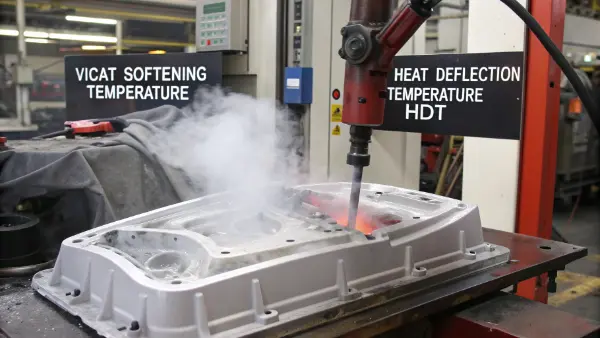
Heat resistance in industrial plastics is usually judged by the continuous service temperature for long-term use and by test metrics like Vicat softening temperature and heat deflection temperature (HDT). In practical terms, many high-performance plastics can work above 150°C, while top-end engineering polymers can sustain 250°C or more depending on conditions.
You might think a high melting point is all you need. But the truth is much more complex. High heat changes how plastics behave over time. If you pick the wrong material, your project will fail. Let us break down the details so you can make the best choice.
What Does Safe Really Mean for Plastics in High Heat?
Do you know what makes a plastic part truly safe under heat? Most people just look at the melting point. That is a big mistake. A part can fail long before it turns into a liquid.
A plastic can still fail before melting if it softens, creeps, embrittles, or loses electrical insulation under heat and load. Safety decisions must rely on required load, exposure time, airflow, chemical environment, and whether the part is structural. The true threshold is where properties drop enough to cause deformation.
I have seen many engineers make this mistake. Years ago, a client came to me at CavityMold. They had designed a plastic bracket for a machine. The data sheet said the melting point was high enough. But the part failed in just two weeks. Why? Because the part was under a heavy load. The heat did not melt the plastic. But the heat made the plastic soft. The heavy load then bent the soft plastic out of shape. We call this creep.
You must look at the whole picture. How long will the part stay hot? A short spike in heat is very different from long, steady heat. Prolonged exposure to high temperatures speeds up the breakdown of plastics. This lowers their mechanical strength. You also need to think about the environment. Is there air blowing over the part to cool it? Are there chemicals nearby? Heat makes chemicals attack plastics much faster.
If a part is just a cover, a little softening might be fine. But if the part holds other things up, it must stay stiff. Overreliance on untested plastic grades will increase your risk. This is very true for safety-critical systems. You must test the parts in real extreme heat conditions. Safety means the part keeps its shape and does its job, day after day, in the heat.
What Are the Critical Temperature Thresholds You Must Know?
Do you know the exact temperatures where plastics start to break down? There are specific heat zones you must watch. Crossing these lines changes everything for your project.
Critical thresholds start below 100°C, where standard plastics lose strength. About 150°C is the dividing line for heat-resistant materials. The 200°C to 260°C range requires specialized materials like PEEK or PTFE. Some plastics can survive brief spikes above 300°C, but they are not safe for continuous use there.
Let us talk about these temperature zones in detail. The first zone is below 100°C. Many everyday plastics lose their strength here. They can lose their shape easily. This range is a warning zone for standard materials. If your part gets this hot, you must be careful.
The next big line is around 150°C. I call this the gateway to high performance. If your project needs to work above 150°C, you can no longer use basic plastics. You must use engineering plastics. These materials cost more, but they stay strong.
Then we reach the 200°C to 260°C range. This is extreme heat. Very few materials can survive here for a long time. You have to use specialized plastics. I will talk about those specific materials later. But you must know that working in this zone requires expert design.
Finally, we have the zone above 300°C. You might read that some plastics can handle this heat. But you must read the fine print. They can only handle this heat for a very short time. If you leave them at 300°C, they will burn or break down completely. I always tell my clients to leave a big safety margin. If your machine runs at 200°C, do not pick a plastic that fails at 205°C. A small heat spike will destroy your work. Always know your thresholds.
Which High-Performance Plastics Can Survive Extreme Heat?
Are you looking for materials that laugh at high temperatures? When the heat gets extreme, you need the heavy hitters of the plastic world. Let us look at the best options.
Polyetheretherketone (PEEK) has a melting point above 340°C, perfect for extreme heat. Polyimide maintains structure over 260°C, great for aerospace. Polyphenylene sulfide (PPS) keeps stability up to 240°C, ideal for hot automotive parts. Polytetrafluoroethylene (PTFE) gives stability up to 260°C with exceptional chemical resistance.
When clients come to me with extreme heat problems, I always look at these four materials. First is PEEK. PEEK is amazing. It has a melting point above 340°C. It is very tough. We use PEEK for parts that go inside car engines or deep inside oil wells. It is expensive, but it rarely fails.
Next is Polyimide. This plastic stays strong even above 260°C. I often see Polyimide used in space projects and tiny electronics. It does not burn easily. It keeps its shape very well.
Then we have PPS. PPS can handle heat up to 240°C. The best thing about PPS is how it handles stress. If you have a part that gets hot and gets pushed hard, PPS is a great choice. Many car makers use PPS for parts under the hood.
Finally, there is PTFE. You might know PTFE as Teflon. It works great up to 260°C. But PTFE has a special power. It ignores almost all chemicals. If your part sits in hot acid, PTFE is your best friend.
Here is a quick look at these high-end options:
| Material | Max Continuous Heat | Best Feature |
|---|---|---|
| PEEK | 250°C | Extreme strength |
| Polyimide | 260°C+ | Great for electronics |
| PPS | 240°C | High stress tolerance |
| PTFE | 260°C | Chemical resistance |
These materials are the kings of heat. But they need special tools to mold. At CavityMold, we spend a lot of time making sure our machines can melt and form these tough plastics correctly.
How Do Standard Plastics and Additives Handle the Heat?
What if your project does not need extreme space-age plastics? Everyday plastics have limits, but you can push those limits with a few clever tricks.
Acrylonitrile Butadiene Styrene (ABS) deforms around 105°C. Polycarbonate starts softening at 147°C. Thermosetting plastics outperform standard thermoplastics in heat due to cross-linked molecules. You can also add carbon fiber or ceramic fillers to improve the heat tolerance of baseline plastics for better performance.
Let us look at standard plastics first. ABS is very common. We use it all the time. But ABS starts to warp and bend at just 105°C. You must be very careful if you put ABS near a motor or a heater. Polycarbonate is stronger. It starts to get soft around 147°C. If you use Polycarbonate, you must design your part well so it does not bend when it gets warm.
But what if you want to use a standard plastic, and you need just a little more heat resistance? I love using additives. You can mix things into the plastic before you mold it. If you mix glass fibers or carbon fibers into the plastic, it gets much stronger. The fibers act like a skeleton. They hold the plastic together when it gets hot. Ceramic fillers do the same thing. They soak up the heat and keep the plastic stiff.
You should also know the difference between thermoplastics and thermosetting plastics. Thermoplastics melt when they get hot. You can cool them down and melt them again. Most plastics we use are thermoplastics. But thermosetting plastics are different. Once you mold them and bake them, they lock into place. Their molecules form strong cross-links. They do not melt again. They just burn if they get too hot. Because of this, thermosetting plastics are often much better at handling high heat than basic thermoplastics.
What Are the Best Rules for Selecting Heat-Resistant Plastics?
How do you make the final choice for your project? Picking the right plastic is like solving a puzzle. You need strict rules to make sure you get it right every time.
For industrial safety, use the maximum continuous service temperature as your first filter. Then verify HDT or Vicat metrics if the part carries a load. Keep normal operating temperatures well below the published limits, because real-world factors like aging and heat spikes reduce your safety margin.
I always tell project managers to follow a simple path. Step one is the continuous service temperature. This is the heat level the plastic can take day after day, year after year. Do not look at the melting point first. Look at the continuous use number. If your machine runs at 130°C all day, your plastic must have a continuous use rating higher than 130°C.
Step two is looking at the load. Does the part hold weight? If yes, you must check the Heat Deflection Temperature (HDT). The HDT tells you when the plastic will bend under weight. A practical example helps here. Let us say you have a plastic box. The box just sits there and gets hot to 130°C. A standard high-heat Polycarbonate might be fine. But what if that box is actually a bracket holding a heavy motor? The heat is still 130°C. But the weight changes everything. The Polycarbonate will bend. You must switch to a stronger material like PEI or PPS. Creep resistance matters more than the melting point here.
Here is a simple guide for useful material ranges:
| Material Family | Typical Continuous Use | Notes |
|---|---|---|
| ABS / Standard PC | 80–140 °C | Moderate heat only |
| Polyamide / PBT | 100–150 °C | Needs fiber reinforcement |
| PEI / PPS / PEEK | 170–260 °C+ | Demanding industrial use |
| Special Polymers | 260 °C and above | Extreme heat only |
Always leave a gap between your real temperature and the plastic limit. Things get older. Heat spikes happen. Play it safe, and your parts will last.
Conclusion
Understanding heat resistance saves your projects from failure. You must look past the melting point. Think about continuous service temperature, loads, and time. By choosing the right plastics and using smart additives, you ensure your industrial parts stay safe and strong under fire.