
Do you have harsh chemicals eating through your buckets? It is a real pain when a bucket leaks dangerous liquids onto your shop floor. You need a bucket that can handle the tough stuff without melting or breaking apart.
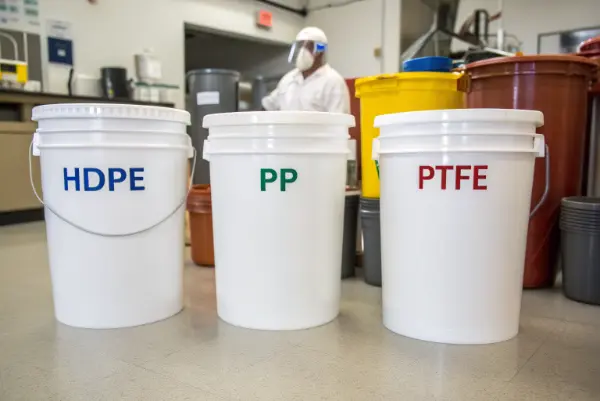
For most harsh chemicals, High-Density Polyethylene (HDPE) and Polypropylene (PP) are the best practical choices. They resist many acids and bases safely. If you have extreme chemicals, Polytetrafluoroethylene (PTFE) offers the highest resistance. But PTFE is very expensive. HDPE is the best mix of safety and low cost.
Choosing the wrong plastic can cost you a lot of money and create a huge safety hazard. I know this because I manage projects for mold designs every day. Let us look closer at which plastics will actually work for your chemical storage needs so you do not waste time or risk safety.
What is the best material for buckets?
Are you tired of buying buckets that crack after a few weeks? Storing industrial liquids in weak containers causes spills. You need a standard material that works for almost everything in your shop.
The best overall material for utility buckets is HDPE. It offers broad chemical resistance and handles everyday acids and alkalis well. If you need a bucket to hold warm liquids, PP is the next best choice because it takes heat better than HDPE.
Practical Choices for Everyday Shop Use
I see a lot of plastic parts in my job. We make molds for consumer electronics at CavityMold. Sometimes we use chemicals to clean our machines. I always tell my team to grab the HDPE buckets first. HDPE stands for High-Density Polyethylene. It is the king of the bucket world. It handles most solvents and acids. You can drop it, and it usually will not crack. It is cheap to make. That is why most 5-gallon buckets you see in stores are made of HDPE.
But sometimes, HDPE is not enough. Let us say you have a warm chemical. HDPE can get soft if it gets too warm. That is when we use Polypropylene, or PP. PP is very strong. It has great chemical resistance. More importantly, it can take higher heat than standard polyethylene.
There are other plastics like Low-Density Polyethylene (LDPE). LDPE is softer. It is good for light duties. But it is less resistant than HDPE. You should not use LDPE for harsh chemicals. Also, people ask about ABS plastic. ABS is great for toy bricks. But it is bad for chemical buckets. It has low chemical resistance. Chemicals will eat right through ABS.
Here is a simple look at common bucket materials:
| Material | Best For | Heat Tolerance | Cost | Chemical Resistance |
|---|---|---|---|---|
| HDPE | General harsh chemicals | Medium | Low | Very Good |
| PP | Warm chemicals | High | Low | Very Good |
| LDPE | Light duties | Low | Low | Fair |
| ABS | Do not use for chemicals | Medium | Medium | Poor |
So, stick to HDPE or PP. They are the easiest to find. They will keep your liquids safe. They keep your costs low. That is how we keep things running smoothly in our mold shop.
What plastic is best for chemical resistance?
Do you have highly aggressive chemicals that destroy normal buckets? Watching an expensive solvent melt your container is scary. You need a plastic that is basically immune to chemical attacks.
PTFE (Teflon) is the best plastic for pure chemical resistance. It survives the most aggressive chemicals and strong oxidizers. PEEK and PVDF also offer amazing resistance. However, these materials are usually too expensive for standard utility buckets.
Going Beyond Standard Plastics
Sometimes regular plastic is not enough. If you work with super harsh chemicals, HDPE might fail. In our factory, we sometimes deal with very aggressive cleaning agents. When that happens, we need specialty plastics. PTFE is the absolute best. You might know it as Teflon. Nothing really sticks to it. Almost nothing can melt it. It handles strong oxidizers perfectly. But there is a big problem. Making a 5-gallon bucket out of pure PTFE is incredibly expensive. It is just not practical for normal use. We only use PTFE for very small, specialized parts in our mold designs.
Other amazing plastics are PEEK and PVDF. They are excellent for harsh environments. They resist almost everything. But like PTFE, they are overkill for a standard bucket. You would pay hundreds of dollars for one bucket.
What about Nylon? Do not use Nylon for strong acids. Nylon is strong for mechanical parts. We use it in gears. But strong acids and bases will destroy Nylon quickly.
If you want the safest general answer for harsh chemicals, choose HDPE first. If the chemical is too strong for HDPE, you must move up to a fluoropolymer like PTFE. Always check a chemical compatibility chart. Chemical resistance depends on the exact chemical, the concentration, the temperature, and the exposure time. A chemical might be safe at room temperature but dangerous when hot.
| Plastic Type | Chemical Resistance Level | Practicality for Buckets | Main Drawback |
|---|---|---|---|
| PTFE | Extreme | Very Low | Way too expensive |
| PVDF | Excellent | Low | High cost |
| HDPE | Good to Very Good | Very High | Fails with extreme oxidizers |
| Nylon | Poor against acids | Low | Weak against bases |
Always know your exact chemical mixture. Tell me the chemical, and I can tell you the exact mold or bucket material to use.
Is polyethylene better than PVC for chemical resistance?
Are you confused between using PE or PVC for your chemical storage? Guessing the wrong one can lead to brittle plastic and dangerous leaks. You need to know which one holds up better under pressure.
Yes, Polyethylene (especially HDPE) is generally better than PVC for broad chemical resistance in buckets. Polyethylene handles most solvents and acids well. PVC provides good resistance but can become very brittle and crack at lower temperatures.
Why Polyethylene Usually Wins
I have seen many materials fail in my 10 years of product design. PVC is a very common plastic. We use it for pipes all the time. PVC stands for Polyvinyl Chloride. It handles some industrial chemicals okay. There is also CPVC, which handles heat a bit better. But for bucket-style storage, PVC has big limits. The biggest issue is cold weather. PVC can get very brittle. If you drop a cold PVC bucket, it will shatter. You do not want a bucket of harsh chemicals to shatter on your feet.
Polyethylene, on the other hand, is much tougher. It stays flexible even when it gets cold. Polyethylene buckets are generally resistant to most solvents and acids. This makes them suitable for diverse chemical storage. They bounce instead of break. That is a huge safety plus in any busy shop.
Sometimes, people try to use epoxy-coated buckets. An epoxy coating can enhance the chemical resistance of underlying materials like metal. But if the epoxy scratches, the metal will rust or melt. A solid Polyethylene bucket does not have a coating to scratch off. The protection goes all the way through.
Also, some manufacturers make copolymer plastics. These mix different plastics together. Copolymer plastics can offer increased flexibility and chemical resistance compared to standard polyethylene. But standard HDPE is still the most trusted baseline.
| Feature | Polyethylene (HDPE) | PVC |
|---|---|---|
| General Chemical Resistance | Excellent for most acids/solvents | Good, but limited compared to PE |
| Cold Temperature Strength | High (stays tough) | Low (becomes brittle) |
| Drop Impact | Bounces or dents | Can shatter or crack |
| Bucket Use Popularity | Extremely High | Very Low |
So, stick to Polyethylene for buckets. PVC is great for stationary pipes, but it is not the right choice for a heavy bucket you carry around.
What is the most acid resistant plastic?
Are your acids eating through standard plastic containers? Storing heavy acids like sulfuric or nitric acid is very dangerous. You need the absolute strongest barrier against acidic corrosion.
PTFE is the most acid-resistant plastic available. It can hold almost any highly concentrated acid without degrading. For practical and affordable acid storage, Polypropylene (PP) and HDPE are the most commonly used, handling most standard acids effectively.
Handling Extreme Acids Safely
Acids are tricky. I remember testing a new mold flow for a plastic part that had to hold battery acid. We had to be very careful. Not all plastics can handle acids. Polypropylene (PP) is resistant to many acids and alkalis. It is a great choice for a lot of acid jobs. But PP may not perform well with strong oxidizing agents. Nitric acid is a strong oxidizer. It will eat PP over time.
HDPE is also great for everyday acids. It is cheap and safe. But what if you have the worst acids? What if you have boiling, highly concentrated sulfuric acid? Standard utility buckets will fail. This is when you look at the extreme plastics.
PTFE exhibits superior chemical resistance. It stands strong against aggressive chemicals. It is the most acid-resistant plastic you can find easily. It will not melt. It will not react. But as I said before, it is too expensive for a big bucket.
You must always remember the important caveat. Chemical resistance depends on four things. It depends on the exact chemical. It depends on the concentration. It depends on the temperature. And it depends on the exposure time. A 10% acid might be safe in HDPE for a year. A 90% acid might destroy it in a week.
Here is a guide for acid resistance:
| Acid Type | Best Practical Plastic | Best Extreme Plastic |
|---|---|---|
| Mild Acids (Vinegar, Citric) | HDPE | – |
| Standard Battery Acid | PP or HDPE | – |
| Strong Oxidizing Acids | None (Do not use standard plastic) | PTFE / PVDF |
| Hot Concentrated Acids | None | PTFE |
Never guess with acids. Always read the safety data sheet for your chemical. Then match it to a trusted chemical compatibility chart.
Conclusion
Choosing the right plastic bucket keeps your shop safe and saves money. For almost all harsh chemicals, HDPE and PP are your best choices. For extreme acids, you need expensive PTFE. Always check the exact chemical and temperature before you store it.