
Are you struggling to balance high-performance plastic needs with growing environmental regulations? Many manufacturers face this exact dilemma. You need the durability of ABS, but you worry about its ecological footprint and safety standards. This conflict creates hesitation in material selection and slows down production cycles.
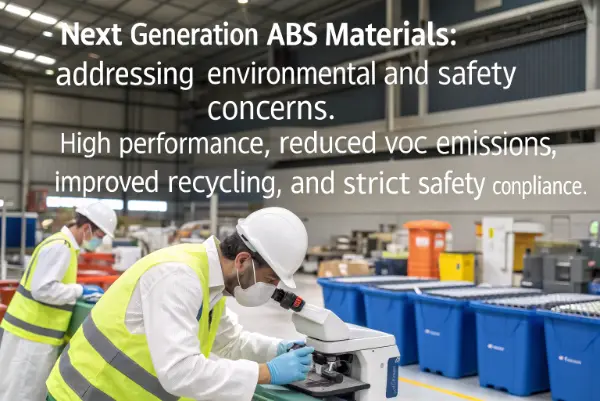
Next-generation ABS materials address these concerns by incorporating bio-based additives and improved recycling capabilities without sacrificing mechanical strength. These advanced formulations significantly reduce volatile organic compound (VOC) emissions during processing. By switching to these modern variants, manufacturers can maintain product quality while meeting strict sustainability goals and safety compliance.
It is time we stop viewing ABS as just a traditional, somewhat problematic plastic. The industry has moved forward, and the new options available are game-changers. Let’s look closer at how these materials are evolving and what that means for your next project.
Is ABS material traditionally considered environmentally friendly?
We often hear debates about plastics, but the specific reputation of Acrylonitrile Butadiene Styrene (ABS) is complex. You might wonder if standard ABS fits into a green manufacturing model. The short answer has historically been "no," which causes significant headaches for companies trying to market eco-conscious products.
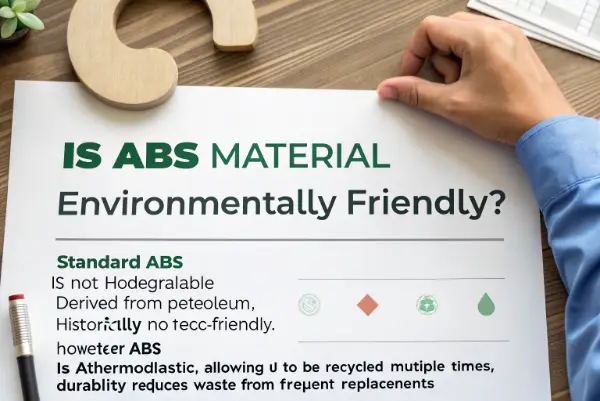
Standard ABS is not biodegradable and is derived from petroleum, meaning it is not traditionally considered environmentally friendly. However, it is a thermoplastic, which allows it to be melted down and recycled multiple times. The real environmental value comes from its durability, as long-lasting products reduce the need for frequent replacements and waste.
To understand this better, we need to look at the lifecycle of the material. I recall a project from a few years ago where a client wanted to switch away from ABS entirely because of "bad PR." We had to sit down and really analyze the alternatives.
Standard ABS is a terpolymer. This means it is made of three distinct monomers: acrylonitrile, butadiene, and styrene. None of these are renewable. Extraction and processing consume significant energy. However, simply labeling it "bad" misses the nuance of modern manufacturing.
The "unfriendly" label comes from three main areas:
- Source: It comes from oil and gas.
- End of Life: It sits in landfills for centuries if not recycled.
- Processing: It can release fumes during molding.
But here is where the critical thinking comes in. If you use a "greener" plastic that breaks after six months, you have to manufacture two products instead of one. ABS parts can last for decades. This durability is a form of sustainability.
Furthermore, the industry is shifting toward Bio-ABS. This is not just a buzzword. Chemical companies are now synthesizing the acrylonitrile and butadiene components from biomass feedstocks.
Comparing Traditional vs. Sustainable ABS
| Feature | Traditional ABS | Recycled ABS (rABS) | Bio-based ABS |
|---|---|---|---|
| Raw Material | Petroleum/Natural Gas | Post-consumer waste | Lignin or Vegetable Oil |
| Carbon Footprint | High | Low (energy used in reprocessing) | Neutral to Low |
| Cost | Low | Low to Medium | High (currently) |
| Performance | Excellent Impact Resistance | Variable (depends on purity) | Comparable to Virgin ABS |
This table shows that while traditional ABS has issues, the material family is evolving. You do not always have to abandon the material; you might just need to change the type or source of the ABS you specify.
What specific impact does ABS have on the environment during its lifecycle?
Understanding the full scope of environmental impact is crucial for any project manager. You need to know exactly where the damage occurs to mitigate it. Is it the extraction, the molding, or the disposal that causes the most harm?
The primary environmental impact of ABS comes from its energy-intensive production process and the release of microplastics if disposed of improperly. Manufacturing ABS generates a significant carbon footprint due to the refining of oil. Additionally, if ABS waste enters the ocean or soil, it breaks down into harmful micro-particles rather than biodegrading.
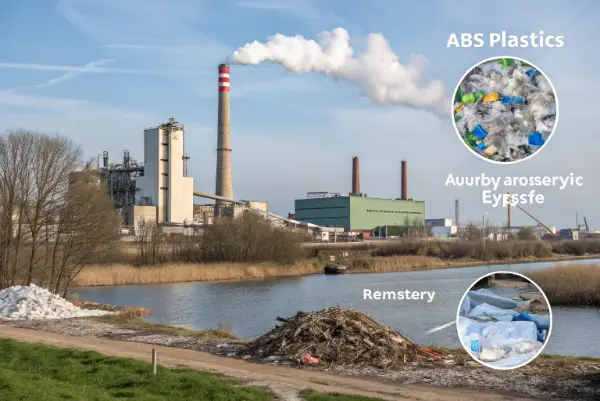
When we talk about impact, we have to look at the "Invisible Costs." In my experience at CavityMold, we see that the waste generated during the injection molding process—sprues and runners—is often the first place environmental impact happens.
If a factory throws away these scraps, that is immediate waste. But if we use regrind (crushing the runners and putting them back in the machine), we reduce the impact significantly.
Here is a breakdown of the negative impacts:
- Energy Consumption: Creating the monomers requires high heat and pressure.
- Fumes: Styrene is a hazardous chemical. If released into the air, it contributes to smog and health issues.
- Persistency: It does not rot. It stays.
However, let’s analyze the Positive Impact Potential.
Because ABS is lightweight, it saves fuel in transportation. If you use metal parts for a car interior, the car is heavier and burns more gas. If you use ABS, the car is lighter.
The Microplastic Problem
This is the most critical issue facing us today. ABS tends to fragment.
- Mechanical Wear: Tires and shoe soles wear down.
- UV Degradation: Sun exposure makes ABS brittle, causing it to flake off.
Strategies to Mitigate Impact:
- Additives: Use UV stabilizers to prevent degradation.
- Closed Loop: Ensure your factory recycles 100% of internal waste.
- Design: Design parts that are easy to disassemble so the ABS can be separated from metals and electronics for recycling.
What is the environmental impact of ABS filaments specifically in 3D printing?
3D printing (Additive Manufacturing) is often seen as a cleaner alternative to traditional manufacturing. However, when you use ABS filaments, specific risks arise. Many of you use 3D printing for prototyping before coming to us for mass production molds.
ABS filaments release Ultra-Fine Particles (UFPs) and Volatile Organic Compounds (VOCs) like styrene when heated during 3D printing. These emissions can lower indoor air quality and pose health risks in poorly ventilated spaces. Furthermore, support structures used in printing often become immediate non-recyclable waste, adding to the landfill burden.
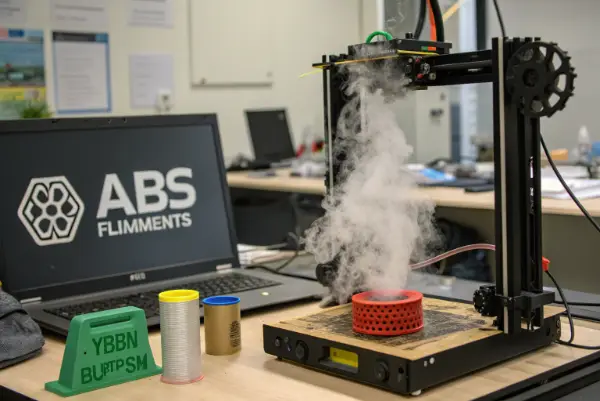
I have walked into many prototyping labs that smell like burning plastic. That smell is styrene. It is not just unpleasant; it is a sign of environmental pollution on a micro-scale.
In injection molding, the molten plastic is contained inside a steel barrel and injected into a closed mold. The fumes are largely trapped or managed by industrial ventilation. In 3D printing, the plastic is melted in the open air (unless you have an enclosed printer).
The Waste Factor in Printing:
- Failed Prints: 3D printing has a higher failure rate than injection molding. A warped print is 100% waste.
- Supports: You cannot print overhangs without support material. This material is broken off and usually thrown away.
Critical Analysis of Filament vs. Pellet:
When we buy ABS pellets for injection molding, they are bulk shipped efficiently. Filaments require:
- Extrusion into wire.
- Winding onto plastic spools (more waste).
- Vacuum packaging (plastic waste).
- Individual shipping boxes.
The carbon footprint of 1kg of printed ABS is much higher than 1kg of molded ABS.
Making Prototyping Safer
If you are managing a project and need to prototype with ABS:
- Enclosure: Only use printers with HEPA filters.
- Temperature Control: Do not overheat the nozzle; higher heat equals more fumes.
- Transition: Move to injection molding as soon as the design is fixed.
We often advise clients to switch to PLA for visual prototypes to save the environment, and only use ABS for functional testing where heat resistance is required.
How can we sustain the environment for future generations while using ABS?
We cannot simply stop using plastic overnight. It is too essential for medical devices, automotive safety, and electronics. The question is not about elimination, but about adaptation. How do we responsibly manage this material moving forward?
To sustain the environment, we must transition to a Circular Economy model for ABS. This involves designing products for easy disassembly, increasing the use of post-consumer recycled (PCR) ABS, and investing in chemical recycling technologies. By closing the loop, we keep the material in use and out of the environment.
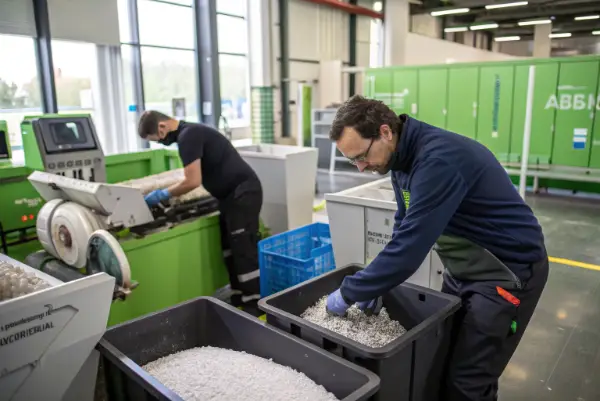
This is the most important part of our discussion. It requires a shift in mindset from "Make-Use-Dispose" to "Make-Use-Recover."
At CavityMold, we are seeing more requests for molds designed for recycled materials. This is a positive trend. But "recycled" ABS behaves differently than virgin ABS. It might shrink differently or have different flow rates.
Steps for Sustainable ABS Usage:
Design for Recycling (DfR):
Do not glue ABS to other plastics. Use snap fits or screws. If you glue ABS to PVC, neither can be recycled easily. If they are mechanically joined, they can be separated.Chemical Recycling:
Mechanical recycling (grinding) degrades the plastic over time. Chemical recycling breaks the ABS back down into its monomers (oil). This allows us to make "virgin-quality" plastic from old waste. This technology is expensive but necessary for the future.Standardization:
If every manufacturer uses a slightly different blend of ABS, recycling becomes hard. If we standardize the grades, large-scale recycling becomes profitable.
The Role of Project Managers (Like You)
You have power in the spec sheet.
- Ask: "Can we use 30% recycled content in this part?"
- Check: "Does our supplier (like CavityMold) recycle their runners?"
- Plan: "what happens to this product in 5 years?"
Sustainable Material Selection Matrix
| Strategy | Action Item | Benefit |
|---|---|---|
| Reduction | Thin-wall molding | Uses less material, faster cooling time. |
| Reuse | Modular design | Only broken parts need replacement, not the whole unit. |
| Recycle | Single-material assembly | Avoids mixing polymers, making recycling cheaper. |
| Recover | Energy recovery | If recycling fails, burn in high-tech plants for energy (last resort). |
We are moving toward "Green ABS." This includes ABS composites reinforced with natural fibers like hemp or bamboo. These reduce the petroleum content and improve the texture.
Conclusion
Next-generation ABS is changing the manufacturing landscape. By understanding the environmental impact of traditional ABS and embracing bio-based alternatives, recycling strategies, and safer processing methods, we can continue to use this versatile material responsibly. It is up to us to design, mold, and manage plastics with the future in mind.