
Struggling to combine PVC with other plastics in your projects? This process is full of challenges, leading to failed parts, wasted material, and project delays. Mastering the unique properties of PVC and its compatibility with other materials is the only way to ensure a successful multi-material component.
To master multi-material injection molding with PVC, you must focus on two key areas: material compatibility and strict process control. Success involves selecting a substrate or overmold material that bonds well, like TPEs or certain polyurethanes, and managing PVC’s narrow processing window. Careful control of melt temperature, injection speed, and mold temperature prevents degradation and ensures a strong, reliable bond between the materials.

Successfully bonding PVC to another material isn’t just a matter of luck; it’s a science. It requires a deep understanding of how PVC behaves under heat and pressure, and how it interacts with other polymers. Without this knowledge, you’re essentially gambling with your project’s outcome. But once you understand the core principles, you can unlock a new range of design possibilities for your products. Let’s break down the essential steps to get you there.
Can PVC Even Be Used in Injection Molding?
You may have heard that PVC is too difficult for injection molding. This misconception could make you avoid a cost-effective and durable material, limiting your design options. But with the right approach, you can easily harness its benefits without the headaches.
Absolutely. Polyvinyl Chloride (PVC) is widely used in injection molding for its excellent chemical resistance, durability, and low cost. The main challenge is its thermal sensitivity; it can degrade and release corrosive gas if overheated. However, with proper process control, corrosion-resistant equipment, and the right material grade (rigid or flexible), PVC is a highly effective and reliable choice for countless molded parts.

The idea that PVC is "unmoldable" is a myth, but it comes from a real place. PVC has a very narrow processing window between its melting point and its degradation point. If you get it too hot, it doesn’t just burn—it releases hydrochloric acid, which can corrode your mold and machine. I remember a project early in my career where a client insisted on using a standard steel mold for a rush PVC job. Within a few cycles, we started seeing pitting on the mold surface. We had to stop production and explain that a special corrosion-resistant steel, like stainless 420, was non-negotiable.
To use PVC successfully, you have to understand its two main forms:
Rigid vs. Flexible PVC
The properties of your final part depend entirely on whether you use rigid or flexible PVC.
- Rigid PVC (RPVC or uPVC): This form is strong, stiff, and impact-resistant. Think of window frames, pipes, and electrical conduit boxes. It contains no plasticizers, which gives it excellent structural integrity.
- Flexible PVC (PVC-P): This form is soft and pliable. Plasticizers are added to make it flexible, perfect for applications like wire insulation, flooring, and soft-touch grips on tools.
The choice between them dictates the additives required and the exact processing parameters you’ll use.
| Feature | Rigid PVC (uPVC) | Flexible PVC (PVC-P) |
|---|---|---|
| Composition | No plasticizers | Contains plasticizers (e.g., phthalates) |
| Properties | Stiff, strong, high chemical resistance | Soft, pliable, good insulation properties |
| Applications | Pipes, fittings, window profiles, credit cards | Hoses, cable insulation, flooring, medical tubing |
| Processing | Higher melt viscosity, requires more pressure | Lower melt viscosity, flows more easily |
Managing PVC’s thermal stability is the most critical part of the job. Heat stabilizers are always added to the raw material to prevent it from breaking down during molding. This is why working with a reliable PVC supplier who provides a consistent, well-formulated compound is just as important as the molding process itself.
What Materials Are Compatible with PVC for Overmolding?
Trying to bond PVC with an incompatible material is a direct path to failure. Parts can delaminate, seals can leak, and the entire production run can be wasted. Knowing which polymers create a strong chemical bond with PVC is fundamental to multi-material success.
For successful overmolding, PVC bonds best with materials that have similar chemical structures or melting temperatures. Thermoplastic elastomers (TPEs), especially Styrenic-based TPE-S, and some thermoplastic polyurethanes (TPUs) offer excellent chemical adhesion to PVC. Other vinyls, like chlorinated polyethylene (CPE), also bond well. Materials like polyethylene and polypropylene, however, require mechanical interlocks in the mold design as they do not bond chemically to PVC.

Choosing the right material pairing is half the battle in multi-material molding. I once worked on a project for a handheld medical device that needed a soft, non-slip grip over a rigid PVC casing. The initial design team specified a silicone overmold. We had to explain that silicone and PVC do not bond chemically. The parts would feel fine at first, but the grip would eventually peel right off. We recommended switching to a specific grade of TPE-S that was designed for PVC adhesion. After a quick trial, we achieved a bond so strong that the TPE would tear before it separated from the PVC substrate.
Chemical vs. Mechanical Bonding
There are two ways to get two materials to stick together in multi-material molding:
- Chemical Bonding: This is the ideal scenario. The molecules of the two materials fuse together at the interface during the molding process, creating a permanent, seamless bond. This requires careful selection of compatible polymers.
- Mechanical Bonding: This method is used when materials are chemically incompatible. The mold is designed with undercuts, holes, or textured surfaces on the first shot (the substrate). During the second shot, the overmold material flows into these features, physically locking the two parts together. It’s a mechanical grip, not a chemical fusion.
For PVC, achieving a strong chemical bond limits your options but delivers the best results.
Good and Bad Pairings for PVC
Here’s a quick reference table to guide your material selection for overmolding onto a PVC substrate.
| Compatibility | Material Class | Specific Examples | Bond Type |
|---|---|---|---|
| Excellent | Thermoplastic Elastomers (TPE) | TPE-S (Styrenic Block Copolymers) | Chemical |
| Good | Thermoplastic Polyurethane (TPU) | Specific ether-based grades | Chemical |
| Good | Other Vinyls | CPE (Chlorinated Polyethylene), EVA | Chemical |
| Poor | Polyolefins | PE (Polyethylene), PP (Polypropylene) | Mechanical only |
| Poor | Engineering Plastics | PC (Polycarbonate), ABS, Nylon (PA) | Mechanical only |
| Poor | Thermoset Rubbers | Silicone (LSR), EPDM | Mechanical only |
When in doubt, always request compatibility data from your material suppliers. They often have specific grades developed for multi-material applications and can provide adhesion test results. A small investment in testing upfront can save you from a massive production failure down the line.
What Are the Key Process Parameters for PVC Injection Molding?
Getting PVC molding parameters wrong is costly. You’ll end up with burnt material, short shots, or brittle parts. Even worse, you could damage your mold or machine with corrosive off-gassing. Dialing in the correct parameters is not just for quality—it’s for safety and equipment longevity.
The most critical process parameters for PVC injection molding are temperature, injection pressure, and screw speed. Because PVC degrades easily, melt temperature must be tightly controlled within a narrow range (typically 160-190°C). Injection pressure should be high enough to fill the cavity without causing excessive shear heat. Finally, a low screw speed is essential to prevent frictional heat from degrading the material before it’s injected.

Managing PVC is all about managing heat. I can’t stress this enough. It feels less like melting plastic and more like containing a finicky chemical reaction. We had one client who couldn’t understand why their parts were so brittle. They kept increasing the melt temperature, thinking it would improve flow. They were actually doing the opposite—burning the PVC, which destroys its polymer chains and mechanical properties. We dropped their temperature by 20°C, increased the injection pressure slightly, and the parts came out perfectly.
A Deeper Look at the Core Parameters
To get consistent results with PVC, you need to set up your machine with precision. Here’s a breakdown of the most important settings and why they matter.
- Melt Temperature: This is the most critical parameter. For most PVC grades, the sweet spot is between 160°C and 190°C (320°F and 375°F). Go below this, and you’ll have high viscosity and short shots. Go above it, and the material degrades, turning yellow or brown and releasing corrosive gas. Use a pyrometer to verify the actual melt temperature, don’t just trust the machine’s display.
- Mold Temperature: A warm mold is essential for PVC. Typically, mold temperatures are set between 20°C and 60°C (68°F and 140°F). A warmer mold helps the material flow better, reduces internal stresses in the part, and improves the surface finish. For rigid PVC, a cooler mold might be used to speed up cycle times, while flexible PVC often benefits from a warmer mold.
- Injection Pressure and Speed: PVC is a shear-sensitive material. Injecting too fast generates a lot of frictional heat, which can lead to degradation right in the nozzle or gate. It’s best to use a moderate injection speed with sufficient pressure to fill the part completely. A profiled injection speed, starting slow and then speeding up, can be very effective.
PVC-Specific Machine and Mold Requirements
You can’t just run PVC in any injection molding machine. You need equipment designed to handle its unique challenges.
| Component | Standard Machine | PVC-Ready Machine | Reason for Difference |
|---|---|---|---|
| Screw & Barrel | General-purpose steel (e.g., nitrided) | Bimetallic or chrome/nickel-plated stainless steel | Resists corrosion from hydrochloric acid released during degradation. |
| Screw Design | General-purpose screw with 3:1 compression ratio | Lower compression ratio (e.g., 2:1), smooth and free-flowing design | Reduces frictional heat and material shear to prevent degradation. |
| Nozzle | Open nozzle is common | Free-flow nozzle design, often with a larger opening | Prevents material from stagnating and burning in the nozzle tip. |
| Mold Material | P20, H13 standard tool steels | Stainless steel (420SS) or nickel-plated tool steel | Resists corrosion from PVC off-gassing. |
Ignoring these equipment requirements is a recipe for disaster. Investing in a PVC-specific screw and barrel and using corrosion-resistant mold materials will save you thousands in premature equipment wear and replacement costs. It is a necessary cost of doing business with PVC.
Can PVC Be Thermoformed?
You might be considering thermoforming as an alternative to injection molding for your PVC part. It’s often seen as a simpler, cheaper process. But if you don’t understand its limitations, you could end up with a part that doesn’t meet your project’s functional or aesthetic requirements.
Yes, PVC is an excellent material for thermoforming, particularly rigid PVC sheets. The process involves heating a PVC sheet until it becomes pliable, then stretching it over a mold and allowing it to cool. It’s widely used for making packaging like blister packs and clamshells, as well as for larger items like signage and wall panels. Thermoforming is ideal for thin-walled, relatively simple parts and offers lower tooling costs than injection molding.
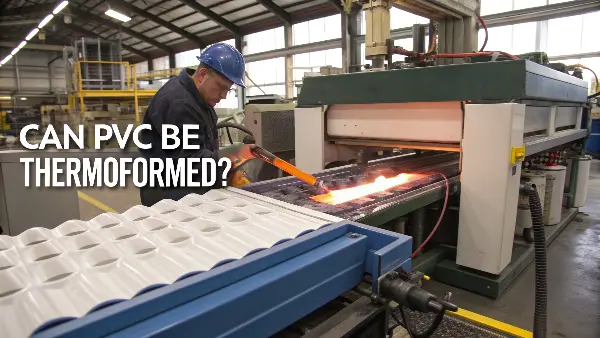
While both processes shape plastic, thermoforming and injection molding are fundamentally different. I often get questions from clients asking if we can just thermoform a part they originally designed for injection molding. The answer is almost always no. The design considerations are completely different. Injection molding can create complex geometries, varying wall thicknesses, and intricate features like threaded bosses or snap-fits. Thermoforming is best for creating shell-like parts with relatively uniform wall thickness.
Let’s compare the two processes directly to see where each one shines.
Injection Molding vs. Thermoforming for PVC
Understanding the strengths and weaknesses of each process will help you choose the right one for your application.
| Feature | Injection Molding | Thermoforming |
|---|---|---|
| Starting Material | Pellets | Extruded Sheets |
| Complexity of Parts | High (complex 3D shapes, varying thickness, fine details) | Low to Medium (shell-like shapes, mostly uniform thickness) |
| Tooling Cost | High | Low to Medium |
| Part Cost | Low at high volumes | Low at low-to-medium volumes |
| Cycle Time | Fast (seconds to a minute) | Slower (minutes per sheet, but can produce multiple parts) |
| Waste | Low (runners can often be reground and reused) | High (trim from the sheet is waste unless reclaimed) |
| Typical Applications | Fittings, housings, gears, multi-material grips, enclosures | Clamshell packaging, trays, signage, automotive interior panels |
When to Choose Thermoforming for PVC
You should consider thermoforming your PVC part if:
- Your part is a thin-walled, hollow, or shell-like design. Think trays, covers, or enclosures without complex internal features.
- You need low to medium production volumes. Tooling for thermoforming is much cheaper and faster to produce than an injection mold, making it cost-effective for smaller runs.
- Your budget for tooling is limited. This is often the biggest driver. If you’re prototyping or launching a new product, thermoforming can be a great way to get to market without a massive upfront investment.
However, if your part requires high precision, complex features, tight tolerances, or very high strength, injection molding is almost always the superior choice. For multi-material parts, like the PVC-TPE bond we discussed earlier, injection molding is the only practical option.
Conclusion
Mastering multi-material molding with PVC is entirely achievable. It comes down to respecting the material’s sensitivity to heat, choosing compatible partners for bonding, and using the right equipment. With a firm grasp of these principles, you can confidently add PVC to your multi-material design toolkit.