
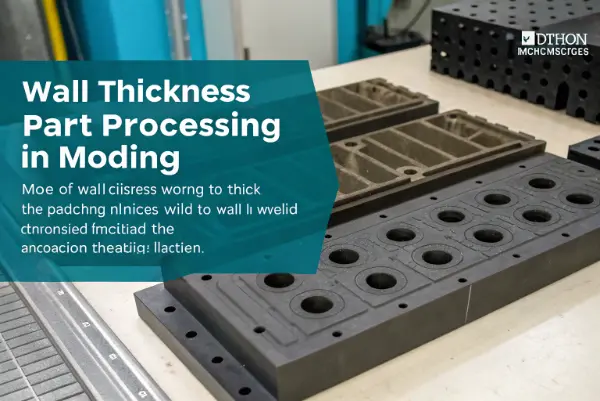
The thickness of the wall relative to the size of the whole part affects the processing of the part. Too thick walls can pose processing challenges as can too thin walls.
What’s even more important than the thickness of the wall is the uniformity of the wall thickness. Better to design a part to have moderate and consistent wall thickness across the entire part than to have notably thick or thin varying wall thickness. Except of course if having varied, thin or thick. walls are essential to the part function and/or aesthetics. In which case more advanced injection molding techniques can be applied to mitigate against any possible issues posed.
In this article we focus on injection molding of parts with thick walls and discuss some advanced techniques processors in the industry employ in handling such.
What Classifies as Thick walls in Injection Molding?
Whether a part is regarded as thin walled or thick walled depends on the type and overall design. For containers, thin walled containers have thickness within the micrometers range. Once your part thickness starts to leave the micrometer range into millimeters, it is within the range of a thick wall container.
Where injection molding of thick walls might be necessary
Thick walled containers are often required in applications where the molded part needs to withstand load, pressure, high impact and/or have good resistance to radiation, possibly for extended periods.
The wall thickness should always include a draft angle of at least 0.5 degrees to aid ejection.
Production of Preforms
Preforms are commonly used in plastic bottles manufacturing. Many plastic bottles companies purchase preforms as their starting feedstock. These are then converted to plastic bottles using blow molding processes. These bottles can then be sold as packaging materials to beverage or bottle water manufacturers or other similar uses.
The bottles start off as preforms with thick walls, this is then blown down to bigger bottles with much thinner walls. The walls can be as little as a tenth of the preform wall thickness.
Large parts with complex design requiring multiple gates and complex ejection
Heavy duty containers, equipment housings and casings for machinery and electricals, automotive parts, load bearing supports and large displays are some examples. In such cases the part may be required to be of a certain minimum weight.
While blow molding is a common process for producing containers. The container design might be too complicated for a simple blow molding process where a parison is injected into two mold halves and blown into a hollow container. The part application may not allow simple blowing and ejection and the mold filling process might require multiple gates.
Radiation and Insulation
Where the material is being used for insulation or needs to block radiation a minimum thickness is often required to achieve this.
Material limitations and Requirements
The mechanical properties of the material from which the container is to be produced is a key factor in determining the thickness of the part.Materials need to have sufficient rigidity, impact strength, resilience and strength to allow for thin walls.
A container may need to be made out of specific materials for reasons such as chemical resistance and UV stability, however the mechanical properties mean the walls will need to be thicker to meet the load bearing requirements. This is particularly important for large parts that may buckle under their own weight or under load.Some rigid materials may also pose a problem of brittleness if walls are too thin.
Challenges posed by thick walls
The defects and problems that thick walled containers may pose if not well managed are linked to two main events in injection molding; heat transfer and filling. These can result in problems such as;
- Shrinkage
- Slow cooling
- Residual stress
- Heat dissipation
- Long cycle times
- Uneven cooling
- Warping
- Flow marks
- Internal voids
- Sink marks/surface sinks
These defects can lead to the part having poor mechanical properties and nonuniform densities and dimensional instability.
Polymers to Consider for Injection Molding of Thick Walled Containers
PC and PET are commonly used on thick walled containers. Nonetheless, diverse polymers are used for thick walled container injection molding. The polymer selected depends on specific application. For example structural applications may use polymers such as PP or ABS while containers that need to be transparent with thick walls might use PC or PET.
The advanced injection molding process selected will depend on both the specific material properties and the design parameters of the part which includes wall thickness. For example PC is often used for producing lenses due to its ability to retain optical clarity and dimensional stability.
Scientific injection molding, Advanced Simulation and process analysis
In the materials selection and product design process, simulations are carried out to analyse how much pressure a part can withstand. Variable parameters in such simulations include materials, wall thickness amongst others. Analysis is carried out to optimize process parameters like temperature and pressure before production commences. This saves costs.
Simulations are particularly important for thick walled containers because the temperature on the part of the wall next to the mold surface often varies significantly. This can lead to defects like warping and loss of mechanical properties of the finished part. Advanced Simulations can be used to predict the temperature of the wall at any point. This is used to select the optimum parameters to operate at . Calculating the temperature away from the mold surface based on temperature of the mold requires complex computing which can be done with simulation softwares.
Overmolding and two shot molding
In this process, the injection molding process is advanced in such a way that one material is first injected into the mold then within the same cycle a second shot is injected over the first material. Both materials are typically polymers. Injecting the part in layers can reduce the cooling time and allows more efficient and faster cooling.
Water assisted injection molding
In this advanced injection molding process, after the melt is injected into a mold, water at high pressure is pumped into the mold from one end and out through another. The pressure is held long enough through the cooling process to maintain a hollow space in the part. This also aids in achieving more uniform cooling as the water absorbs some of the heat. The pressure from the water also helps maintain dimensional stability and prevents issues like warping or internal void.
Microcellular Injection Molding
This process involves injecting the part at high pressure then reducing the pressure afterwards. This can reduce the chances of defects like internal voids and residual pressure.
Hot runner system
Reduces cycle time. Since thick walled containers already inherently incur long cycle time attributed to long cooling time, using a hot runner system can buy back some of that time.
Conformal cooling system
Here the cooling channels are adapted to the shape of the container. This facilitates more uniform cooling
Fillers for thick walled parts in injection molding
Where permitted, fillers like calcium carbonate and glass fibers can be added to mitigate against shrinkage associated with injection molding of thick walled containers.
Conclusion
While moderate to thin walls are preferred for high speed injection molding with short cycle times, certain application necessitates thick walled containers to be molded.