
Precision Injection Molding Cost-Benefit Analysis
Answer in one sentence: Choose precision injection molding when the cost of variation, assembly, scrap, warranty, or failure justifies the added tooling, process, and measurement investment.
Engineering scope: This guide separates design assumptions, process controls, inspection evidence, and buyer decisions so the recommendation can be verified on the actual resin, mold, machine, and production requirement.


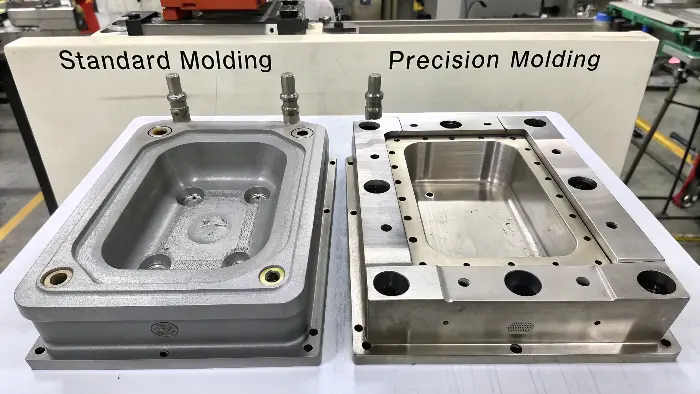
Compare value, not the word precision
Precision molding can reduce assembly variation, improve fit, control sealing, or protect a performance requirement. It can also increase tool inspection, machine requirements, measurement, validation, maintenance, and change-control costs. The decision should link each added control to a business or functional risk.
Build the total-cost model
Include mold design and steel, machining and inspection, inserts, machine capability, process development, gauges, sampling, scrap, rework, assembly, downtime, warranty, field failure, maintenance, and expected engineering changes. Compare the cost of tighter control with the expected cost of variation under standard molding.
Use a volume-sensitive model. A higher tool investment may be justified at one demand level but not at another; the crossover also depends on reject rate, cycle, cavity count, and the value of avoiding a failure.
A decision matrix for buyers
Score the requirement across function, tolerance stack, product risk, production volume, supplier capability, measurement access, and program maturity. If the product design is still changing, staged tooling or a targeted precision feature may be better than making the entire mold highly constrained.
What to ask in an RFQ
Ask which characteristics need precision, how the supplier will control them, what evidence will be supplied, what the measurement uncertainty is, how repairs are handled, and what changes trigger requalification. This exposes whether the premium is tied to a real control plan.
Frequently Asked Questions
Is precision molding always more expensive per part?
Not necessarily. It can cost more to qualify and tool, but it may reduce scrap, assembly, warranty, or failure costs when the added control solves a real risk.
How do I calculate the break-even point?
Compare incremental tooling and validation cost with expected savings in scrap, rework, assembly, downtime, warranty, and failure across realistic volume and reject-rate scenarios.
Should every feature be held to a precision tolerance?
Usually no. Apply tighter controls to functional critical characteristics and use practical tolerances elsewhere.
What if the design is still changing?
Use a staged review and avoid locking expensive precision features until the geometry, material, function, and tolerance stack are stable.
Related Cavity Mold Services
Engineering and DFM; Mold making; Plastic injection molding; Contact Cavity Mold.
For a drawing, resin, tolerance, finish, cavity-count, or process-window review, contact Cavity Mold.