
Evaluating injection molding problems starts with a controlled description of the defect and evidence from material, mold, machine, process, design, measurement, and handling. Changing several settings at once can make a temporary improvement while removing the evidence needed to find the cause.
Describe the problem precisely
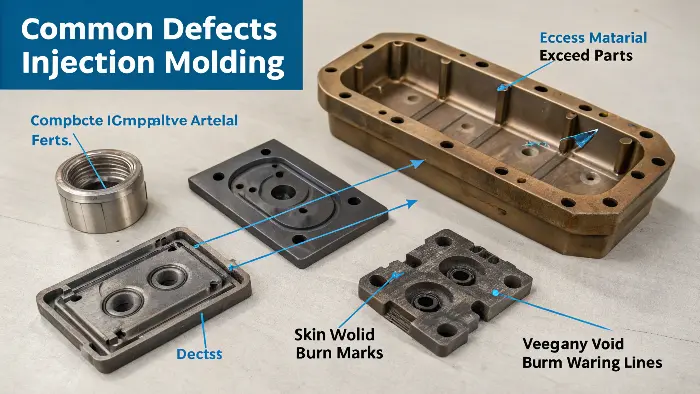
- Record defect type, location, cavity, part revision, severity, frequency, lot, shift, and time of onset.
- Separate appearance, dimension, fit, strength, leakage, and functional failures; they may have different causes.
- Contain suspect material and preserve good and bad samples, photographs, measurements, and machine records.
Check the process chain
- Verify resin identity, drying, storage, color, regrind, contamination, and lot traceability.
- Inspect gates, runners, vents, cooling, parting surfaces, ejectors, inserts, wear, and cavity balance.
- Confirm machine calibration, temperatures, pressure, speed, cushion, screw recovery, cycle, and alarms.
- Review wall thickness, flow length, draft, ribs, bosses, shrinkage assumptions, and tolerance allocation.
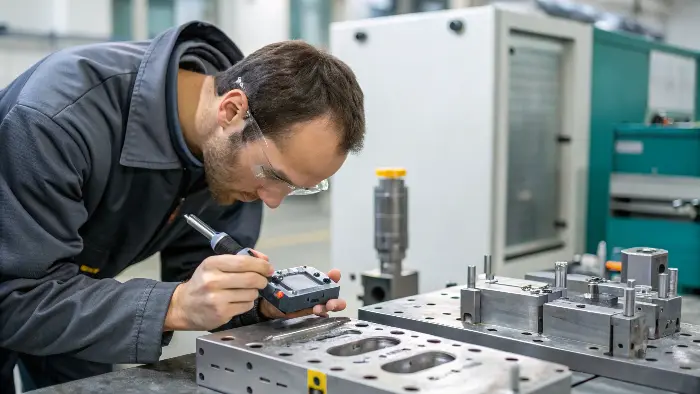
- Confirm gauges, datums, lighting, sampling, and measurement repeatability.
Correct with evidence
Use a controlled trial or DOE when variables interact. Change one factor where practical, record the result, confirm the correction over a stable run, and update the control plan. A diagnosis is complete only when the cause, correction, verification, and recurrence prevention are documented.
Plan the next step
Share your part, resin, annual volume, critical dimensions, finish, and timing with the Cavity Mold team through our contact page. We can review the manufacturing risks and recommend a practical next step.
Related Cavity Mold resources
- Plastic injection molding services
- Injection mold engineering services
- Injection mold making services
- Contact Cavity Mold
Technical references
- Protolabs injection molding defects guide
- Autodesk Moldflow flow-mark troubleshooting
- Protolabs injection molding quality control
Start with evidence, not a setting change
When a molded part is out of specification, the first useful question is not “which temperature should we change?” It is whether the signal is real, repeatable, and associated with material, mold, machine, process, measurement, or handling.
| Decision | What to check | Boundary |
|---|---|---|
| Confirm the symptom | Identify the CTQ, sample identity, cavity, time, lot, and measurement method. | Do not diagnose an unrepeatable or poorly measured symptom as a process fact. |
| Contain the risk | Separate accepted, suspect, and rejected material and preserve traceability. | Containment protects the customer while the cause remains open. |
| Classify the cause | Compare material, mold, machine, process, measurement, and handling evidence. | Keep multiple hypotheses until the data removes one. |
| Test the correction | Change a controlled input and verify the same CTQ again. | A temporary improvement is not a released corrective action. |
Four-step triage
- Write the symptom in measurable terms.
- Collect the current setup, material, mold, and inspection records.
- Rank hypotheses by evidence and risk.
- Verify the correction under the approved acceptance method.
Use engineering review when the cause crosses design and process boundaries, and keep the molding context attached to the evidence.