
Key takeaway: Polishing deep ribs and narrow slots requires access planning, draft, tool-mark control, edge protection, inspection, and realistic finish limits.
Plan access before steel is cut
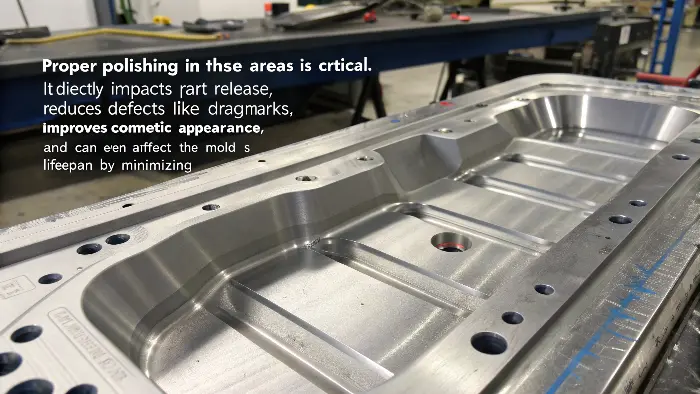
Deep ribs and narrow slots are difficult because the tool, abrasive, lighting, and inspection device may not reach the surface at a useful angle. Review draft, width-to-depth ratio, corner radii, EDM or milling strategy, parting, ejection, and the requested finish together.
If the geometry demands a finish that cannot be physically reached, the design needs a clear tradeoff: alter the feature, change the finish, add an insert, or accept a documented cosmetic limit.
- Map every polishing surface and tool direction.
- Provide enough draft and corner access for manufacturing.
- Identify areas that will need visual or tactile inspection.
Protect geometry while removing marks
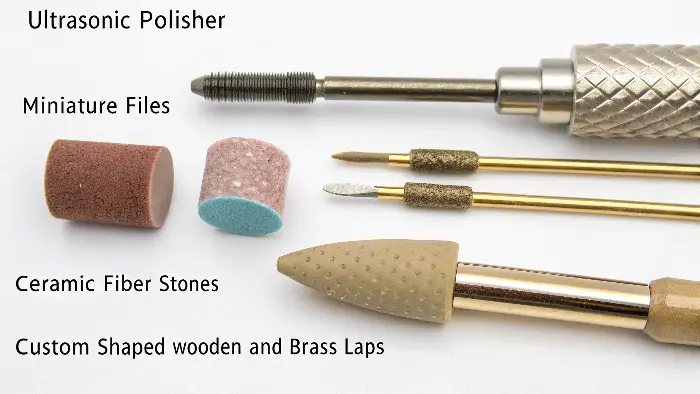
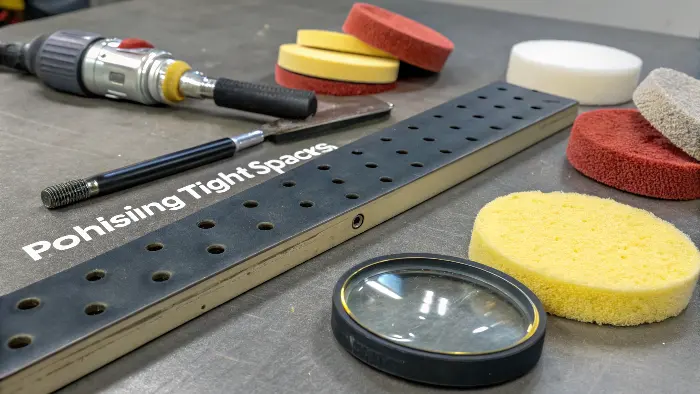
Use suitable tools and abrasives for the slot or rib, keep pressure controlled, and protect sharp edges, shutoffs, vents, and parting lines. Overworking a narrow feature can round the edge, change the gap, or create a release problem even when the surface looks brighter.
Progressive inspection is important because the operator has fewer opportunities to see the bottom of a deep feature. Use a reference sample and inspect after each stage that affects geometry or finish.
- Control abrasive size and contamination.
- Check edge condition and feature dimensions.
- Stop when the agreed finish or geometry limit is reached.
Validate release and appearance
Mold the actual resin and inspect the feature on the part. Deep ribs and slots can show drag, blush, trapped air, or texture differences that are not visible on the open steel. The validation record should state which surfaces meet the target and which have approved limits.
- Check ejection and draft-related scuffing.
- Compare cosmetic zones under consistent lighting.
- Tie any correction to a steel-safe and revision-controlled plan.
Frequently Asked Questions
Why are deep ribs hard to polish?
They restrict tool access, visibility, abrasive control, and inspection angle while increasing the risk of rounding or changing the feature.
Can a narrow slot always receive the same finish as a flat cavity?
No. The achievable finish depends on access, depth, draft, steel, geometry, and the inspection requirement.
What proves the feature is acceptable?
Representative molded parts should meet the agreed appearance, release, dimensions, and functional criteria for the specific feature.
Need a part-specific review? Share the 3D model, resin or grade, annual volume, finish requirement, tolerance concerns, and target launch date through our contact page. We can then align DFM, mold design, process, inspection, and delivery assumptions.
Sources and further reading
- Protolabs: Surface finishes and design access
- Autodesk: Mold surface classifications
- Protolabs: Complex molded features
Related Cavity Mold Services
For a connected review of design, tooling, molding, and launch requirements, see our engineering service, mold-making service, injection molding service, or contact our team.
Design access before specifying the finish
Deep ribs and narrow slots create a finishing problem before they create a polishing problem. Tool access, line of sight, abrasive size, edge protection, cleaning, and inspection must be designed together.
Feature-risk checklist
- Confirm the required surface on the rib face, slot wall, floor, radius, and shutoff separately.
- Check whether the tool can be held without damaging thin steel or edges.
- Define how abrasive debris, paste, and loose particles will be removed.
- Use a reference coupon, sample feature, or inspection method when direct viewing is limited.
Deep-feature workflow
- Mark the accessible and inaccessible surfaces.
- Select a finishing method that matches the smallest feature.
- Protect edges and functional shutoffs during the sequence.
- Inspect the tool and molded feature before final approval.
Discuss the geometry with engineering before the tool finishing scope is fixed.