
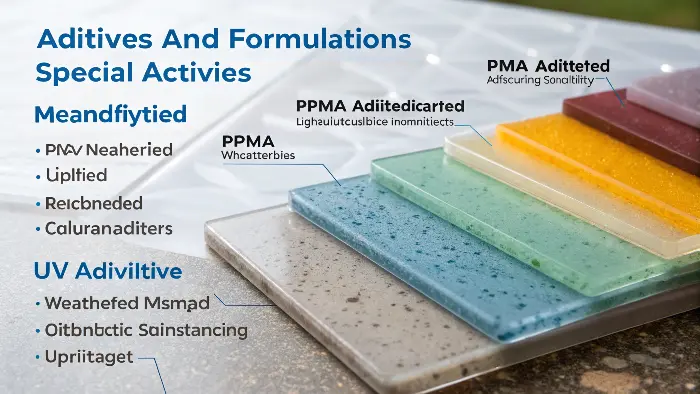
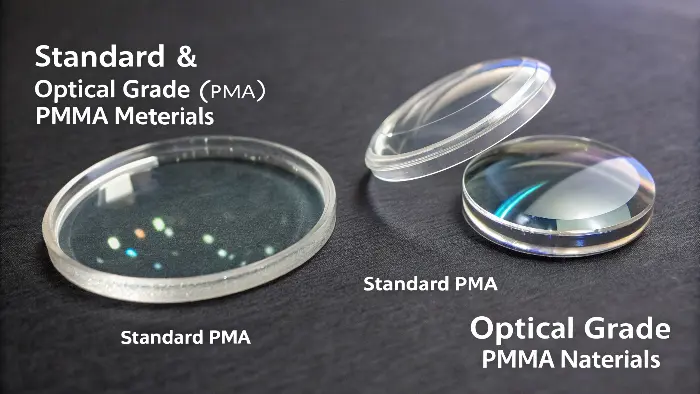
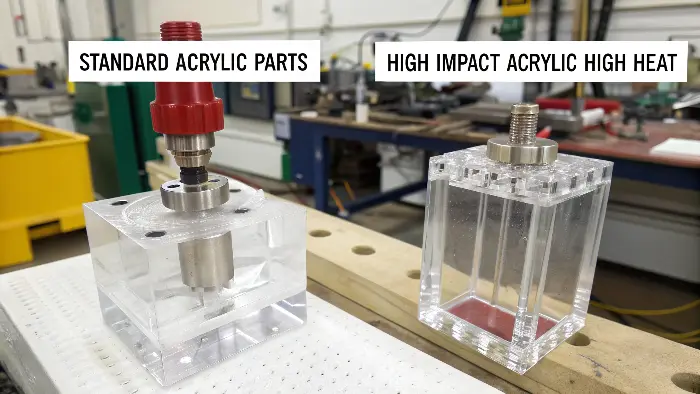
Selecting the right acrylic PMMA grade requires balancing flow, impact, heat resistance, UV and weathering, optical clarity, color, shrinkage, and regulations. The grade should be selected from the actual part and service conditions, not only from the word “acrylic” or a supplier’s general ranking.
Grade-selection checklist
- Define flow length, wall thickness, gate, cycle, and filling pressure requirements.
- Set impact, heat-deflection, chemical, UV, weathering, and service-life requirements.
- Specify transmission, haze, color, gloss, birefringence, and visible-surface limits for optical parts.
- Check shrinkage, moisture, drying, stress, creep, and dimensional stability.
- Confirm colorants, additives, recycled content, food or medical requirements, and supply traceability.
Validate the grade in the mold
Use the manufacturer’s data sheet and processing guide, then trial the exact grade, color, and lot in the production tool. Compare dimensions, appearance, stress, optical performance, assembly, and service tests. A higher-flow grade may help fill but change shrinkage, strength, heat behavior, or optical quality.
Control substitutions
Record the approved supplier, grade, color, lot, process window, tests, and requalification triggers. Treat “equivalent” material as a change until evidence proves otherwise.
Plan the next step
Share your part, resin, annual volume, critical dimensions, finish, and timing with the Cavity Mold team through our contact page. We can review the manufacturing risks and recommend a practical next step.
Related Cavity Mold resources
- Injection mold engineering services
- Plastic injection molding services
- Injection mold making services
- Contact Cavity Mold
Technical references
- ISO PMMA material designation standard
- Teknor Apex PMMA processing guide
- Autodesk PMMA materials and processing
Approve a grade with a documented sequence
Acrylic is not enough information for production. Ask for the exact PMMA grade, revision-controlled data sheet, processing guide, color or additive definition, and evidence connecting the material to service.
| Decision point | Check | Evidence or boundary |
|---|---|---|
| Flow and geometry | Define flow length, wall, gate, surface, optical zone, cycle, and dimensions. | Set the filling and appearance requirement. |
| Service | Screen heat, impact, UV, weathering, chemical, creep, and cleanliness. | Set grade approval and validation boundary. |
| Processing | Check shrinkage, moisture, drying, residence, and thermal limits. | Carry assumptions into the process plan. |
| Change control | Define substitute, additive, color, and supplier-notification rules. | Do not accept an unreviewed grade change. |
Grade approval sequence
- Collect exact grade data.
- Map each property to a part requirement.
- Approve the test sample and inspection method.
- Freeze the grade and substitute rule.
Review the grade with engineering and carry it into the supplier request.