
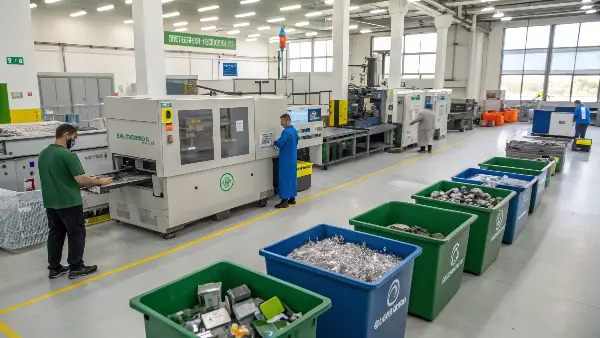
Designing injection-molded products for recyclability means considering material choice, component compatibility, separability, labeling, durability, and realistic end-of-life routes. A recyclable claim should describe a system that can collect, sort, process, and reuse the material, not only a resin symbol on the part.
Design rules that improve the chance of recovery
- Simplify material families: avoid unnecessary mixed polymers, incompatible overmolds, coatings, and additives that prevent sorting or reduce recovered quality.
- Plan separation: make clips, fasteners, inserts, labels, and elastomers removable where the product requires multiple materials.
- Use practical identification: specify resin, color, filler, and marking in a way that supports the intended sorting route.
- Protect durability: a part that lasts longer may avoid more material use and replacement, even when it is not immediately recyclable.
- Design the mold for stable quality: uniform walls, controlled cooling, and repeatable filling reduce scrap before the product reaches end of life.
Check the whole product system
Confirm whether the target market has collection and sorting for the selected polymer. Review disassembly time, contamination, pigment, barrier layers, adhesives, and the value of the recovered stream. For recycled content, define the allowable percentage and test moisture, melt flow, color, odor, mechanical performance, and regulatory requirements.
Make the claim evidence-based
Document the material specification, design assumptions, local recycling route, test results, and limitations. “Designed for recyclability” is more accurate than promising that every part will be recycled.
Plan the next step
Share your part, resin, annual volume, critical dimensions, finish, and timing with the Cavity Mold team through our contact page. We can review the manufacturing risks and recommend a practical next step.
Related Cavity Mold resources
- Injection mold engineering services
- Plastic injection molding services
- Injection mold making services
- Contact Cavity Mold
Technical references
Design the recovery route into the product: Designing injection-molded products for recyclability means making the material route easier to identify, separate, collect, and process without losing the product’s required function. The design review should cover the main resin, attachments, coatings, labels, color, additives, and how the part will actually be recovered.
Design choices that influence recovery
Designing injection-molded products for recyclability means making the material route easier to identify, separate, collect, and process without losing the product’s required function. The design review should cover the main resin, attachments, coatings, labels, color, additives, and how the part will actually be recovered.
A material and attachment review
| Decision area | What to examine | Evidence or output |
|---|---|---|
| Material architecture | Single-family construction or justified multi-material interfaces | Material map and separation rationale |
| Attachments | Fasteners, inserts, overmolds, labels, coatings, and adhesives | Disassembly or sorting assessment |
| Appearance and identification | Color, marking, additives, and clear material identification | Marking plan and material declaration |
| Performance | Strength, barrier, heat, chemical, and service requirements | Application test and end-of-life tradeoff |
Validate the intended route
- List every material, insert, coating, label, adhesive, and overmold in the part.
- Check whether the recovery route can identify and separate those components.
- Do not claim recyclability without defining the collection, sorting, and processing assumptions.
- Record where durability or safety requirements require a tradeoff and who approves it.
What to include in a recyclable-part brief
A design review should include part CAD, material map, assembly details, use environment, target market, recovery assumptions, and required performance tests. The engineering team can connect recyclability choices to tooling and production feasibility.