

The best injection molding material is the grade that meets the part’s function and environment while remaining moldable, inspectable, and economical at the planned volume. Start with loads, temperature, chemicals, moisture, appearance, dimensional stability, and service life. Only then compare resin families, fillers, additives, and supplier grades.
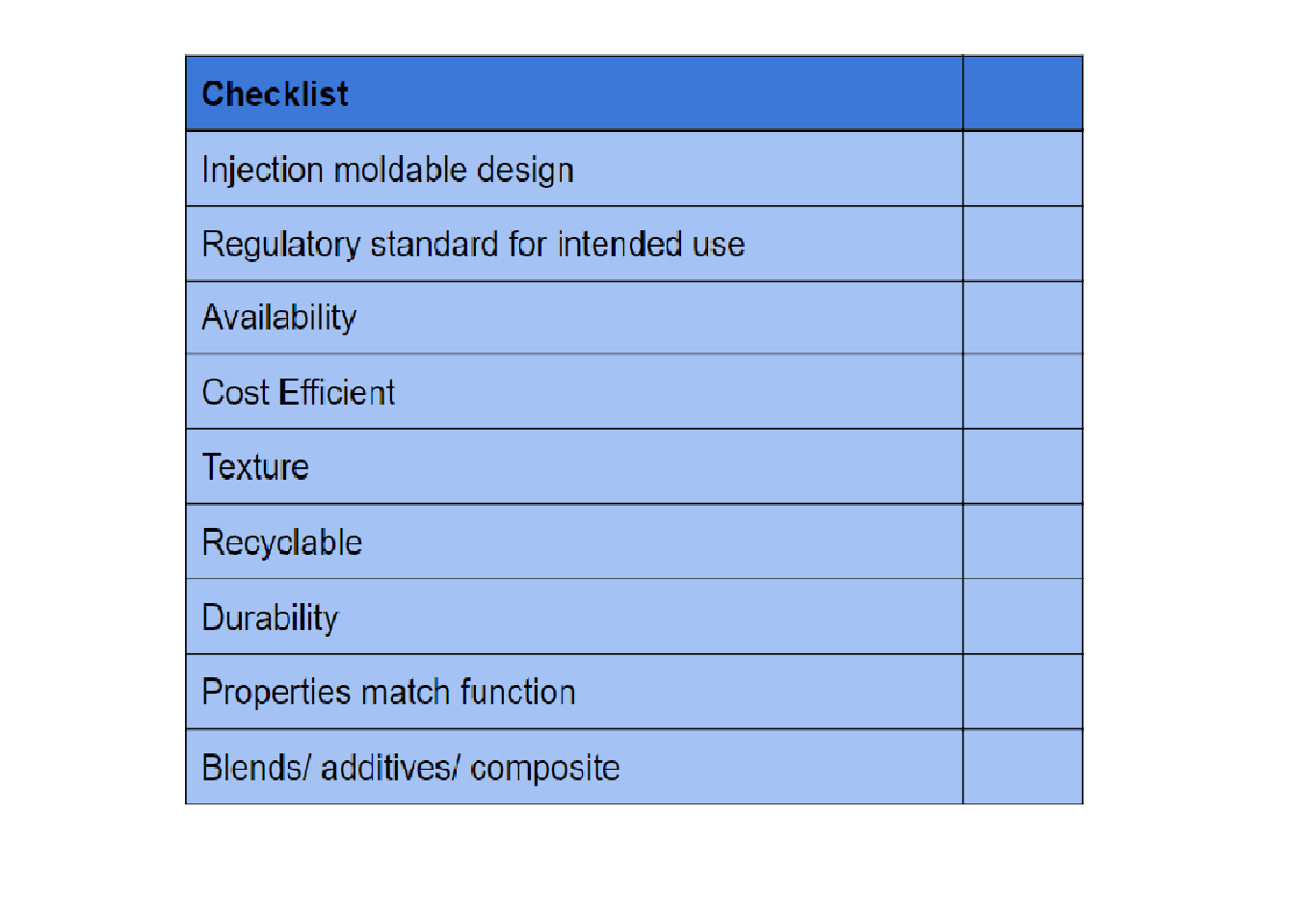
A practical material-selection sequence
- Define the job: load type, stress duration, impact, wear, fatigue, temperature, humidity, chemicals, UV, electrical exposure, and cleaning.
- Define the geometry: wall thickness, flow length, ribs, bosses, snap features, inserts, texture, transparency, and tolerances.
- Shortlist resin families: compare unfilled, reinforced, modified, and elastomer options without assuming a family name identifies a complete grade.
- Check processing: drying, melt and mold temperature, shear sensitivity, shrinkage, mold steel, cooling, ejection, and residence time.
- Test the shortlisted grades: use representative geometry and the relevant mechanical, dimensional, appearance, and environmental tests.
- Freeze the grade: document supplier, grade code, color, additive package, approved alternatives, and change-control rules.
The Protolabs thermoplastic material-selection guide emphasizes evaluating material data against loads, stresses, temperature, aging, and the actual design. It also warns that a mold is designed around the shrink behavior of a particular resin, so material changes after tooling are not automatically risk-free.
Quick comparison of common injection molding families
| Family | Often evaluated for | Design or process caution |
|---|---|---|
| ABS | Housings, trim, impact and appearance balance | Moisture, weld lines, surface finish, and chemical exposure depend on grade |
| PP | Low density, chemical resistance, living hinges, and cost-sensitive parts | Higher shrinkage and flexural behavior can affect fit and warpage |
| PC | Impact, temperature, and transparent structural components | Residual stress, drying, chemical sensitivity, and higher processing demand |
| PA or nylon | Wear, strength, temperature, and engineering components | Moisture absorption, conditioning, shrinkage, and fiber orientation |
| POM | Low-friction, wear, dimensional, and moving features | Grade-specific processing, venting, and thermal safety requirements |
| PMMA or clear grades | Appearance, transparency, and light transmission | Stress, brittleness, contamination, polish, and optical inspection |
| TPE or TPU | Flexibility, grip, seals, and soft-touch surfaces | Bonding, compression set, recovery, ejection, and material compatibility |
How material choice changes the mold
Resin choice affects gate size, runner strategy, cooling, venting, steel wear, draft, ejection, and cavity shrink compensation. Filled materials may increase abrasion and create flow-direction differences. Moisture-sensitive materials need reliable drying and storage. High-temperature grades may require different heaters, steel, machine capability, and maintenance. Soft materials may need more support during ejection.
Do not select a material only by unit price. Compare resin cost, cycle time, scrap risk, tool complexity, inspection, secondary operations, and field-failure risk. A more expensive grade can be the lower total-cost choice if it avoids redesign or unstable production, but that decision should be supported by requirements and testing.
RFQ material checklist
- Part function, load, temperature, chemical, moisture, UV, electrical, and service-life requirements.
- Exact grade, color, reinforcement, additives, approved alternatives, and supplier data sheet.
- Critical dimensions, appearance, transparency, texture, weld-line limits, and test method.
- Annual volume, batch size, cycle target, tool ownership, cavity count, and inspection plan.
For a part-specific decision, use Cavity Mold’s engineering review, injection molding service, and related TPE material guide. Contact the team with the CAD, requirements, candidate grades, and expected volume.
Turn requirements into a material test matrix
A resin shortlist is useful only when each selection criterion is tied to a product requirement and a verification route. Create rows for load, temperature, impact, wear, chemicals, moisture, UV, electrical behavior, appearance, dimensional stability, and customer constraints.
| Requirement | Material question | Verification |
|---|---|---|
| Load and fatigue | Does the grade retain performance over time and temperature? | Calculation plus representative testing |
| Dimensional interface | How do shrinkage, conditioning, filler, and cooling affect the datum? | Grade data, trials, and dimensional study |
| Processing fit | Can the resin be dried, filled, cooled, and ejected in the planned tool? | Supplier data and DFM/process review |
Record supplier, grade, color, additive package, alternatives, and change-control rule. Account for tool steel, drying, cycle, scrap, inspection, and field-risk implications. Use the engineering service to connect the shortlist to geometry, or the estimator for an early cost discussion.