
PA6, PA66, PA12, and PA1010: Choosing a Polyamide
Key takeaway: Choosing PA6, PA66, PA12, or PA1010 requires balancing moisture behavior, strength, heat, chemicals, toughness, dimensional stability, cost, and service conditions.
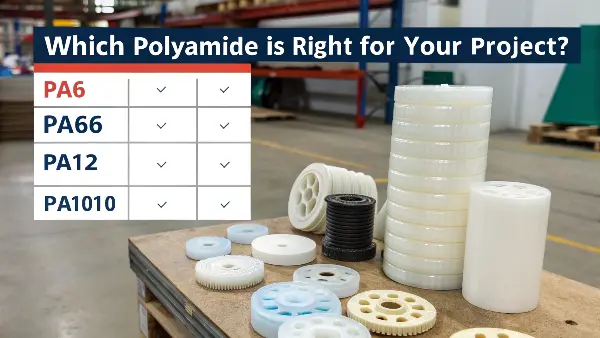
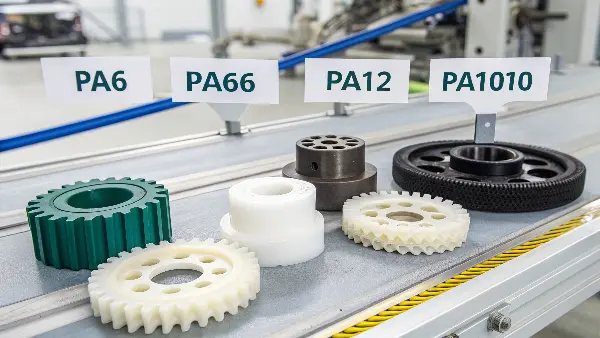

Choose from the service environment
PA6, PA66, PA12, and PA1010 are families with many grades, not four interchangeable specifications. Compare moisture exposure, temperature, load, impact, wear, chemicals, dimensional stability, electrical or regulatory needs, color, reinforcement, and cost over the actual service life.
BASF identifies PA6 and PA66 families within Ultramid, while Arkema describes PA12 as a material with lower moisture absorption than shorter-chain polyamides. Evonik’s VESTAMID Terra DS identifies PA1010 as a bio-based polyamide 1010. These references help frame the selection, but the exact grade datasheet and application approval remain decisive.
- Define dry, conditioned, hot, cold, chemical, and load conditions.
- Compare reinforced and unreinforced grades separately.
- Request the exact grade’s data sheet, processing guidance, and compliance documents.
Understand the practical tradeoffs
PA6 and PA66 can provide strong engineering performance, but moisture conditioning can change dimensions and mechanical behavior. PA12 is often considered when toughness, chemical resistance, and lower moisture sensitivity are important. PA1010 can be attractive where its specific property, sourcing, or bio-based content fits the design, but it still needs grade-specific validation.
Do not choose from a generic property table alone. Mold temperature, drying, gate, shrinkage, fiber orientation, wall thickness, and post-conditioning can change the part result.
- Make moisture conditioning part of dimensional validation.
- Review shrinkage and fiber orientation if reinforced.
- Test the actual grade in the actual geometry.
Lock the material decision with evidence
Create a material selection record linking requirements to grade, supplier, lot, drying or handling limits, mold and process settings, tests, and approvals. If the grade changes, recheck flow, shrinkage, dimensions, appearance, strength, and chemical or thermal performance before release.
- Use a controlled approved-material list.
- Keep certificates and lot traceability with production records.
- Define change-control and requalification triggers.
Frequently Asked Questions
Are PA6, PA66, PA12, and PA1010 interchangeable?
No. They differ in moisture behavior, thermal and mechanical performance, chemical resistance, toughness, shrinkage, processing, and grade availability.
Why is the exact grade important?
Reinforcement, additives, color, flame retardance, viscosity, and supplier formulation can change processing and part performance substantially.
What should be validated after a polyamide change?
Flow, drying, shrinkage, dimensions, conditioning, appearance, strength, chemical or thermal performance, and the applicable release documents.
Need a part-specific review? Share the 3D model, resin or grade, annual volume, finish requirement, tolerance concerns, and target launch date through our contact page. We can then align DFM, mold design, process, inspection, and delivery assumptions.
Sources and further reading
Related Cavity Mold Services
For a connected review of design, tooling, molding, and launch requirements, see our engineering service, mold-making service, injection molding service, or contact our team.