
Gate Design to Prevent Injection Molding Jetting
Key takeaway: Gate design can reduce injection molding jetting when it guides melt into stable wall contact while controlling speed, shear, temperature, and cosmetic placement.
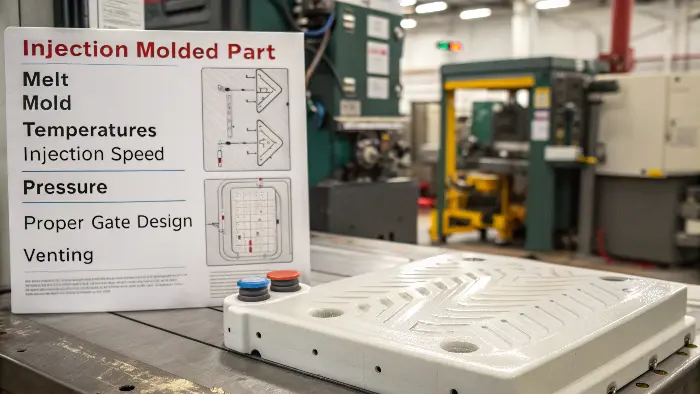

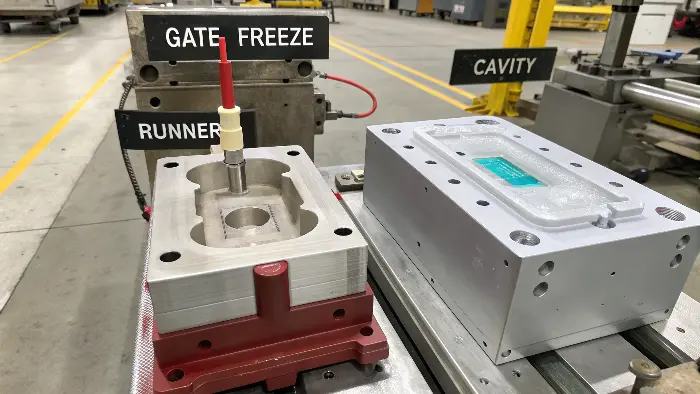
Choose the gate from the flow path
A gate should direct melt into a predictable path that supports filling, packing, weld-line placement, venting, appearance, and ejection. If the stream leaves the gate and travels through open space, it can form jetting before it contacts the cavity wall.
Review gate position and entry direction with the part’s cosmetic zones, wall changes, inserts, ribs, and end-of-fill areas. The best gate is a compromise between flow behavior and the practical requirements of vestige, tooling, and assembly.
- Aim for stable wall contact at the gate entry.
- Keep the first flow path away from sensitive cosmetic or sealing zones.
- Provide vents at the actual end-of-fill and air-trap locations.
Tune the process around the gate
Injection speed near the gate, melt and mold temperature, gate size, overlap or transition geometry, and packing strategy interact. A controlled speed profile can reduce an initial free jet, but slowing the entire fill can cause premature freeze or worsen a weld line. Use a small matrix of trials rather than one dramatic setting change.
Inspect gate vestige and shear-sensitive features after the trial. If process tuning does not create a useful window, return to the gate or flow-path design.
- Separate gate geometry trials from speed and temperature trials.
- Record cosmetic, dimensional, weight, and pressure results.
- Confirm the chosen gate can be manufactured and maintained.
Release a gate standard
Document gate type, location, dimensions, vestige limit, approved speed profile, temperature assumptions, inspection lighting, and reaction plan. This gives production and future mold corrections a stable reference and prevents the same jetting issue from returning after a setup change.
- Link the gate decision to the mold revision.
- Keep a good sample and a rejected sample for comparison.
- Review the gate after maintenance and material changes.
Frequently Asked Questions
How does a gate cause jetting?
A restrictive or poorly oriented gate can send melt into open space without stable mold-wall contact, creating a meandering flow mark.
Should the gate always be made larger?
Not necessarily. Gate size, location, type, vestige, shear, packing, cooling, and the material all need to be evaluated together.
What proves the gate solution works?
Repeat shots should meet cosmetic, dimensional, weight, fill balance, and cycle criteria over an approved process window.
Need a part-specific review? Share the 3D model, resin or grade, annual volume, finish requirement, tolerance concerns, and target launch date through our contact page. We can then align DFM, mold design, process, inspection, and delivery assumptions.
Sources and further reading
Related Cavity Mold Services
For a connected review of design, tooling, molding, and launch requirements, see our engineering service, mold-making service, injection molding service, or contact our team.