
Key takeaway: Automated injection mold polishing should be evaluated through repeatability, access, abrasive control, programming, inspection, labor, cycle, maintenance, and measured ROI.

Start with a repeatable polishing task
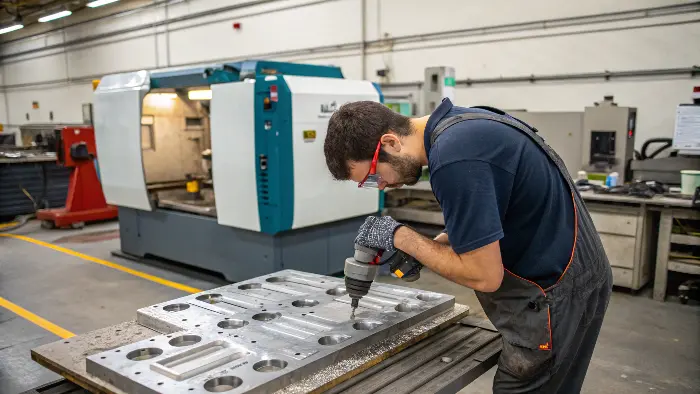
Automation is most promising when the surface, fixture, tool, path, material removal, and inspection requirement are stable enough to describe. Deep ribs, narrow slots, variable EDM condition, changing steel, and hand-correction zones can require more human judgment or a hybrid process.
ABB describes force control as a way to maintain controlled contact for grinding, polishing, and buffing; the RoboGrind research likewise combines perception, path planning, and force-controlled treatment. These capabilities do not remove the need for process engineering, fixturing, and final inspection.
- Define surface geometry, access, and allowable variation.
- Measure starting condition and target finish.
- Separate repeatable passes from expert correction work.
Build an evidence-based ROI model
Measure current labor hours, rework, abrasive consumption, setup and programming time, cycle, throughput, quality escapes, maintenance, fixture cost, training, integration, inspection, and the value of capacity released. Compare those actuals with automation capital, programming, tooling, safety, service, and downtime during launch.
Do not use a generic payback promise. Run a pilot on representative molds and measure finish consistency, edge preservation, access, cycle, abrasive wear, operator intervention, and molded-part result.
- Use baseline data from comparable molds.
- Include integration, inspection, maintenance, and downtime.
- Calculate low, base, and high utilization cases.
Implement with human oversight
A practical rollout usually starts with one well-defined surface family, a controlled fixture, a validated tool and abrasive set, and a clear stop or handoff rule. Operators still need to inspect the surface and the molded part, respond to tool wear, and approve changes to geometry or finish.
Release the cell through documented trials, safety review, calibration, inspection, preventive maintenance, and a change-control process. Automation is a production system, not just a robot purchase.
- Pilot before scaling to different geometries.
- Track force, speed, path, abrasive, and inspection data.
- Keep a qualified manual fallback for exceptions.
Frequently Asked Questions
What should be automated first?
Start with a repeatable surface family where geometry, fixturing, tool path, abrasive, and inspection requirements are stable and measurable.
How should ROI be calculated?
Use measured baseline labor, rework, consumables, cycle, quality, capacity, integration, inspection, maintenance, and utilization—not a generic payback claim.
Does automation remove the need for polishing expertise?
No. Process setup, exception handling, tool wear, geometry limits, and final mold and molded-part inspection still require skilled oversight.
Need a part-specific review? Share the 3D model, resin or grade, annual volume, finish requirement, tolerance concerns, and target launch date through our contact page. We can then align DFM, mold design, process, inspection, and delivery assumptions.
Sources and further reading
- ABB: RobotWare machining force control
- RoboGrind research: Robotic surface treatment
- Autodesk: Mold surface classifications
Related Cavity Mold Services
For a connected review of design, tooling, molding, and launch requirements, see our engineering service, mold-making service, injection molding service, or contact our team.
Prove the feature fit before the ROI
Automated polishing is most useful when the feature, abrasive path, fixturing, process window, and inspection method are repeatable. Start with the work that can be measured, not the headline labor saving.
| Decision | Evidence to review | Boundary |
|---|---|---|
| Benefit | Labor, cycle, repeatability, ergonomics, and data capture. | Use measured baseline values from the actual tool family. |
| Investment | Cell, fixturing, programming, training, maintenance, and integration. | Include commissioning and changeover, not only machine price. |
| Risk | Feature access, surface damage, debris, programming time, and fallback skill. | Keep a controlled manual route until evidence is stable. |
Automation-readiness questions
- Can the geometry be fixtured without masking the required surface?
- Can the toolpath control edges, shutoffs, radii, and local pressure?
- Can the process detect tool wear, abrasive change, and incomplete coverage?
- Can the output be inspected with the same acceptance method as manual work?
Implementation gates
- Select a representative tool family.
- Measure the manual baseline and variation.
- Pilot the automated path with inspection evidence.
- Scale only when the process boundary and fallback are clear.
Review the tool family with mold-making and use a scoped automation RFQ only after the pilot assumptions are known.