
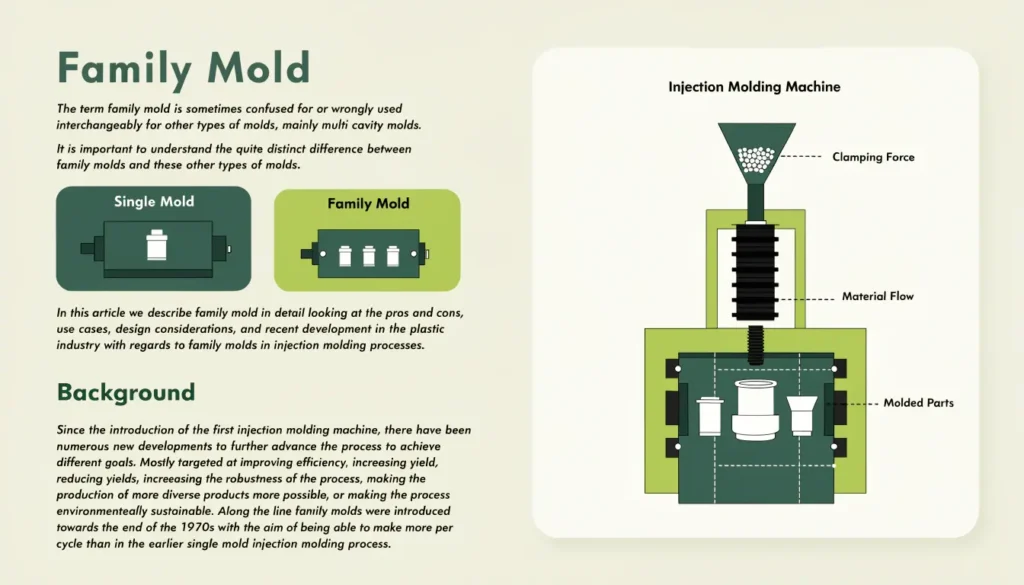
Since the introduction of the first injection molding machine, there have been numerous new developments to further advance the process to achieve different goals. Mostly targeted at improving efficiency, increasing yield, reducing cost, increasing the robustness of the process, making the production of more diverse products more possible, or making the process environmentally sustainable. Along the line family molds were introduced towards the end of the 1970s1 with the aim of being able to make more per cycle than in the earlier single mold injection molding process.
The term family mold is sometimes confused for or wrongly used interchangeably for other types of molds, mainly multi cavity molds. It is important to understand the quite distinct difference between family molds and these other types of molds. In this article we describe family mold in detail looking at the pros and cons, use cases, design considerations, and recent development in the plastic industry with regards to family molds in injection molding processes.
Family Molds Explained
In injection molding, (and sometimes in other molding processes like rotational molding), the term family mold refers to a mold system whereby more than one component type gets produced in a cycle. This is different from a multi cavity mold system where the multiple cavities simply replicate the same part and are intended to be identical. In the family mold technology, each mold cavity is dedicated to a different part design. It can therefore be said that the family mold is an advanced form of multicavity mold system.
The aim of the family mold system is to produce all the components of a product in one cycle on one production line rather than having different machines or running different cycles for different parts while changing the molds for each part. Although less common, it is possible that the family mold is made to produce different whole parts or different parts of different product pieces. As will be discussed further on in the article the family mold poses some advantages and also some disadvantages depending on the specific type of application.
Pros and Cons
The pros and cons are highlighted as follows. It should be noted that in discussing the pros and cons of family molds, we are comparing it with not just single cavity mold but also with multi cavity molds systems.
The following are the pros of using a family mold
Lower Mold Cost
For productions less than 50 000 parts, family molds save costs in product manufacturing over having dedicated molds for each part. This is for products that have two or more parts to be fitted together and cannot be made in a single mold cavity. The cost reduction comes from needing one mold maker to make one family mold rather than several different molds for each part. The family mold would be regarded as a single large project while making different mold would be several projects. The family mold would attach to one machine such that the mold maker’s work is focused on connecting the nozzle and parameters and that one machine to the one family mold rather than to several single molds.
Manufacturer Control
The manufacturer is able to produce all parts of the product on one machine. This is particularly advantageous for small scale manufacturers with lower staff numbers to handle multiple machines. Producing all parts in one machine using family molds simplifies the process in a sense.
Better Matching
The dimensions of a part can vary, albeit very slightly from one injection molding machine, or production run to another. This is due to factors such as anisotropic shrinkage, slight variation in raw materials properties at different storage parameters, slight variation in processing conditions (usually within the tolerance range) and other factors. For products where high precision is not a requirement like general consumer goods, these are often acceptable. However this slight change in dimension from one cycle to another might affect how parts of a product fit together. Running a family mold means all the parts are produced in the same run and there is less chance of having a mismatch of parts that are required to fit together.
The cons of using family molds may include the following
Part quality and uniformity issues
Because the molds cavities are not identical, this introduces filling inconsistencies as flow rate and pressure varies along varying wall thickness. For multicavity molds with identical mold cavities, the filling is more balanced compared to family molds. The variation in filling may lead to poor surface finish, dimensional inconsistency and related problems. The operator and mold designer therefore need to put more effort and skill into taking precautions to mitigate against this effect.
More Expensive for Larger Production
Where you are producing over 50,000 parts, then family molds is not the best option. In the case where a product is mass produced in large quantities, it is more cost effective to have dedicated injection molding machines or dedicated production cycles for each part. Here the economics of scale becomes an advantage that using family molds cannot beat.
Design limitation
Family molds often present limitations in the complexity of the part geometry. It is typically limited to simple parts for consumer products. For effective filling of molds, the cavities must be in alignment with each other. This also places limitations on factors such as gate positioning. Complicated features such as undercuts and bosses are to be avoided to prevent complicated ejection mechanisms. Single cavity molds and dedicated multiple cavity molds offer more design flexibility beyond what family molds can accommodate.
Design Considerations for Family Molds
The following are some of the factors mold designers put into consideration when designing family mods
- If using balanced runner system a 2% variation in pressure across all cavities
- For unbalanced runner system the different cavity volumes needs to be carefully compensated for, the runner gets wider for larger cavities and additional restrictions are used to reduce pressure for smaller cavities
- Cold runner systems with two plate designs pose less design challenges than hot runner three plate systems
- Sophisticated temperature control systems are often required for family molds. Different cavities have different cooling requirements as the geometry varies
- The different geometries and cavity sizes should be in line with the ejection system design
- Cycle times are ultimately determined by the last cavity to cool since all cavities will not cool at different rates
Common Use Cases where Family Molds Make Sense
Two Halves of Casings and Housings
Equipment casings, tool kit boxes, lunch boxes all mostly come in two halves that must be later assembled in such a way as to allow the product to open and close. While a post processing stage is still required to assemble, producing all parts for a piece in one cycle could make the production line more organized. It also improves the chance of better matches making the assembly process easier.
Parts of Toys
Dolls, toy cars, train sets and others are good candidates for family molds. While these do not require very high precision, it is however important that the parts fit well with little effort by the user. Therefore molding each set in a single cycle is ideal. This also makes it easier to change colors of different sets.
Medical Devices
Some medical devices such as surgical tools, protective gears and kits come in sets that have accompanying caps and fitting pieces. Molding these together in family molds is more efficient and could make better matches. It should be noted however that medical devices requiring high precision might require advanced molding techniques which may not be accommodated by family molds. Here we refer to family molds used in the manufacture of simple medical parts.
Prototype Production
Family molds are suitable for production of prototypes of a product that requires two or more parts to be molded. Rather than investing in different single cavities and multiple production cycles, all the parts for the prototype can be produced in one cycle on one machine. This makes it easier to make modifications to the product design. If only one part needs to be modified and remolded. The gates to the other parts can be closed off and the cycle repeated for just that one part where required. This is particularly useful where the raw material is relatively expensive.
Automotive Interior
Parts like storage compartments made of plastics comprise of two or more parts that fit together. Family molds can also be applied to insert molding or micromolding. Such diverse automotive parts of various sizes and even those requiring metal inserts can be achieved using family molds. Note that this is mainly for automotive interiors which do not require as much precision as high performance automotive parts like gears. As discussed earlier, standard family mold methods might not offer this level of precision.
Utensil Sets
It is common for utensils to be bought in sets. These can vary from those for personal household use or for restaurants and service industry. In one cycle a spoon, forks and knives are produced and each cycle means a full set completed. Down the line this makes packing, quality check and packaging easier to align.
Recent Advancements in Family Mold Technology
Initially injection molding processes using family molds were largely limited to products with simple designs and non complex features. WIth further advancement in technologies being implemented into injection molding processes, family molds could increasingly be applied for production of more sophisticated parts with high precision and even those with complex features.
Advancement in conformal cooling channels now means mold makers can go beyond straight cooling channels to designing more complex cooling channels offering better control over heat exchange. This is particularly significant for family molds having cavities with diverse geometry. These cooling channels can vary from spiral to zigzag to natural complex geometries. This is aided by the use of simulation software for predictive analysis and optimization of the heat transfer process.
For example Husky in recent years developed the Active Reasoning Technology also known as ART 2.0 . The AI platform provides the foundation for a family of mold controllers with capabilities including advanced temperature control systems, integrated smart machines and networking systems with data analysis, monitoring and optimization features for injection molding.
Conclusion
The benefits of family mold are best reaped in injection molding processes where production rate is relatively low. Less than 50,000 parts is typically recommended. For larger mass production injection molding processes it may be best to run different multi cavity molds for the different parts. This way the manufacturer still gets the advantage of having multiple mold cavities to speed up production per cycle but will simply have to manage the additional requirements to assemble parts from different production cycles or production lines.
By Ololade Olatunji
18th August, 2026
"Advanced Injection Molding Methods: Review – PMC", https://pmc.ncbi.nlm.nih.gov/articles/PMC10489002/. Historical accounts of injection molding technology development place the emergence of family mold configurations in the late 1970s as manufacturers sought to increase production efficiency by molding multiple part types in a single cycle. Evidence role: historical_context; source type: research. Supports: The approximate timeframe when family mold technology emerged in injection molding. Scope note: Exact dating of manufacturing innovations can be difficult to pinpoint, as adoption often occurred gradually across different industries and regions. ↩