
Are you struggling to keep up with the fast-changing PMMA market? Prices swing. Demand shifts. New rules appear. If you make or buy acrylic parts, one wrong guess can cost you money and time. I feel this pain too, and I want to help.
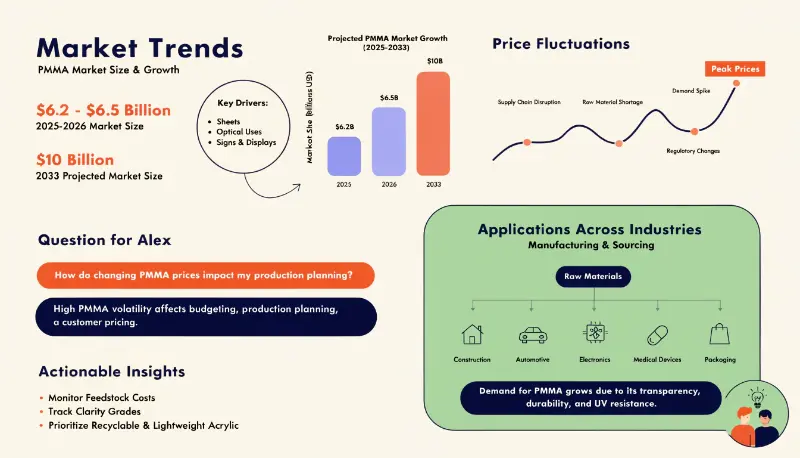
PMMA demand is growing fast. The market sits near $6.2–$6.5 billion in 2025–2026, and it may reach about $10 billion by 2033.1 Growth comes from sheets, optical uses, signs, and displays. Manufacturers should watch feedstock costs, clarity grades, and rising demand for recyclable, lightweight acrylic across many industries2.
I have spent years watching this material grow. PMMA is simple to explain but hard to master. Let me break down the big questions I hear most from project managers like Alex. Each answer will help you make smarter choices for your next mold project.
Is PMMA the same as plexiglass?
Do you get confused by all the names for this clear plastic? Acrylic, plexiglass, PMMA, Plexiglas. It feels like a puzzle. I hear this question almost every week, and the mix-up can lead to wrong orders and wasted budgets.
Yes, PMMA and plexiglass are the same family of material. PMMA is the scientific name, which stands for polymethyl methacrylate. Plexiglass is a common trade name for acrylic sheet. So when someone says plexiglass, they mean a PMMA product in sheet form. The material is the same.
Why so many names?
The confusion starts with branding. Companies gave their acrylic products catchy names. Over time, people used those names for all acrylic. It is like calling all tissues "Kleenex." The core material stays the same, but the label changes.
A simple name guide
Here is a table I use to explain it to my clients:
| Name | What it means | Where you hear it |
|---|---|---|
| PMMA | The chemical name | Labs, data sheets |
| Acrylic | The common material name | Factories, shops |
| Plexiglass | A generic trade name | Signs, glazing |
| Plexiglas | A registered brand | Product packaging |
For manufacturers, this matters a lot. When you order molds or sheets, you should know the grade, not just the name. A cheap "acrylic" and a premium "optical PMMA" can behave very differently. One may yellow fast. The other stays clear for years. I always tell buyers to ask for the exact grade and spec. That one step saves many headaches down the road.
What company makes Plexiglas?
Have you ever tried to source Plexiglas and hit a wall? You search the name, but the results confuse you. Different brands. Different sellers. You just want to know who really makes it. This gap wastes hours of your day.
Plexiglas is a registered brand made by Röhm GmbH, a German company. In North America, the Plexiglas brand is handled by Arkema-linked and Trinseo-linked operations over the years. Many other companies also make PMMA acrylic sheets under their own names, so you have many trusted suppliers to choose from worldwide.
The big players
Plexiglas started long ago in Germany. Röhm holds the name in many regions. But do not stop there. Many strong makers exist around the world. Here are the main ones I track:
| Company | Region | Known for |
|---|---|---|
| Röhm | Germany | Plexiglas brand |
| Trinseo | USA | Acrylic sheets |
| Mitsubishi Chemical | Japan | Shinkolite brand |
| Evonik (former parent) | Germany | High-grade PMMA |
| Local Asian makers | China, India | Fast-growing supply |
Why this matters for you
Asia-Pacific is now the fastest-growing region for PMMA. China and India build more capacity each year. This gives buyers more choice and better prices. But quality can vary. I always run a small test batch first. I check clarity, thickness, and surface finish. A trusted partner should share full data sheets. If a supplier hides the grade, that is a red flag. At CavityMold, I stress clear specs and honest sourcing. This keeps my clients safe from bad surprises and supply chain gaps.
Is PMMA stronger than glass?
Are you unsure if acrylic can replace glass in your product? You worry it may crack or scratch. Glass feels safe but heavy. Acrylic feels light but risky. This doubt stops many good design ideas before they start.
PMMA is not harder than glass, but it is much stronger against impact. Acrylic can be up to 10 to 17 times more impact-resistant than standard glass. It is also about half the weight. So PMMA breaks less easily, though it scratches more easily than glass. For many uses, this trade-off is worth it.
Strength is more than one number
People think "strong" means one thing. It does not. Glass wins on surface hardness. It resists scratches well. But glass shatters into sharp pieces. PMMA bends and absorbs shock. It rarely breaks into dangerous shards. This makes it safer in many settings.
Where acrylic wins
Here is how I compare them for clients:
| Feature | PMMA (Acrylic) | Glass |
|---|---|---|
| Impact resistance | Very high | Low |
| Weight | Light | Heavy |
| Scratch resistance | Lower | Higher |
| Clarity | Excellent | Excellent |
| Safety when broken | Safe | Dangerous |
| Shaping ease | Easy | Hard |
This is why cars, planes, and signs use more PMMA now. Lightweight and shatter-resistant grades open new doors. In automotive and aerospace, every gram counts. Acrylic cuts weight and boosts safety at the same time. I have seen clients switch from glass to PMMA and cut both cost and risk. The key is picking the right coating. A hard coat fixes the scratch weakness. Then you get the best of both worlds.
Is PMMA cheaper than polycarbonate?
Are you stuck choosing between acrylic and polycarbonate? Both look clear. Both seem strong. But the price gap confuses you. Pick wrong, and you overspend or under-build. I have made this call many times, and I know the stress.
Yes, PMMA is usually cheaper than polycarbonate. Acrylic costs less per sheet and shows better clarity and scratch resistance. Polycarbonate costs more but handles impact and heat much better. So the best choice depends on your need. For clarity and cost, pick PMMA. For extreme toughness, pick polycarbonate.
Cost is not the whole story
I never pick a material on price alone. I look at the full job. PMMA saves money up front. But if your part faces hard hits or high heat, polycarbonate may save money later. Fewer failures mean fewer returns.
My decision guide
Here is the simple chart I share with my team:
| Factor | PMMA | Polycarbonate |
|---|---|---|
| Price | Lower | Higher |
| Clarity | Best | Good |
| Impact strength | Good | Best |
| Heat resistance | Fair | High |
| Scratch resistance | Better | Worse |
| UV resistance | Excellent | Needs coating |
What buyers should watch
PMMA prices link to MMA monomer costs. This feedstock can swing with oil and supply shifts. Trade tariffs and global tension can also move prices. I watch these trends closely. I also track new PMMA composites and bio-based grades. These offer better strength and greener options. Sustainability pressure is real. Buyers now ask for recyclable material. So I advise clients to plan for both cost and future rules. A smart choice today keeps you strong for years.
Conclusion
PMMA and plexiglass are the same acrylic family, growing fast toward a $10 billion market by 2033. It beats glass on impact and weight. It beats polycarbonate on price and clarity. Watch feedstock costs, grades, and green trends. Pick the right partner, and choose spec over name.
"Polymethyl Methacrylate Market Size & Share Report, 2033", https://www.grandviewresearch.com/industry-analysis/polymethyl-methacrylate-pmma-industry. Market research firms track PMMA industry valuations and provide growth forecasts based on demand trends across automotive, construction, electronics, and signage sectors, though specific figures vary by methodology and regional scope. Evidence role: statistic; source type: research. Supports: current market valuation and future growth projections for the global PMMA market. Scope note: Market projections depend on assumptions about economic conditions, regulatory changes, and technological adoption rates that may shift over the forecast period. ↩
"Circular Economy | US EPA", https://www.epa.gov/circulareconomy. Automotive and construction sectors increasingly prioritize lightweight polymers for fuel efficiency and structural performance, while sustainability initiatives drive interest in polymer recycling technologies, though PMMA recycling infrastructure remains less developed than for commodity plastics like PET. Evidence role: general_support; source type: research. Supports: industry trends toward lightweight materials and circular economy principles in polymer applications. Scope note: The extent of recyclability demand varies significantly by region and industry segment, with technical and economic barriers still limiting widespread PMMA recycling adoption. ↩