
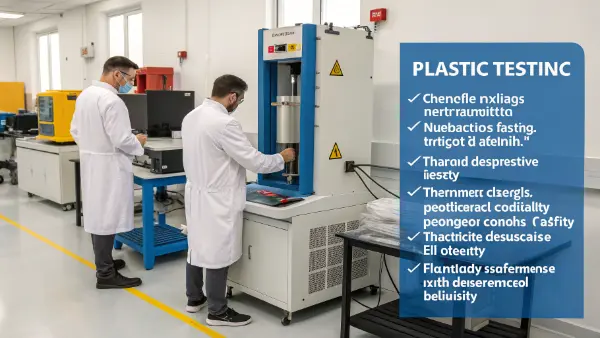
Bad plastic parts can ruin a whole project. If your plastic breaks or fails, you lose a lot of time and money. I will show you the best material testing methods to ensure plastic safety. This way, you can make safe and strong molds every time.
To ensure plastic safety in manufacturing, you must use a test program that covers mechanical performance, chemical safety, thermal behavior, flammability, and defect detection. Testing methods like tensile testing, thermal analysis, and non-destructive checks verify the material is safe. These tests prove the plastic is fit for its final use.
You might think testing plastic is too hard or takes too long. But if you skip it, your products might fail in the real world. Let us look closer at how to test plastic right. You will see how simple tests save you from big problems later. Keep reading to learn the exact steps we use.
What are the five types of material testing?
Picking the wrong test leaves hidden flaws in your parts. You might send bad parts to your customers. I know this fear. But you can fix this by knowing the five main types of material tests. This gives you total peace of mind.
The five main types of material testing for plastics are mechanical testing, chemical testing, thermal testing, flammability testing, and non-destructive testing. Mechanical tests check strength. Chemical tests check safety. Thermal tests check heat limits. Flammability tests check fire safety. Non-destructive tests find hidden flaws without breaking the part.
Breaking down the five core tests
Mechanical testing looks at how strong the plastic is. We use tensile testing to see if the plastic stretches or breaks. Impact tests show us if the plastic can take a sudden hit. We also do fatigue tests. Fatigue tests bend the plastic many times. This shows how it acts after a long time. Chemical testing is very important for safety. We check if the plastic reacts to bad chemicals. If the plastic touches food, we do migration tests. This makes sure no bad things go into the food.
Thermal testing looks at heat. We test how the plastic acts when it gets hot or cold. We want to know when it melts. Flammability testing is about fire. We need to know if the plastic will burn easily. UL 94 is a very common test for this. Non-destructive testing is cool. We find problems inside the plastic without breaking it. We use X-rays or sound waves. Let me show you a simple table.
| Test Type | What It Checks | Example Test |
|---|---|---|
| Mechanical | Strength and bending | Tensile testing |
| Chemical | Reactions and food safety | Migration test |
| Thermal | Melting and freezing | Heat resistance |
| Flammability | Fire safety | UL 94 test |
| Non-destructive | Hidden bad spots | X-ray scan |
At CavityMold, we use these five tests a lot. If you skip one, your plastic part might fail. For example, a plastic part might pass the strength test. But it might fail the heat test. When your customer uses it in a hot car, it melts. You also need density testing. This checks if the plastic is solid all the way through. You must use all five tests to be safe. It is the only way to be sure. It saves you from big headaches later. Every good project manager knows this rule. We follow it every single day to give you the best parts.
How do you test plastic materials?
Testing plastic at random times is a bad idea. If you only test at the end, you waste raw materials and money. I will show you a clear step-by-step way to test plastic. You will save time and catch problems early.
You test plastic materials by checking the incoming raw materials first. Next, you do checks while making the part. Finally, you validate the final finished part. You test its strength, heat limits, and chemical safety based on what the part will do. This workflow finds problems before you ship.
The three steps of testing plastic
Testing is not just one step. It is a full process. First, you must test the raw plastic beads. When the plastic arrives at your factory, you check it. You must make sure it is the exact right plastic. We call this incoming raw-material qualification. If the raw material is bad, the final part will always be bad. Second, you do in-process checks. This means you test the plastic while you make the part. You might weigh the parts. You might measure them with rulers. You catch mistakes right away. Third, you do final-part validation. This is when the part is fully done. We test the final part to make sure it is safe to use.
Choosing tests based on the part
You must choose the right tests for the right job. I have a simple rule for you. If the plastic holds heavy things, you must test its strength. You do tensile and impact tests. If the plastic touches food, you must test its chemical safety. You do migration tests. If the plastic goes near electricity, you must test for fire safety. You do flammability tests.
| Part Use | Main Focus | Top Tests |
|---|---|---|
| Structural | Strength | Tensile, Fatigue |
| Food Contact | Safety | Migration, NIAS |
| Electrical | Fire | Flammability |
I remember working on a big mold project last year. We made parts for a simple kitchen tool. We tested the plastic for food safety first. Then we tested it for heat. We knew it would go in a hot dishwasher. We caught a problem early and fixed it. We also check for gels and bad spots in the plastic. This process works every single time. It stops bad parts from leaving the building. You save money and time. You also keep your buyers very happy.
What is the ASTM standard for plastic?
Making up your own tests causes big arguments. Your customers will not trust your results. By using an official standard like ASTM, you prove your parts are safe. Everyone agrees on the rules, and you win trust.
An ASTM standard for plastic is a set of official rules for testing plastic materials. ASTM International makes these rules. For example, ASTM D882 is a standard for testing the strength of plastic films. Following these standards ensures that every factory tests plastic the exact same way.
Why we use ASTM rules
ASTM stands for American Society for Testing and Materials. It is a big group that makes rules for testing things. When we test plastic, we do not guess. We follow the official ASTM book. This is very important. If a buyer in Australia wants a strong part, I must prove it is strong. I tell them it passes the exact ASTM test. Then they know exactly what that means. There is no guessing. This builds strong trust between us and the buyer.
Common ASTM tests for plastics
Let us look at some common tests. One test is ASTM D882. We use this to test thin plastic films. We pull the film until it breaks. We record how much force it took. Another rule is not just ASTM. Some people use ISO rules. ISO 527-3 is like ASTM D882. They both check how plastic stretches and breaks. We also use Charpy and Izod tests. These tests check how the plastic takes a big hit.
| Standard Name | What It Tests | What It Tells Us |
|---|---|---|
| ASTM D882 | Thin plastic pulling | How strong the film is |
| UL 94 | Fire and burning | If the plastic stops burning |
| ISO 527 | Plastic pulling | Tensile strength |
When I talk to project managers like Alex, I always bring up these standards. They love it. It makes their job very easy. They can put the standard name in their weekly reports. It shows they did a great job. We use these rules every single day at CavityMold. It keeps the quality high and the buyers happy. You must use standards to play in the big leagues. It is the best way to prove your parts are safe and ready to sell.
What are the safety precautions in the plastic industry?
Unsafe factories hurt workers and ruin parts. If you ignore safety, machines break and people get hurt. I want to show you the top safety steps in plastic making. This keeps your factory running fast and safe.
Safety precautions in the plastic industry include testing for toxic chemicals, using non-destructive tests to find hidden cracks, and doing flammability tests to stop fires. Workers must wear safe gear. Factories must also check plastics for biocompatibility to ensure the final products do not harm people.
Keeping the parts and people safe
Safety in the plastic industry is about two main things. First, we keep the workers safe. Second, we keep the final users safe. We keep workers safe by wearing the right gear. We also keep the big machines clean. But testing also keeps everyone safe. We use flammability testing. This makes sure the plastic will not catch fire easily. A factory fire is very bad. A house fire from a bad plastic part is also very bad. We test early to stop these fires.
Finding hidden dangers
We must find problems before the part leaves the factory. This is why we use non-destructive testing. We call it NDT. NDT lets us look inside the plastic part. We use X-rays or sound waves. It is like a doctor looking at your bones. We can see tiny air bubbles inside the plastic. An air bubble makes the part very weak. If a part is weak, it can break and hurt someone.
| Safety Danger | How We Test It | Result |
|---|---|---|
| Hidden cracks | Ultrasonic sound test | We find the crack |
| Toxic chemicals | Chemical test | We stop the poison |
| Fire risk | Flammability test | We use safer plastic |
We also test for chemical safety. Some plastics touch human skin. Some touch our food. We do biocompatibility testing. This long word just means the plastic is safe for living things. We check if the plastic leaks bad chemicals. We also check how the sun hurts the plastic over time. We call this UV testing. At CavityMold, safety is always number one. We never skip these important tests. Safe plastic means happy customers and a very safe world for all of us.
Conclusion
Testing your plastic materials is the only way to ensure safety. You must use mechanical, thermal, and chemical tests. Follow official rules like ASTM. By doing this, you build safe and strong parts every time. Safe plastics protect your business and your customers.