
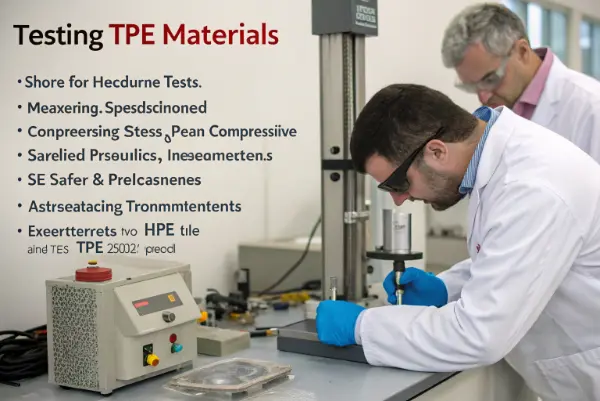
Do you worry about your plastic parts failing in the real world? Broken parts cause bad reviews and lost money. You must test your Thermoplastic Elastomer (TPE) materials properly before you start mass production. Let me show you how to test them the right way.
Testing TPE materials involves a mix of mechanical, thermal, and chemical checks to ensure they are safe and perform well. Common methods include hardness tests (Shore A or D), tensile strength, tear resistance, and compression set. Standard guidelines like ASTM D2240 or D412 guide these tests. These steps make sure your TPE parts stay flexible, strong, and safe during everyday use.
Knowing the right tests saves you time and stress. When I talk to project managers, they always ask which tests matter the most for their projects. Let us look at the main testing areas you need to understand to make better products.
Why Are Core Performance Tests Critical for TPE Materials?
Weak materials ruin good designs quickly. If your TPE is too soft or breaks easily, your project will fail. You need solid facts before you order expensive molds. Core performance tests give you those exact facts to make safe choices.
Core performance tests measure the physical strength of TPE. Hardness testing checks if the material is firm enough. Tensile and elongation tests show how far the TPE can stretch before breaking. Flexural tests check bend resistance. Tear resistance and compression set tests prove the material can handle damage and return to its original shape.
I remember a project a few years ago where we skipped a simple stretch test. The custom part broke during the final assembly. We lost weeks of time and a lot of money. Mechanical tests are the most basic checks you must do for every single project.
Hardness and Stretch Tests
We use Shore A or Shore D tests for hardness. Shore A is for softer rubbers like watch bands. Shore D is for harder plastics like wheels. This test tells you exactly how the material feels to a user. Tensile strength is about pulling power. We pull the TPE in a machine until it snaps. This shows how strong it is under stress. Elongation tells us how much it stretches before it fails.
Bending and Recovery Tests
Flexural testing checks how well the TPE bends. Will it crack after bending a hundred times? We need to know. Compression set is also vital for many parts. Imagine squeezing a rubber ball in your hand. When you let go, it should pop back to a round shape instantly. If it stays flat, it fails the compression set test. Tear resistance checks how easily a small cut will grow into a big rip.
| Test Name | What It Measures | Why It Matters |
|---|---|---|
| Hardness (Shore A/D) | Resistance to poking | Ensures the part feels right |
| Tensile Strength | Pulling force to break | Proves the part is strong |
| Compression Set | Bouncing back after squishing | Keeps seals from leaking |
| Flexural Test | Resistance to bending | Stops parts from cracking |
These core tests form the baseline of your material choice. At CavityMold, we always ask our clients to verify these numbers first. They keep your parts working longer and keep your customers happy. You should never guess when it comes to mechanical strength.
How Do Thermal and Chemical Tests Protect TPE Applications?
Heat and harsh chemicals destroy weak plastics fast. If your product melts in the hot sun or breaks down near oil, customers will return it. You must test how your TPE reacts to the local environment. Let us stop these expensive failures.
Thermal and chemical tests protect TPE by checking its limits. Thermal analysis, like DSC and TGA, finds the melting and breaking points. Chemical resistance tests show how TPE acts near oils or cleaners. Aging and weathering tests use UV light and heat to predict how long the material will last outside.
Heat is a big enemy to many types of plastics. I once saw a custom tool grip melt into a sticky mess just because it was left in a hot car during summer. That is why thermal testing is so important for long-term success.
Heat and Melting Tests
We use two big tests for heat. They are DSC and TGA. DSC stands for Differential Scanning Calorimetry. It sounds complex, but it simply tells us when the plastic starts to melt and soften. TGA stands for Thermogravimetric Analysis. It tells us when the plastic gets so hot that it breaks down and burns away. These tests make sure your part can survive in hot places like a car engine room or a hot kitchen.
Chemicals and Sun Damage
Chemical resistance is just as important as heat. Will the TPE touch soap, motor oil, or gas? We put the TPE in these liquids for days to see if it swells, shrinks, or cracks. Aging tests simulate weather over a long time. We use strong UV lights and hot ovens in a lab. This speeds up time. We can see what the plastic will look like after five years in the sun in just a few weeks.
| Environment Test | What It Does | Real World Use |
|---|---|---|
| DSC / TGA | Finds melting and burning points | Car parts near engines |
| Chemical Resistance | Soaks TPE in liquids | Tools used with oil |
| Weathering | Shines UV light on parts | Outdoor garden tools |
You must match the test to the real world. If your part stays inside a dark room, you might not need UV tests. But if it goes outside, you must test it. Knowing the chemical and heat limits saves you from angry phone calls from buyers.
What Safety and Compliance Checks Must TPE Materials Pass?
Unsafe materials can hurt people and cause huge legal trouble. If your TPE is toxic or dangerous, you cannot sell it anywhere. You need to follow strict international rules. Safety testing keeps you out of trouble and protects your brand.
TPE materials must pass safety checks to meet global rules. They must pass FDA tests for food contact or biocompatibility tests for medical use. They must follow RoHS and REACH rules to avoid toxic chemicals. Electrical conductivity tests are also used to make sure the TPE is safe near electronics.
Making a mold right is only half the job. The plastic must be completely safe for humans. We build many molds for medical devices and baby spoons. These parts touch human skin and mouths every day. Safety is the biggest priority here, and we take it very seriously.
Food and Medical Rules
If a part touches food or drinking water, it needs FDA approval. We test the material to make sure no bad chemicals leak into the food. The plastic must stay pure. For medical parts, we use strict biocompatibility tests. These tests prove the plastic will not cause a skin rash or make a patient sick. Medical rules are very tough, but they save lives.
Toxins and Electricity
Global rules like RoHS and REACH ban harmful heavy metals and bad chemicals. We must test the TPE in a lab to prove it is clean. If you sell in Europe, you must have these papers. Also, we must check how it handles electricity. Electrical conductivity tests check if the plastic can carry power. Sometimes we want it to carry power safely. Other times, we want it to block power to stop dangerous shocks.
| Compliance Type | Why We Need It | Typical Products |
|---|---|---|
| FDA Testing | Stops toxins in food | Spoons, water bottles |
| Biocompatibility | Protects human skin | Medical tubes, masks |
| RoHS / REACH | Bans bad chemicals | Consumer electronics |
| Electrical Tests | Manages electric shocks | Wire covers, plugs |
Do not ever guess on safety rules. Always ask your material supplier for official testing papers. A good partner will always share these records with you freely. This protects your company and ensures the end user is totally safe.
How Do You Apply a Practical Testing Approach to Real TPE Parts?
Lab tests on raw beads are good, but real life is very messy. If you only test raw material, the final product might still fail. You need a clear, step-by-step plan. Let us talk about testing actual finished parts from the mold.
A good testing plan starts with the raw TPE compound. Then, you must test the finished parts. Practical tests include impact resistance to check sudden shocks. Wear and abrasion tests check how well it handles friction. Adhesion tests check if the TPE sticks well to other plastics in overmolded parts.
Let me tell you a secret about plastics. A perfect material in a lab can still make a very bad part. The mold shape, the injection speed, and the cooling time change the plastic. You must test the final piece that comes out of the machine.
Dropping and Rubbing Tests
We use impact resistance tests on the real parts. We hit the part with a heavy weight or drop it from high up. This shows if it breaks under sudden forces like dropping a phone. Next, we use wear and abrasion tests. Imagine a thick shoe sole rubbing on rough ground. We rub the TPE many times on special paper to see how fast it wears away. This ensures the part will last a long time in real hands.
Sticking Parts Together
Many modern TPE parts are overmolded. This means the soft TPE is molded directly over a hard plastic part, like a soft grip on a drill. We must do peel or adhesion testing here. We try to rip the soft part off the hard part with a machine. If it peels too easily, the product is bad. We must fix the mold design or change the heat settings on the machine.
| Practical Test | Focus Area | Real World Example |
|---|---|---|
| Impact Resistance | Sudden drops | Phone cases falling |
| Abrasion Test | Constant rubbing | Tool handles, wheels |
| Adhesion Test | Sticking to other plastics | Soft grips on hard tools |
A smart project manager tests early and tests often. First, test the raw beads. Then, test the first sample parts from the mold. Finally, test those parts after they sit in heat or water. This full circle ensures total success and peace of mind.
Conclusion
Testing TPE materials ensures your products are safe, strong, and reliable. By using mechanical, thermal, chemical, and safety tests, you prevent costly failures. Start with raw materials and always test the finished parts. This complete process guarantees high-quality results every time for your business.