
Standard plastics often fail when you need quick, strong parts for your machines. This delays your projects and costs you a lot of money. Advanced PLA filaments solve this big problem by mixing easy printing with tough, industrial-grade strength for your daily factory needs.
Advanced PLA filaments are special mixes of regular Polylactic Acid combined with tough materials like carbon fiber, glass, or heat-resistant powders. They give you the easy printing of standard PLA but add high strength, heat resistance, and stiffness. These mixes are perfect for making strong industrial parts, quick test molds, and heavy-duty prototypes.
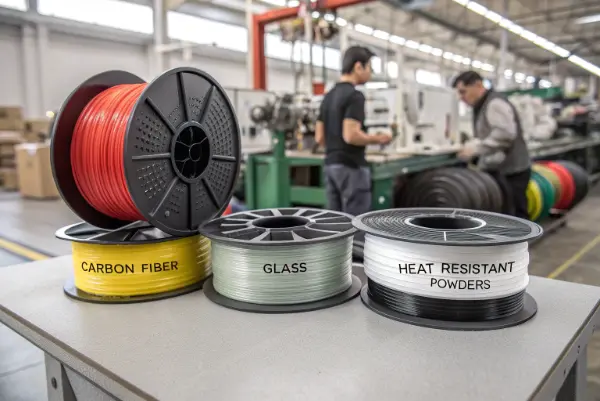
If you want to stop wasting time on weak prototypes and start making parts that actually work on the factory floor, keep reading. I am going to show you exactly how these special plastics can change your workflow today.
What makes advanced PLA filaments different from standard plastics?
Normal PLA melts easily and breaks under stress. This ruins your test parts and slows down your work. Advanced PLA fixes this by adding strong fibers and special chemicals to handle real factory work.
Advanced PLA is a base of regular PLA mixed with special additives to make it act like tough industrial plastics. Standard PLA is just for basic shapes and fun prints. Advanced PLA resists high heat, holds heavy weights, and bends less, making it ready for real factory testing.
The Secret Inside the Plastic
To understand why advanced PLA is so much better, we need to look at what is inside it. Regular PLA is a simple plastic made from plant sugars. It is great because it prints very easily. But it gets soft in the sun and snaps if you hit it hard. When I first started making test parts at CavityMold, I used regular PLA. It was a mistake. The parts broke too fast.
Then, chemists started adding things to the plastic. They mixed in tiny bits of other materials. This process changed everything. The new mixture kept the easy printing of the old plastic, but it gained super strength. You do not need to buy a $50,000 printer to use it. You can use your normal machines to print parts that feel like real factory items.
A Clear Difference in Factory Use
When you manage big projects, you need materials you can trust. You need to know that a bracket will hold a heavy load. Advanced PLA gives you that trust. It stops you from guessing if a part will work.
Here is a simple look at how standard PLA compares to advanced PLA in a real shop:
| Feature | Standard PLA | Advanced PLA |
|---|---|---|
| Ease of Printing | Very Easy | Easy |
| Strength | Low | Very High |
| Heat Resistance | Poor | Good to Excellent |
| Best Use | Display models | Machine parts, tool holders |
Using advanced PLA means you save time. You do not have to reprint broken parts. You just print it once, use it, and move on to your next big task.
How do carbon fiber reinforced PLA filaments improve part strength?
Weak parts snap when you try to test them. It is frustrating to print a big tool just to watch it break in your hands. Adding chopped carbon fiber into the PLA stops this by making the part super stiff.
Carbon fiber reinforced PLA mixes tiny pieces of carbon string into the plastic. These tiny strings act like the steel bars in concrete. They lock the plastic together so it does not bend or break under heavy pressure, giving you a part that is both light and incredibly strong.
Like Steel Bars in Concrete
Think about how builders make a strong floor. They pour wet concrete over a net of steel bars. The concrete is hard, but the steel stops it from cracking. Carbon fiber works exactly the same way in your plastic.
When the printer melts the PLA, the tiny black carbon strings flow into the shape. When the plastic cools, these strings lock together. They stop the part from bending. I have seen standard plastic brackets bend like rubber under heavy weights. But when we switched to carbon fiber PLA at CavityMold, the brackets held up like solid metal blocks.
Why Stiffness Matters for Tools
When you design tools for a factory, they must hold things perfectly still. If a tool bends even a little bit, the final product will be bad. Carbon fiber PLA is very stiff. It does not want to stretch.
But you must remember one thing. Because it is so stiff, it will not bounce back if you drop it really hard. It might chip instead. You trade flexibility for pure stiffness. For most machine jigs and holders, this is exactly what you want.
| Material Type | Does it Bend? | Does it break under weight? | Best For |
|---|---|---|---|
| Plain PLA | Yes, very easily | Yes, quickly | Simple checks |
| Carbon PLA | No, very stiff | No, holds heavy loads | Factory tools |
| Rubber Plastic | Yes, it bounces | No | Grips and tires |
This mix of light weight and high stiffness makes carbon fiber PLA one of the best choices for testing your new designs quickly.
Can high-temperature PLA replace traditional industrial materials?
Parts sitting near hot machines often warp and fail. You lose time trying to use expensive plastics that are hard to print just to handle the heat. High-temperature PLA lets you print parts that stay solid even when things get hot.
High-temperature PLA, or HT-PLA, can handle heat much better than normal PLA after it is baked in an oven. This baking process changes the plastic so it does not melt under normal machine heat. Yes, it can replace many traditional plastics for hot tools and engine test parts.
The Magic of Baking Plastic
Normal PLA gets soft if you leave it in a hot car. You cannot use it near a warm motor. But HT-PLA has a special trick. After you print your part, you put it in an oven for a little while. This is called annealing.
When the plastic heats up in the oven, the tiny bits inside it line up perfectly. They pack together tightly. When it cools down, it is much harder to melt again. I remember testing an unbaked PLA part near a mold heater. It turned to mush in five minutes. We baked the next part, and it sat near the heater all day without losing its shape.
Replacing Hard-to-Print Plastics
For a long time, if you wanted a part to survive heat, you had to use hard plastics like ABS or Nylon. These plastics smell bad when they print. They also warp and lift off the printer bed. They cause a lot of headaches for project managers.
HT-PLA prints as easily as plain PLA. It does not smell. It stays flat on the bed. Once you bake it, it matches the heat resistance of those hard-to-print plastics. This saves you so much time and stops you from throwing away bad prints.
| Plastic Type | Print Difficulty | Needs Baking? | Heat Resistance |
|---|---|---|---|
| Standard PLA | Easy | No | Low (Soft at 60°C) |
| ABS Plastic | Hard (Warps) | No | High (Soft at 100°C) |
| Baked HT-PLA | Easy | Yes | High (Soft at 100°C+) |
By using HT-PLA, you keep your printing simple while getting the tough, hot-weather parts your factory needs.
What are the best practices for printing specialty PLA formulations?
Printing special plastics often leads to jammed nozzles and failed prints. Wasting expensive material hurts your project budget. Using the right settings and strong printer parts will keep your printing smooth and clean every time.
To print specialty PLA, you must use a hardened steel nozzle because materials like carbon fiber will ruin soft brass nozzles quickly. You also need to dry the filament in a heat box before printing, slow down your print speed, and use slightly higher heat for strong layers.
You Need Tough Tools for Tough Plastic
Standard 3D printers come with a nozzle made of brass. Brass is a very soft metal. If you push carbon fiber or glass through a brass nozzle, the fibers act like sandpaper. They scratch the inside of the hole. Within a few hours, the hole gets too big, and your print looks terrible.
You must change that nozzle to hardened steel. A steel nozzle does not scratch easily. It will last a very long time. When we first used glass-filled PLA at CavityMold, we ruined a brass nozzle in one day. We switched to steel, and we have not changed it in months.
Keeping the Plastic Dry and Slow
Specialty PLA loves to pull water out of the air. If the plastic gets wet, it boils inside the hot nozzle. This makes tiny bubbles in your part. The part will look ugly and break easily. Always put your filament in a drying box before you use it.
You also need to slow down. Special plastics are thicker than normal PLA. If you try to print too fast, the printer will skip and leave holes in your part.
| Setting / Tool | Standard PLA | Carbon/Special PLA | Reason |
|---|---|---|---|
| Nozzle Metal | Brass | Hardened Steel | Stops scratching and wear |
| Plastic State | Normal | Very Dry | Stops bubbles and popping |
| Print Speed | Fast | Slow | Helps thick plastic flow |
| Heat Setting | Low | High | Melts the fibers together |
If you follow these simple steps, you will get perfect parts every single time you press the print button.
How does advanced PLA fit into rapid prototyping and mold making?
Making real metal molds right away is too slow and costs too much. If your first design is wrong, you lose thousands of dollars. Using advanced PLA lets you print a cheap, strong mold to test your ideas first.
Advanced PLA fits into mold making by acting as a fast, cheap substitute for metal during early tests. You can print a tough mold insert in a few hours, use it to form test products, and check your design before paying for a real, expensive metal mold.
The High Cost of Mistakes
In the injection mold business, time is money. Metal molds take weeks to cut on big machines. They cost a lot of money. If you make a mistake in your design, you have to throw the metal away and start over. This is a nightmare for any project manager.
At CavityMold, we like to test things first. We take our advanced PLA and print a small version of the mold. Because advanced PLA is strong and handles heat well, we can actually shoot soft plastics or resins right into it. We make five or ten real test parts.
A Smart Way to Build
This method changes how you manage your projects. You can print a new mold in one day. You test the parts the next day. If the part is bad, you change the drawing on your computer and print a new mold. You only spend a few dollars on plastic instead of thousands on metal.
Once the printed mold makes a perfect part, you finally pay for the real metal mold. You know the metal mold will work on the first try.
| Step | Using Metal Molds First | Using PLA Molds First |
|---|---|---|
| Time to Test | 3 to 6 weeks | 1 to 2 days |
| Cost to Change | Thousands of dollars | Less than ten dollars |
| Risk of Failure | Very High | Very Low |
| Final Result | Might need rework | Perfect metal mold |
Using advanced PLA for your early testing makes your job less stressful. It protects your budget and helps you deliver great products on time.
Conclusion
Advanced PLA filaments give you a smart way to build strong, heat-resistant parts without the hassle of hard-to-print plastics. By using these special mixes, you can test your designs quickly, save money on early molds, and keep your factory projects running smoothly every day.