
Choosing the right plastic molding process can feel overwhelming. You have a great product design, but turning it into a physical part involves navigating a sea of manufacturing options. Picking the wrong one can lead to costly delays, poor quality, and wasted resources, putting your entire project at risk.
There is no single definitive number, but dozens of plastic molding processes exist, each tailored for specific applications. The most common and widely used types include injection molding, blow molding, extrusion molding, compression molding, and rotational molding. The best process for your project depends on your part’s complexity, material, production volume, and budget.
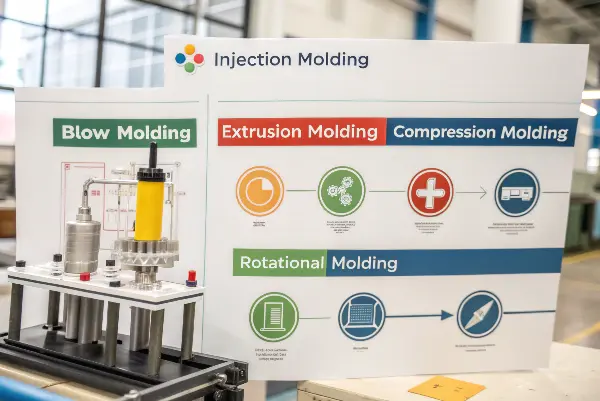
Getting a handle on these different methods is the first step toward making a smart decision for your project. As a project manager myself for over a decade, I’ve seen firsthand how a solid understanding of the basics can make or break a production run. It’s not about memorizing every single process, but about knowing the key players and what they’re good for. This knowledge empowers you to ask the right questions and work effectively with your manufacturing partner. Let’s break down the main categories to give you a clear map of the plastic molding landscape.
What are the main methods for processing plastic?
Struggling to match your project needs with the right plastic processing method? The sheer number of options can be confusing, and a mismatch can compromise your product’s integrity and budget. You need a clear, straightforward guide to the most effective techniques available in the industry today.
The five most prevalent methods for processing plastic are injection molding, extrusion, blow molding, rotational molding, and thermoforming. Each method offers unique advantages. For example, injection molding is ideal for high-volume, complex parts, while extrusion is perfect for creating continuous profiles like pipes and tubing. Understanding these core methods is crucial for efficient manufacturing.
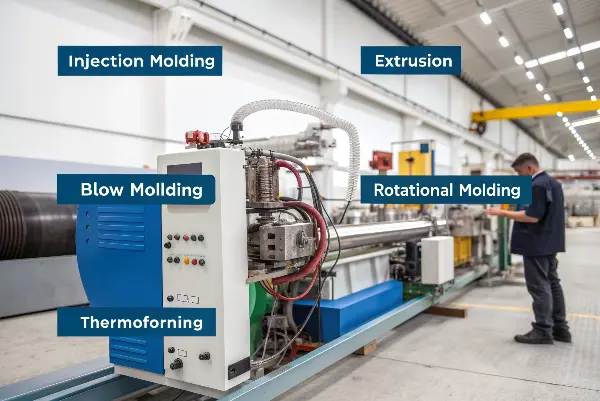
To make the best choice, you need to look closer at how each process works. It’s about understanding the mechanics behind turning raw plastic pellets into a finished product. I remember a project involving a consumer electronics housing. We initially considered thermoforming for its lower tooling cost, but after analyzing the part’s complex geometry and the required high-volume output, we knew injection molding was the only way to go. That decision saved us from major quality issues down the line. Let’s explore the key differences.
Injection Molding
This is the workhorse of the plastic industry. It involves injecting molten plastic into a custom-made mold (like the ones we specialize in at CavityMold) under high pressure. It’s perfect for creating intricate, detailed parts with high precision.
- Best for: High-volume production, complex geometries.
- Common Products: Car parts, electronic housings, medical devices, bottle caps.
Extrusion Molding
Think of this process like squeezing toothpaste from a tube. Molten plastic is pushed through a die to create a continuous shape.
- Best for: Continuous, long parts with a consistent cross-section.
- Common Products: Pipes, window frames, plastic sheeting, wire insulation.
Blow Molding
This process is used to create hollow plastic parts. It starts with a heated plastic tube, which is then placed in a mold and inflated with air, pushing the plastic against the mold walls.
- Best for: Hollow, thin-walled containers.
- Common Products: Bottles, tanks, and other containers.
| Process | Best for Volume | Part Complexity | Tooling Cost |
|---|---|---|---|
| Injection Molding | High | High | High |
| Extrusion | High | Low | Low-Medium |
| Blow Molding | High | Medium (Hollow) | Medium |
| Rotational Molding | Low-Medium | High (Hollow) | Low |
| Thermoforming | Medium-High | Low | Low |
What are the typical steps in a molding process?
You’ve chosen a molding method, but what happens next? The journey from a digital file to a physical part can seem like a black box, full of technical steps and potential pitfalls. Without a clear understanding of the workflow, it’s easy to lose track and miss critical deadlines.
A typical plastic molding process follows a clear sequence: design, mold creation, material selection, setup, and production. It begins with finalizing the part design (CAD), then manufacturing the mold (tooling). Once the mold is ready, the machine is set up with the chosen plastic material, and the production cycle of melting, injecting, cooling, and ejecting begins.
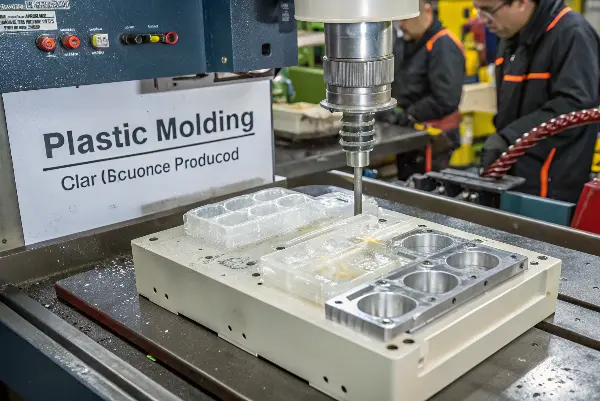
Each of these steps is a project in itself, with its own set of challenges and considerations. I’ve learned that overlooking any single stage can have a domino effect on the entire production timeline. For instance, on a project for a medical device, we spent an extra week refining the mold design to improve the cooling channels. This small delay upfront felt frustrating, but it ended up cutting the cycle time by 15%, saving the client a significant amount of money over the full production run. It’s a classic case of "measure twice, cut once." Let’s walk through the typical stages you’ll encounter.
The Five Core Stages
Part Design & Prototyping: This is where it all starts. Your CAD model is finalized. Key considerations here are draft angles, wall thickness, and material flow. Prototyping, often using 3D printing or CNC machining, helps validate the design before committing to expensive tooling.
Mold (Tooling) Design & Manufacturing: This is our specialty at CavityMold. Based on the final part design, engineers create a detailed mold design. This mold, usually made from steel or aluminum, is then precision-machined. This is the most time-consuming and costly phase, but a well-made mold is the foundation of a successful product.
Material Selection & Preparation: The right plastic resin is chosen based on the product’s requirements—strength, flexibility, temperature resistance, etc. The plastic, usually in pellet form, is then dried to the correct moisture level to prevent defects during molding.
Machine Setup & Calibration: The finished mold is installed in the molding machine. The machine parameters—temperature, pressure, injection speed, and cooling time—are carefully calibrated for the specific material and part. This "dialing in" process is critical for achieving consistent quality.
Production & Quality Control: The automated cycle begins. Plastic is melted, injected, cooled, and the finished part is ejected. Throughout the run, parts are regularly inspected to ensure they meet the required specifications and quality standards. Minor adjustments to the machine settings might be needed to maintain consistency.
Can we group molding into three main types?
Trying to remember dozens of molding processes is impractical. You need a simpler way to categorize them to make quick, high-level decisions. Is there a straightforward way to group these methods into a few main categories that are easy to understand and apply to your projects?
Yes, you can broadly group plastic molding into three main types based on the material’s behavior and the process mechanics: injection molding, extrusion molding, and compression molding. This simplification helps distinguish between processes for creating complex solid parts (injection), continuous profiles (extrusion), and strong, simple shapes from thermoset materials (compression).
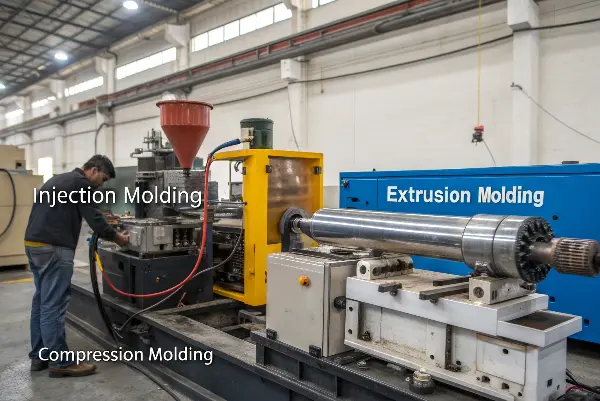
While this simplification is helpful, it’s important to remember that it doesn’t cover everything. Processes like blow molding and rotational molding are major players but fall outside this simple three-part structure. I often use this "big three" classification as a starting point in conversations with clients. It helps frame the discussion. For example, when a client asks for a durable, solid part with complex features, my mind immediately goes to injection molding. If they need a long, simple seal, I think of extrusion. Let’s break down these three foundational categories.
The "Big Three" Explained
This grouping provides a solid framework for understanding the landscape. Each represents a fundamentally different way of shaping plastic.
Injection Molding:
This process is defined by injecting molten material into a closed cavity. It’s the go-to for high-volume, high-precision parts. Its strength is its ability to produce incredibly complex geometries with tight tolerances, making it dominant in the automotive, electronics, and medical industries. The key limitation is the high upfront cost of the mold.Extrusion Molding:
This process is defined by pushing molten material through a shaped die. It’s a continuous process, ideal for products with a consistent profile. Think of pipes, tubing, and window frames. It’s highly efficient for the right kind of product, but it can’t create standalone, complex shapes like injection molding can.Compression Molding:
This process involves placing a pre-measured amount of molding material into a heated mold cavity and then compressing it into shape. It’s one of the oldest molding techniques and is most often used with thermoset plastics, which undergo a chemical change to harden permanently. It’s excellent for producing strong, flat, or moderately curved parts.
| Feature | Injection Molding | Extrusion Molding | Compression Molding |
|---|---|---|---|
| Action | Injecting | Pushing | Compressing |
| Material State | Molten liquid | Molten liquid | Pre-heated solid/putty |
| Process Type | Discontinuous (per part) | Continuous | Discontinuous (per part) |
| Typical Part | Complex 3D parts | Long 2D profiles | Simple, robust parts |
| Common Material | Thermoplastics | Thermoplastics | Thermosets |
Conclusion
Understanding the different plastic molding processes is key to successful manufacturing. From injection and extrusion to blow molding, each method has unique strengths. Knowing the basic types and their typical steps empowers you to make informed decisions, ensuring your final product is both high-quality and cost-effective.