
Struggling to choose the right plastic for a high-stress application? The wrong choice can lead to failed parts, costly recalls, and a damaged reputation. We can help you navigate the options to find the perfect material that delivers the strength and durability your project demands.
The strongest injection molded plastic depends on the type of strength required. For overall tensile strength, PEEK (Polyether Ether Ketone) is often the top choice, with values exceeding 100 MPa. For impact strength, Polycarbonate (PC) is exceptional. High-performance materials like Ultem (PEI) also offer a great balance of strength, stiffness, and heat resistance, making them ideal for demanding engineering applications.
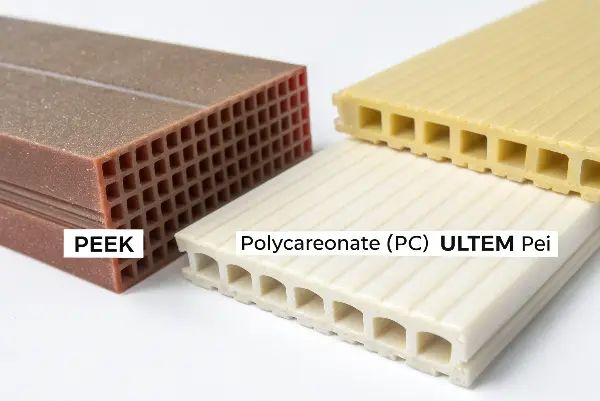
So, we know there isn’t one single "strongest" plastic, but a group of high-performers. It really comes down to what you mean by "strong." Let’s break down the different types of strength and look at the best materials for each specific need. You’ll be surprised how the right choice can transform your product’s performance.
Which plastic has the highest strength?
Choosing a material based on "strength" can feel like a shot in the dark. You see a high number on a data sheet but wonder if it translates to real-world performance. This uncertainty can lead to over-engineering and high costs, or worse, a part that fails under pressure.
When engineers refer to the highest strength, they often mean tensile strength—a material’s ability to resist being pulled apart. In this category, high-performance polymers like PEEK (Polyether Ether Ketone) and Ultem (PEI) are leaders. Glass or carbon fiber-filled versions of these plastics can achieve tensile strengths comparable to some metals, making them exceptional choices for the most demanding applications.
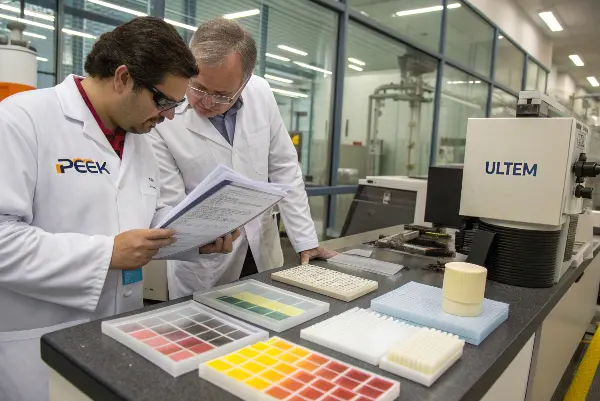
To really understand which plastic has the highest strength, we need to look at specific metrics. I always tell my clients, like Alex, a project manager I’ve worked with, to start with the application’s primary stress. Is the part being pulled, bent, or hit? This distinction is critical.
Understanding Strength Metrics
The main measurement for a plastic’s ability to withstand a pulling force is its ultimate tensile strength. This tells you the maximum stress it can handle before it starts to permanently deform or break. For parts that need to be stiff and not bend, we look at the flexural modulus. These two numbers give us a solid baseline for comparing materials.
Comparing High-Strength Plastics
Let’s compare some of the top contenders. I’ve put together a simple table to show how these materials stack up. Remember, adding fillers like glass fiber drastically increases these values. For one project, we switched from a standard Nylon to a 30% glass-filled version, and the part’s rigidity more than doubled, solving a critical deflection issue.
| Material | Typical Tensile Strength (MPa) | Key Characteristics |
|---|---|---|
| PEEK | 90 – 110 | Excellent chemical and heat resistance, strong |
| Ultem (PEI) | 100 – 115 | High strength-to-weight ratio, flame retardant |
| Glass-Filled Nylon (PA66-GF30) | 130 – 180 | Very strong and stiff, good wear resistance |
| Polycarbonate (PC) | 55 – 65 | High impact strength, good clarity |
Choosing the right one means balancing these properties with cost and processability.
What is the hardest plastic to break?
Have you ever designed a product that passed all lab tests, only to have it crack or shatter when dropped? It’s a frustrating experience that can damage customer trust. A material that is strong on paper might be too brittle for real-world impacts, a costly lesson to learn.
The hardest plastic to break is typically Polycarbonate (PC). It has exceptional impact strength, meaning it can absorb a sudden, high-energy force without fracturing. This is why it’s used for things like safety goggles, riot shields, and bullet-resistant glass. For even tougher applications, fiber-reinforced composites or certain grades of PEEK also offer incredible resistance to breaking.

When we talk about being "hard to break," we’re moving away from tensile strength and focusing on impact resistance and toughness. This is a measure of a material’s ability to absorb energy and deform without fracturing. It’s the difference between a material that bends and one that shatters. I learned this early in my career when a housing made from a very stiff plastic kept cracking on the assembly line. We needed toughness, not just rigidity.
Measuring Impact Strength
The standard test for this is the Izod impact test. It involves striking a notched sample with a pendulum and measuring the energy absorbed before it breaks. A higher Izod value means the material is tougher and more resistant to sudden shocks. This is a crucial number for any part that might be dropped, hit, or subjected to sudden loads.
Top Plastics for Impact Resistance
Polycarbonate is the undisputed champion here for general use. It has a unique ability to deform under impact, spreading the energy out rather than concentrating it at one point. But other materials also perform well, especially when you need other properties too.
| Material | Notched Izod Impact (J/m) | Key Characteristics |
|---|---|---|
| Polycarbonate (PC) | 640 – 850 | Extremely high impact resistance, transparent |
| PEEK | 80 – 110 | High impact, chemical, and temperature resistance |
| ABS | 200 – 400 | Good balance of toughness and stiffness, low cost |
| High-Impact Polystyrene (HIPS) | 50 – 130 | Low cost, good impact strength, easy to process |
The choice often comes down to balancing impact needs with other requirements like UV stability, chemical resistance, or cost.
What plastic is tough but not brittle?
You need a strong plastic, but many of the strongest options are stiff and brittle, like glass. They can handle a steady load but snap under sudden impact. This creates a difficult trade-off: do you choose a flexible material that might deform, or a rigid one that might shatter?
Polycarbonate (PC) is a prime example of a plastic that is tough but not brittle. It combines good tensile strength with outstanding impact resistance, allowing it to bend and deform under stress rather than fracturing. Other materials like ABS and specific grades of Nylon (PA) also offer an excellent balance of strength, flexibility, and toughness, making them very durable.
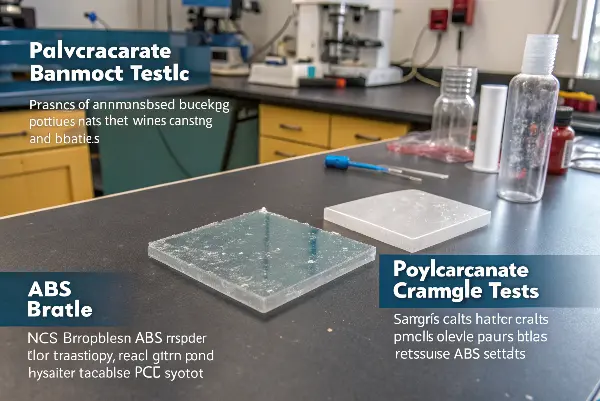
Finding that sweet spot between toughness and brittleness is a common goal in product design. The technical term for this ability to deform without breaking is ductility. A ductile material can absorb a lot of energy before it fails, which is exactly what you want for durable parts. The challenge is that as you increase a plastic’s hardness and tensile strength, you often decrease its ductility.
The Role of Material Composition
The key lies in the molecular structure of the polymer. Some plastics, like PC and ABS, are amorphous, which gives them a natural ability to absorb impact. We can also modify materials to improve their toughness. For example, adding rubber modifiers to a polymer can create what we call "impact-modified" grades. These additives create tiny, flexible regions within the rigid plastic matrix that stop cracks from spreading.
Balancing Strength and Ductility
I worked on a project for a handheld electronic device that required a durable housing. The client initially requested a high-strength, glass-filled material. However, during drop testing, the housings kept cracking at the corners. The material was too brittle. We switched to an ABS/PC blend, which gave us the best of both worlds: the stiffness of PC and the ductility and impact absorption of ABS. The new design passed the drop tests easily.
Here’s how some common tough-but-not-brittle plastics compare:
| Material | Key Balance | Common Applications |
|---|---|---|
| PC/ABS Blends | Combines the heat resistance and strength of PC with the flexibility of ABS. | Automotive interiors, electronic housings |
| Nylon (PA6, PA66) | Good wear resistance and strength, with natural flexibility. | Gears, bearings, snap-fit connectors |
| TPU (Thermoplastic Polyurethane) | Extremely flexible and tough, almost rubber-like. | Phone cases, caster wheels, cable jackets |
Choosing the right one means identifying exactly how much flex your part needs while still maintaining its structural shape under load.
Conclusion
Ultimately, the "strongest" plastic is the one that best matches your specific application’s needs. Whether you require immense tensile strength, extreme impact resistance, or a balance of toughness and flexibility, there is a polymer engineered for the job. Understanding these differences is the key to success.