
Struggling to understand how to turn a plastic part design into a physical product? The world of manufacturing can seem complex and intimidating, making it hard to know where to start. This guide will break down the injection molding process, making it simple and clear for you.
Injection molding is a manufacturing process for producing parts by injecting molten material into a mold. It’s the most common method for mass-producing plastic parts. The process involves melting plastic pellets, forcing the liquid plastic into a precisely machined mold cavity under high pressure, allowing it to cool and solidify, and then ejecting the finished part.
I’ve been in this industry for over a decade, and I remember feeling overwhelmed at first. It’s like learning a new language. But once you grasp the core concepts, you see how this incredible process shapes so many products we use every day. It’s a powerful tool for bringing ideas to life, from simple bottle caps to complex automotive components. Let’s walk through it together, step by step, and I’ll show you exactly how it all works. I want you to feel confident in your next project.
What Are the Key Steps in the Injection Molding Process?
Trying to manage an injection molding project without understanding the core cycle can lead to confusion. You might miss critical details that impact timing and quality, causing frustrating delays. Let me outline the four fundamental stages so you can follow along with any production run confidently.
The injection molding process consists of four main stages: clamping, injection, cooling, and ejection. First, the two halves of the mold are securely closed (clamped). Next, molten plastic is injected into the mold cavity. Then, the plastic cools and solidifies into the shape of the part. Finally, the mold opens and the part is pushed out (ejected).
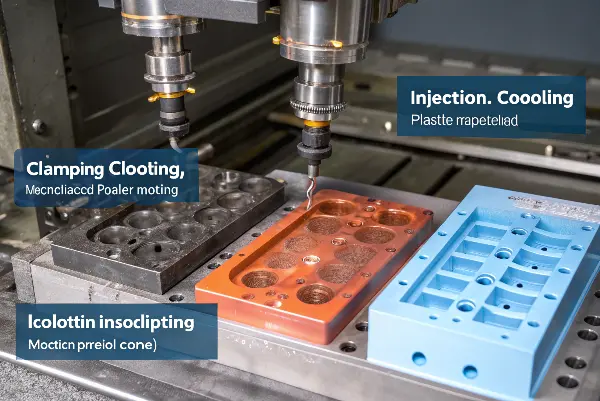
To really understand what’s happening inside the machine, let’s look at each of those four stages in more detail. Each step has its own set of critical parameters that my team and I monitor carefully. Getting any of them wrong can affect the final part’s quality. Think of it as a carefully choreographed dance where timing and precision are everything.
1. Clamping
Before we inject any plastic, the machine has to prepare the mold. A mold has two halves, the "cavity" side and the "core" side. The injection molding machine’s clamping unit pushes these two halves together with immense force. We measure this in tons. A small machine might have 50 tons of clamping force, while a massive one could have thousands. This force is essential to keep the mold shut against the high pressure of the molten plastic that’s about to be injected. If the clamp isn’t strong enough, the plastic can seep out, creating a defect called "flash."
2. Injection
Once the mold is securely clamped, it’s time for the main event. Plastic pellets are fed from a hopper into a heated barrel. A large reciprocating screw inside the barrel melts the pellets and pushes the molten plastic forward. When enough molten plastic is ready, the screw rapidly pushes it into the mold cavity. This happens very quickly and under extremely high pressure. We control the injection speed and pressure very carefully to ensure the mold fills completely and uniformly.
3. Cooling
As soon as the molten plastic fills the mold, the cooling phase begins. The mold has channels running through it where a coolant, usually water, circulates. This draws heat out of the plastic, causing it to solidify and take the shape of the mold. The cooling time is often the longest part of the entire cycle. It depends on the type of plastic, the thickness of the part’s walls, and the mold’s temperature. If you cool it too fast or too slow, the part can warp or have other issues.
4. Ejection
After the part has cooled enough to hold its shape, the clamping unit opens the mold. Then, an ejection mechanism, usually a set of pins or a plate, pushes the finished part out of the mold cavity. The part falls into a collection bin, and the cycle is ready to begin again. The entire process, from clamping to ejection, can take anywhere from a few seconds to a couple of minutes.
What Materials Are Commonly Used in Injection Molding?
Feeling overwhelmed by the sheer number of plastic options available? Choosing the wrong material can lead to product failure, costing you time and money. I’ll help you navigate the most common choices and understand their typical applications, so you can select the right one for your project.
The most widely used materials in injection molding are thermoplastics. These include commodities like Polypropylene (PP) and Polyethylene (PE) for everyday items, and engineering plastics like Acrylonitrile Butadiene Styrene (ABS), Polycarbonate (PC), and Nylon (PA) for more demanding applications requiring strength, heat resistance, or durability. The choice depends on the part’s specific requirements.
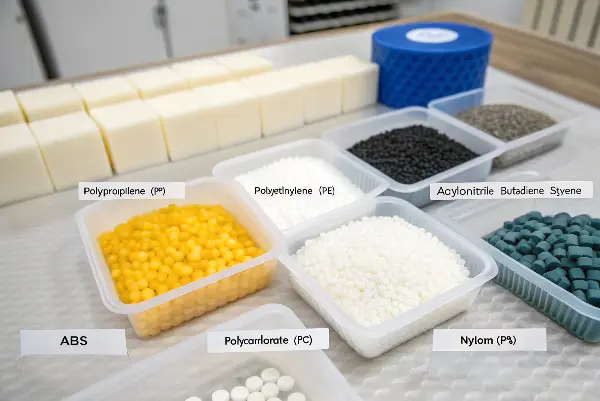
When I first started, the material data sheets looked like a foreign language. But you don’t need to be a polymer scientist to make a good choice. For most projects, you’ll be working with a handful of go-to plastics. The key is to match the material’s properties—like strength, flexibility, and cost—to what your part needs to do. Let’s break down the most popular options and where they shine.
Commodity Thermoplastics
These are the workhorses of the plastics world. They are produced in high volumes, are easy to process, and are very cost-effective. They are perfect for everyday consumer goods where extreme performance isn’t the top priority.
- Polypropylene (PP): You see PP everywhere. It’s in food containers, car bumpers, and furniture. It has great chemical resistance and is very flexible, but it’s not as strong as engineering plastics.
- Polyethylene (PE): This is another incredibly common plastic, famous for its use in milk jugs (HDPE) and plastic bags (LDPE). It’s tough, cheap, and has excellent moisture resistance.
- Polystyrene (PS): Used for things like disposable cups, cutlery, and CD cases. It’s rigid and clear, but can be brittle.
Engineering Thermoplastics
When a part needs to be strong, withstand high temperatures, or resist impact, we turn to engineering plastics. They cost more than commodity plastics, but their superior performance justifies the price for the right application.
Here’s a simple table comparing some of the most common ones I work with at CavityMold:
| Material | Key Properties | Common Applications |
|---|---|---|
| ABS | High impact strength, good rigidity, scratch resistant | LEGO bricks, keyboard caps, electronic housings |
| PC | Extremely tough, transparent, heat resistant | Eyeglass lenses, water bottles, safety goggles |
| Nylon (PA) | Strong, durable, low-friction, good chemical resistance | Gears, bearings, zip ties, engine components |
| POM (Acetal) | High stiffness, low friction, excellent dimensional stability | Buckles, gears, conveyor belt parts |
Choosing the right material is a critical first step. We always discuss the end-use of the part with clients like Alex to ensure we select a polymer that will perform reliably for years to come.
How Should You Design Parts for Successful Injection Molding?
Have you ever designed a part that looked perfect on screen but failed in production? It’s a common frustration that often stems from not following key design rules for molding. Overlooking these principles can lead to costly mold rework and defective parts, derailing your entire project timeline.
For successful injection molding design, focus on maintaining uniform wall thickness to prevent warping and sink marks. Incorporate draft angles (typically 1-2 degrees) on vertical surfaces to allow for easy part ejection from the mold. Use generous radii and fillets on corners to reduce stress concentrations and improve plastic flow. Finally, avoid undercuts, or design them with sliding actions in the mold.
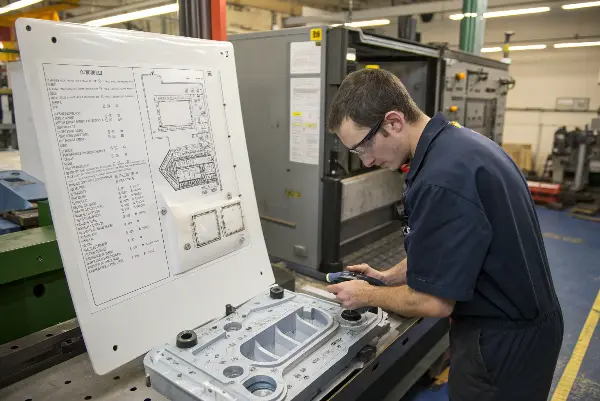
I’ve reviewed thousands of part designs over the years. The most successful ones always have a few things in common. They aren’t necessarily the most complex or clever designs, but they are the ones that respect the physics of how molten plastic flows and cools. It’s a partnership between the designer’s vision and the realities of the manufacturing process. By keeping a few key principles in mind, you can save yourself a lot of headaches down the road.
The Golden Rule: Uniform Wall Thickness
This is the single most important rule in injection molding design. If a part has sections that are much thicker than others, the plastic will cool at different rates. The thick sections will cool slower and shrink more, pulling on the thinner sections and causing defects like warping, sink marks (small depressions), or voids (internal bubbles). Try to keep the wall thickness consistent throughout your part. If you need to add strength, use ribs instead of making the whole wall thicker.
Don’t Forget Draft Angles
Imagine trying to pull a perfect cylinder out of a tight-fitting cup. It creates a vacuum and friction makes it stick. The same thing happens in a mold. A draft angle is a small taper, typically 1 to 2 degrees, applied to the faces of the part that are parallel to the direction the mold opens. This tiny angle makes a huge difference, allowing the part to release cleanly from the mold without being damaged by the ejection pins. It prevents drag marks and scratches on the surface of your finished part.
Round Your Corners with Fillets and Radii
Sharp internal corners are a major source of stress in a plastic part. They can make the part weaker and more likely to crack under load. They also disrupt the flow of molten plastic as it fills the mold. By adding a smooth, rounded edge (a fillet on an inside corner, a radius on an outside corner), you distribute stress more evenly and help the plastic flow smoothly. This results in a stronger, more durable part that is easier to mold.
Be Smart About Undercuts
An undercut is any feature that prevents the part from being ejected directly from the mold, like a side hole or a snap-fit clip. While they are sometimes necessary, they add significant complexity and cost to the mold because they require side-actions or lifters—moving parts within the mold itself. If an undercut is unavoidable, we can definitely build a mold for it. But if you can redesign the part to achieve the same function without an undercut, you’ll save a lot of money and potential headaches.
What Are the Main Advantages and Disadvantages of Injection Molding?
Considering injection molding for your project but not sure if it’s the right fit? Jumping in without weighing the pros and cons can be a costly mistake. You might end up with a process that’s too expensive for low volumes or too slow for your initial prototypes.
The primary advantage of injection molding is its incredibly low cost per part at high volumes. It also offers high repeatability, a wide range of material choices, and excellent surface finishes. However, the main disadvantages are the very high initial tooling costs to create the mold and the long lead times required for mold manufacturing, making it unsuitable for prototyping or low-volume production.
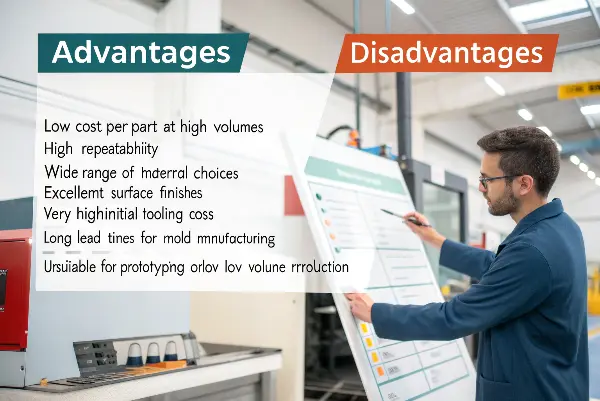
Every manufacturing process has its sweet spot, and injection molding is no different. I often talk with project managers who are trying to decide between molding, 3D printing, or CNC machining. The right choice always depends on three things: how many parts you need, how quickly you need them, and how much you can invest upfront. Let’s break down where injection molding truly excels and where other methods might be a better choice.
The Advantages: Why It’s So Popular
The benefits of injection molding are why it’s the dominant process for mass-producing plastic parts. Once you get past the initial investment, the economics are hard to beat.
- Low Cost at Scale: The magic of injection molding is in its efficiency. While the initial mold (tooling) can cost thousands or even tens of thousands of dollars, the cost to produce each individual part is extremely low—often just pennies. The more parts you make, the more the tooling cost is spread out, driving your per-part cost down.
- High Repeatability and Precision: An injection mold is a solid piece of steel. Once it’s made, every single part it produces will be virtually identical to the last. This high level of consistency is critical for products with tight tolerances and interlocking components.
- Material and Color Flexibility: As we discussed earlier, there is a vast library of thermoplastic polymers available. You can choose materials that are rigid, flexible, strong, heat-resistant, or transparent. You can also mix in colorants directly with the raw pellets, so the parts come out of the mold in their final color, eliminating the need for painting.
- Speed: Although making the mold takes time, the molding cycle itself is very fast. A typical cycle can take as little as 15-30 seconds, meaning thousands of parts can be produced in a single day.
The Disadvantages: When to Be Cautious
Despite its strengths, injection molding isn’t the right solution for every problem. The drawbacks are mainly concentrated at the beginning of the project.
| Disadvantage | Description | When It Matters Most |
|---|---|---|
| High Upfront Tooling Cost | The steel mold is a custom, high-precision tool. Designing and machining it is a significant investment. | For startups, low-volume products, or early-stage prototypes. |
| Long Lead Times | A production-quality mold can take anywhere from 4 to 12 weeks to manufacture and test. | When you have a tight deadline and need parts immediately. |
| Design Change Difficulty | Once the steel mold is cut, making changes is difficult and expensive. Removing steel is easy, but adding it back is not. | During the early design phase when the product is still evolving. |
| Minimum Volume Requirements | Because of the high tooling cost, it’s generally not economical to mold just a few hundred parts. | For one-off custom parts or very small production runs. |
Conclusion
Injection molding is a powerful and efficient process for mass production. By understanding the core steps, materials, and design principles, you can confidently navigate your projects from concept to reality. It’s all about matching the right process to your specific needs of volume, cost, and speed.