
How to Control Quality in Precision Injection Molded Parts
Answer in one sentence: Precision injection molded quality cannot be guaranteed by one inspection; it requires controlled design, material, tooling, process, metrology, traceability, and change management.
Engineering scope: This guide separates design assumptions, process controls, inspection evidence, and buyer decisions so the recommendation can be verified on the actual resin, mold, machine, and production requirement.


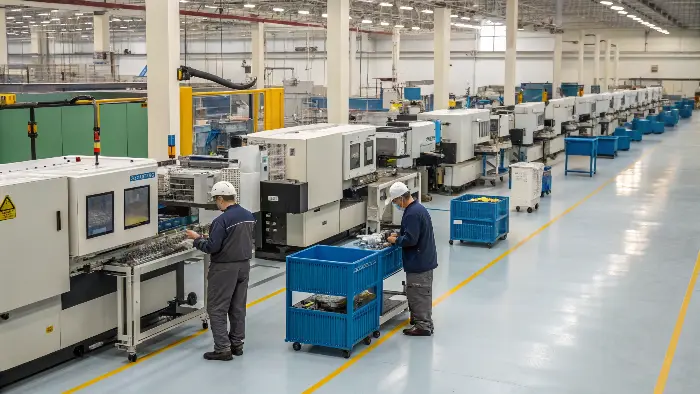
Start with a CTQ and risk map
Translate product function into critical-to-quality characteristics: dimensions, datum relationships, sealing surfaces, fit, weight, appearance, strength, leak performance, or other measurable outputs. Rank risks by severity, occurrence, and detectability, then assign a control or test to each important characteristic.
Control the full chain
Use the specified resin and lot controls, documented drying and handling, qualified mold and machine, stable cooling, approved setup, and a process window. Precision can be lost through a worn insert, drifted sensor, cavity imbalance, unapproved regrind, or a measurement fixture that is not repeatable.
Inspection should be connected to decisions. A report that only lists measurements without sample identity, drawing revision, instrument, datum, temperature, and disposition is difficult to use as evidence.
Capability, metrology, and release
Choose a measurement method whose uncertainty is small relative to the tolerance, validate the fixture and datum scheme, and define sampling by cavity and production stage. Use capability or stability analysis when required by the customer or risk plan, and distinguish process spread from measurement variation.
Change control is part of quality
Material, mold repair, cavity insert, machine, process setting, supplier, software, gauge, and packaging changes can affect precision. Record the change, evaluate impact, run the required verification, and preserve the approval trail before release.
Frequently Asked Questions
Can 100% inspection guarantee quality?
No. It may detect some nonconforming parts, but it cannot replace robust design, process control, measurement validation, traceability, and change management.
What are critical-to-quality characteristics?
They are measurable features whose variation affects function, fit, safety, regulatory performance, assembly, or an agreed customer requirement.
Why is measurement uncertainty important?
If the gauge or method is not sufficiently repeatable relative to the tolerance, pass/fail decisions may be unreliable even when the numbers look precise.
How should precision parts be sampled?
Use a risk-based plan that identifies cavity, lot, machine, time, and process stage. Critical features may need more frequent or automated checks than general features.
Related Cavity Mold Services
Engineering and DFM; Mold making; Plastic injection molding; Contact Cavity Mold.
For a drawing, resin, tolerance, finish, cavity-count, or process-window review, contact Cavity Mold.