
Finding the right material for medical products is hard. If you pick the wrong plastic, the product might fail or harm a patient. This can ruin your project and cost a lot of money. You need safe, proven materials to make sure your healthcare devices work perfectly.
Biocompatible materials are safe materials used in medical devices, implants, and drug delivery systems. They do not harm the human body. Common biocompatible plastics include PEEK, silicone, polycarbonate, and polypropylene. Choosing the right material depends on how long the product stays in the body and what job it needs to do.

Choosing the right material for healthcare products is a big step. I have seen many projects struggle because the material did not fit the design. Let us look closer at how to pick the best biocompatible materials for your next medical project.
What Are Biocompatible Materials and Why Do They Matter in Healthcare?
Medical products face strict rules. If your material is not safe, your product will never reach the market. This wastes time and resources. Understanding biocompatibility helps you pass tests quickly and keep your project on track.
Biocompatibility means a material can be used in the body without causing a bad reaction. It matters because patient safety is the top priority in healthcare. Safe materials stop infections, swelling, or toxic responses. They ensure that tools, drug systems, and implants work well for a long time.

Let us break down what makes a material safe for medical use. When I started making molds at CavityMold back in 2009, I learned quickly that medical plastics are very different from normal plastics. A regular plastic might look clean, but it can release bad chemicals into the body. Biocompatible plastics are made to be pure. They do not react with blood or human tissue at all.
We can group medical materials into three main types based on contact time. This is how safety testers look at your product. First, we have limited contact materials. These touch the body for less than 24 hours. Think of tools used during a quick doctor check-up. Second, we have prolonged contact materials. These stay in or on the body for 24 hours to 30 days. Tubes and simple wound covers fit here. Third, we have permanent contact materials. These are implants that stay in the body for more than 30 days.
To make things easy, look at this simple table to understand the rules:
| Contact Time | Body Contact Type | Product Examples |
|---|---|---|
| Limited (Under 24 hours) | Skin or short-term use | Syringes, surgical tools, masks |
| Prolonged (1 to 30 days) | Blood path, tissue | Catheters, drug delivery parts |
| Permanent (Over 30 days) | Bone, deep tissue | Joint replacements, heart pacemakers |
You must know your product’s category before you pick a material. If you need a permanent implant, you cannot use a plastic made for limited contact. The rules are strict. Testing standards like ISO 10993 will check every part of your material. If you ignore these rules, your project will fail the safety tests. I always tell project managers to look at the end use first. It saves a lot of headaches later.
How Do We Choose Materials for Drug Delivery Systems?
Drug delivery devices must be perfect. If the plastic reacts with the medicine, the drug might not work. This puts patients at high risk. You need stable materials that protect the drug and work smoothly every time.
For drug delivery systems, you must choose materials that do not react with chemicals. Cyclic Olefin Copolymer (COC) and Cyclic Olefin Polymer (COP) are great choices. They are clear like glass but do not break easily. Polypropylene is also widely used because it resists chemicals and is easy to mold.

Drug delivery is a tricky area. Over the years, we have made many molds for inhalers, syringes, and auto-injectors. The material must do two very important jobs. First, it must be safe for the patient to touch or use. Second, it must keep the medicine completely safe. Many modern medicines are very sensitive. If the plastic has impurities, it can ruin the drug inside.
I remember working with a client who wanted to use a basic plastic for a new liquid syringe. We had to stop them right away. The basic plastic would have changed the medicine over time. We suggested using COP instead. COP is very clear. Doctors and nurses can see the medicine inside to check for bad bubbles. It also blocks moisture very well. This keeps the medicine fresh for a longer time on the shelf.
Let us look closely at the top materials for drug delivery tools.
1. COP and COC
These plastics are glass clear. They do not break like glass when dropped. They stop water vapor from getting in or out. They are perfect for storing liquid drugs for a long time.
2. Polypropylene (PP)
This is a workhorse material in the medical field. It is tough. It can bend many times without breaking. We use it a lot for moving parts in inhalers. It is very easy to melt and use in our injection molds, which keeps costs down.
3. Polycarbonate (PC)
PC is very strong. It takes high impacts well. We use it for the hard outer shells of medical devices. It can also handle high heat when hospitals need to clean the tools.
When you design a drug delivery tool, think about the drug first. Talk to your mold maker early. We can help you pick a plastic that flows well in the mold and keeps the medicine safe.
Which Plastics Work Best for Medical Implants?
Implants stay inside the body for years. If the material breaks down or causes swelling, the patient needs another surgery. This is a nightmare for everyone. You must use high-grade plastics designed for permanent use.
PEEK (Polyetheretherketone) is the best plastic for medical implants. It is as strong as metal but much lighter. It does not show up on X-rays, which helps doctors see healing bones. Ultra-High Molecular Weight Polyethylene (UHMWPE) is also great for joint replacements because it is very tough and smooth.

Implants are the hardest medical products to make. The inside of the human body is a harsh place for a part. It is warm, wet, and full of different chemicals. Most regular plastics would break down fast in the body. But implant-grade plastics are built to last a lifetime without failing.
When I talk to project managers about permanent implants, PEEK is always the first word I say. PEEK is amazing. Years ago, almost all bone implants were made of metal. Metal is very strong, but it is heavy. It also blocks X-rays. If a doctor puts a metal plate on a broken bone, they cannot easily see the bone healing on the X-ray picture. PEEK solves this big problem. It is clear on X-rays. It is almost as strong as bone. This means it flexes just enough to feel natural for the patient.
Here is a simple breakdown of the top implant materials we see:
PEEK
It is very strong. It handles high heat. It resists almost all chemicals. We use it for spinal implants and bone screws. Molding PEEK is hard work. It needs very high temperatures to melt. Our machines at CavityMold are set up just for this hard job.
UHMWPE
This is a very long name for a very smooth plastic. It wears down very slowly over time. We see it used a lot in hip and knee replacements. It acts just like the smooth cartilage in your own joints.
Implant-Grade Silicone
Silicone is soft and flexible. It is used for soft tissue implants and tubes that must stay inside the body for a very long time. It bends well with the body.
When you pick an implant material, the raw cost is very high. But you cannot cut corners here. The material must be perfect from start to finish.
How Does Mold Manufacturing Affect Biocompatible Materials?
Even the best medical plastic can fail if the mold is bad. A poor mold leaves rough edges or burns the plastic. This creates places for bacteria to grow. You need perfect mold manufacturing to keep your medical parts clean and safe.
Mold manufacturing directly affects the safety of biocompatible materials. The mold must be made of high-grade steel. It needs a very smooth finish so bacteria cannot hide on the final part. The molding process must control heat perfectly so the plastic does not burn or lose its safe properties.
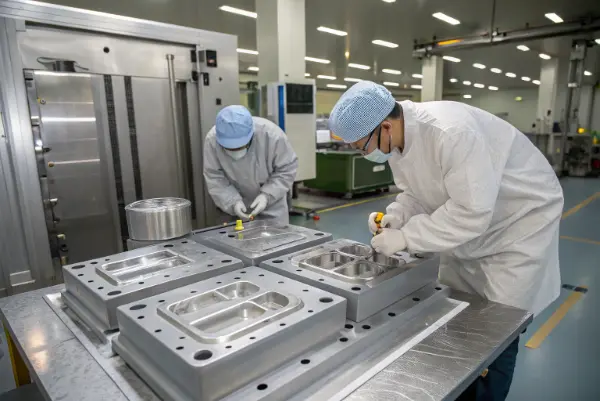
You can buy the most expensive medical plastic in the world. But if your mold maker does a bad job, your final part will be bad. At CavityMold, we know that the mold is the heart of every project. Medical parts need perfectly smooth surfaces. If a plastic part has tiny scratches or rough spots, bacteria will hide there. This causes bad infections for patients.
To stop this from happening, we polish our medical molds to a high mirror finish. We use special tools to make the steel completely smooth. This means the plastic part comes out smooth too.
Let us look at how the mold impacts the final medical material.
Heat Control
Medical plastics like PEEK need very high heat to melt. If the mold gets too hot, the plastic burns. It loses its strength. If it is too cold, the plastic does not fill the mold all the way. We use smart cooling lines inside the mold to keep the heat perfect at all times.
Trapped Air and Venting
When melted plastic fills a mold, it pushes air out. If the air cannot escape, it burns the edges of the plastic part. This ruins the biocompatible rating. We design tiny vents in the mold to let air out safely.
Precision and Shrinkage
All plastics shrink when they cool down. Medical parts must fit together perfectly. A medical syringe must not leak at all. We use special mold flow software before we cut the steel. This tells us exactly how much the plastic will shrink.
| Mold Feature | Why It Matters for Medical Parts |
|---|---|
| High Surface Polish | Stops bacteria, makes parts easy to clean |
| Perfect Temperature Control | Keeps plastic strong, stops parts from warping |
| Good Air Venting | Stops burn marks, keeps the material pure |
Working with an expert mold maker saves you from all these hidden problems. We make sure your great material turns into a great part.
Conclusion
Choosing biocompatible materials is critical for healthcare products. You must pick the right plastic based on contact time and function. By pairing safe materials with precise mold manufacturing, you can create drug delivery systems and implants that are safe, reliable, and ready to help patients.