
Choosing the wrong plastic for your injection molding project can lead to failed parts, wasted budgets, and major production delays. Imagine your new product cracking under stress or warping from heat because the material wasn’t right. A clear guide is essential to navigate the vast world of plastics.
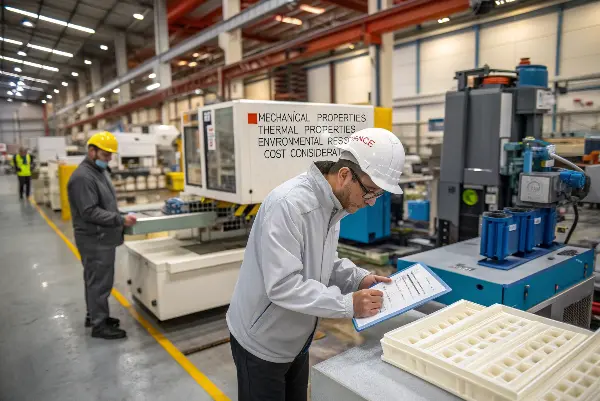
To choose the right injection molding material, you must evaluate its mechanical properties (strength, flexibility), thermal properties (heat resistance), environmental resistance (UV, chemical), and cost. A thorough analysis of your product’s application, performance requirements, and budget is crucial. This ensures the final part functions correctly and meets all specifications without overspending on unnecessary material features.
That’s the high-level view, but the devil is in the details. A successful choice isn’t just about picking a plastic from a chart; it’s about deeply understanding the trade-offs between performance, cost, and manufacturability. Let’s break down the selection process step-by-step, so you can feel confident in your decision.
How Do You Start Choosing the Right Plastic Material?
Staring at a list of hundreds of polymers can feel overwhelming. You know this choice is critical for your project’s success, but where do you even begin the process? Picking randomly or based on a hunch can lead to costly mold redesigns and scrapped parts. The pressure to get it right the first time is immense.
To choose the right plastic, start by defining the product’s functional requirements and operating environment. Consider what the part needs to do and what conditions it will face. Then, create a checklist of necessary material properties, like strength, temperature resistance, and chemical exposure. This systematic approach narrows down your options from hundreds to just a handful of suitable candidates, making the final decision much simpler and more reliable.

The first step I always take with a new project is to forget about specific plastics entirely. Instead, I focus on the part itself. I ask a series of questions that build a complete picture of the product’s life. What is its primary function? Does it need to be rigid and strong, or soft and flexible? Will it be exposed to sunlight for long periods? Does it need to withstand high temperatures from a motor or contact with cleaning chemicals? These questions form the foundation of our material selection process.
I once worked with a client, Alex, who was developing a handheld electronic device. Initially, he was set on using a specific high-performance polymer he had used before. However, by walking through these questions, we realized the housing didn’t need extreme heat resistance, but it did need excellent impact strength and a high-quality surface finish. We shifted our focus and found a more suitable and cost-effective material.
Here’s a simple framework to guide your initial thinking:
Step-by-Step Selection Process
- Define the Application:
- Function: What is the part’s job? Is it a structural component, a housing, a lens, or a gear?
- Environment: Where will it live? Indoors, outdoors, in a car engine, or a medical facility?
- Lifespan: How long does it need to last? A few months or 20 years?
- List Key Properties:
- Based on the application, list the non-negotiable properties. For example, a gear needs high wear resistance, while an outdoor enclosure needs UV stability.
- Consider Aesthetics and Regulations:
- What should it look like? Does it need to be a specific color, clear, or have a certain texture?
- Are there any industry standards or regulations it must meet (e.g., FDA-approved for food contact, UL-rated for flammability)?
- Set a Budget:
- What is the target cost per part? This will help filter out overly expensive specialty polymers early on.
This structured approach transforms a massive, confusing decision into a logical, manageable process.
What Key Criteria Should Guide Your Material Selection?
You have a general idea of your part’s needs, but now you need to translate those needs into technical specifications. Without clear criteria, comparing different materials is like comparing apples and oranges. This uncertainty can lead you to over-engineer the part with an expensive material or, worse, choose one that fails in the field.
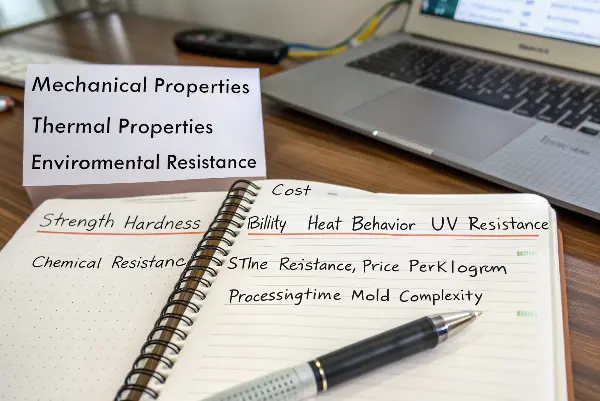
The key criteria for material selection are mechanical properties, thermal properties, environmental resistance, and cost. Mechanical aspects include strength, hardness, and flexibility. Thermal properties relate to how the material behaves with heat. Environmental factors cover resistance to UV, chemicals, and moisture. Finally, cost includes not just the price per kilogram but also its impact on processing time and mold complexity.
Diving into a material datasheet can be intimidating. There are dozens of values, but focusing on the most relevant criteria makes it much easier. I always tell my project managers, like Alex, to think of these criteria as a series of filters. Each one helps you narrow the options until you find the perfect match for your product’s specific demands. Let’s break down the most important ones.
Mechanical Properties
These describe how the material responds to physical forces.
- Tensile Strength: How much pulling force can it take before it breaks? Crucial for parts under tension.
- Flexural Modulus: How stiff is the material? High-modulus materials are rigid, while low-modulus ones are flexible.
- Impact Strength (Izod/Charpy): How well does it handle a sudden shock or impact? Essential for housings and protective components.
- Hardness (Rockwell/Shore): How resistant is it to scratching and indentation? Important for surfaces that will see a lot of wear.
Thermal Properties
These define how the material reacts to temperature changes.
- Heat Deflection Temperature (HDT): At what temperature does the material start to deform under a specific load? This is a critical value for parts used near heat sources.
- Continuous Use Temperature: The maximum temperature the material can withstand for a long period without degrading.
- Coefficient of Thermal Expansion: How much does the material expand or contract with temperature changes? This is vital for assemblies with tight tolerances.
Here is a simplified table to show how different materials stack up in these key areas:
| Material | Tensile Strength (MPa) | Flexural Modulus (GPa) | HDT @ 0.45 MPa (°C) |
|---|---|---|---|
| Polypropylene (PP) | 30 – 40 | 1.0 – 1.5 | 100 – 120 |
| ABS | 40 – 50 | 2.0 – 2.5 | 85 – 105 |
| Polycarbonate (PC) | 60 – 70 | 2.2 – 2.4 | 125 – 135 |
| Nylon 6/6 (PA66) | 75 – 85 | 2.5 – 3.0 | 200 – 250 |
By methodically evaluating each candidate material against these criteria, you can make an informed, data-driven decision instead of a guess.
Are There Any Rules of Thumb for Choosing Materials?
After analyzing datasheets, you might find several materials that seem to fit your technical needs. How do you choose between them? Relying purely on data can sometimes miss the practical nuances of manufacturing and real-world performance. This is where experience and general guidelines become incredibly valuable.
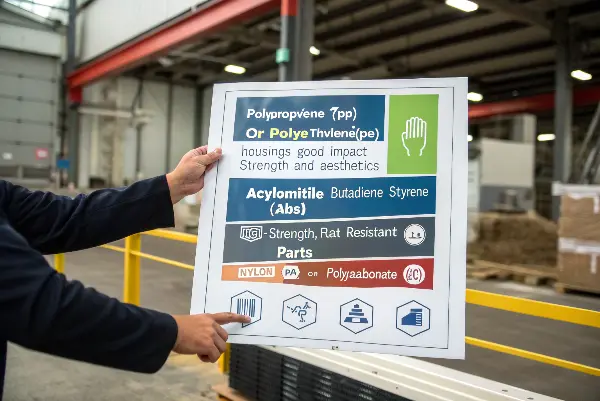
Yes, there are several rules of thumb. For general-purpose, low-cost parts, start with commodity plastics like Polypropylene (PP) or Polyethylene (PE). For housings requiring good impact strength and aesthetics, Acrylonitrile Butadiene Styrene (ABS) is a go-to choice. If you need high strength and heat resistance, look at engineering plastics like Nylon (PA) or Polycarbonate (PC). These starting points help streamline your selection process.
Over the years, I’ve learned that certain materials are consistently reliable for specific applications. These "rules of thumb" aren’t strict laws, but they are fantastic starting points that save a lot of time. When Alex and I are brainstorming a new project, we often start here before we even look at a single datasheet. It helps us quickly frame the problem and narrow our focus to a specific class of plastics. Think of these as shortcuts built from decades of collective industry experience.
For example, if a client needs a simple living hinge—like the cap on a bottle of ketchup—I immediately think of Polypropylene. Its excellent fatigue resistance is unmatched for that application. Trying to achieve that with a rigid plastic like ABS would be a recipe for failure.
Here are some common scenarios and the materials we typically consider first:
Common Applications and Starting Materials
- Consumer Product Housings:
- ABS: The workhorse. It offers a great balance of toughness, stiffness, and surface finish at a reasonable cost. It’s easy to process and can be painted or plated.
- PC/ABS Blend: When you need the toughness of ABS but with higher impact and heat resistance, this blend is a perfect upgrade.
- Gears, Bearings, and Structural Parts:
- Nylon (PA6, PA66): Excellent strength, stiffness, and wear resistance. It’s a top choice for moving parts that experience friction. Just be mindful of its tendency to absorb moisture, which can affect its dimensions and properties.
- Acetal (POM): Another great option for mechanical parts. It has low friction, great dimensional stability, and is resistant to chemicals.
- Clear or Transparent Components:
- Polycarbonate (PC): The king of impact resistance. If you need something that is both clear and incredibly tough, like a safety goggle lens, PC is the answer.
- Acrylic (PMMA): Offers superior optical clarity and scratch resistance compared to PC, but it is more brittle. Great for light pipes and decorative lenses.
- Flexible Parts and Overmolding:
- Thermoplastic Elastomers (TPE/TPU): These materials provide a soft, rubbery feel. They are perfect for grips, seals, and bumpers. They also bond well to rigid plastics in an overmolding process.
Starting with these common pairings helps you stand on the shoulders of giants, leveraging what has worked for countless projects before yours.
What’s the Most Cost-Effective Material for Injection Molding?
Every project has a budget. You might find a high-performance polymer that meets all your technical requirements perfectly, but if it makes your product too expensive to sell, it’s the wrong choice. Balancing performance with cost is often the final and most challenging step in material selection.
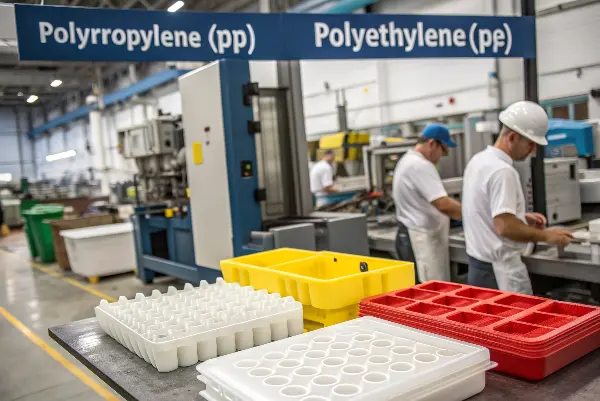
The most cost-effective materials for injection molding are commodity plastics like Polypropylene (PP) and Polyethylene (PE). These materials are produced in massive quantities, making their raw material cost very low. They are also easy to process, which reduces cycle times and energy consumption, further lowering the overall part price. However, their properties are limited, so they are best for non-demanding applications.
When we talk about cost, it’s important to look beyond the price per kilogram listed on a datasheet. The total cost of a part is influenced by several factors, and the raw material is just one piece of the puzzle. I always encourage clients to consider the "total cost of ownership," which includes processing costs, cycle times, and even potential scrap rates.
A cheaper material might require higher processing temperatures, leading to longer cooling times and a slower cycle. Over a production run of a million parts, that extra second or two per part adds up to a significant cost increase. Similarly, some materials are more difficult to mold, leading to a higher rate of rejected parts.
Here’s a breakdown of how to think about material cost more holistically:
Factors Influencing Total Part Cost
- Raw Material Price: This is the baseline, typically measured in dollars per kilogram.
- Commodity Plastics (e.g., PP, PE, PS): ~$1-2/kg. They are the cheapest but have basic performance.
- Engineering Plastics (e.g., ABS, PC, PA): ~$3-5/kg. They offer a significant step up in mechanical and thermal properties.
- High-Performance Plastics (e.g., PEEK, PEI): ~$50+/kg. These are used for extreme applications in aerospace, medical, and automotive where performance is non-negotiable and cost is a secondary concern.
- Processing Efficiency:
- Cycle Time: How quickly can you mold a part? Materials with a wide processing window and fast cooling times are more economical to run.
- Energy Consumption: Does the material require very high barrel temperatures and injection pressures? This directly impacts energy costs.
- Part Design and Weight:
- The simplest way to reduce cost is to use less material. A well-designed part uses only the material it needs to function. A heavy, thick-walled part made from cheap PP might end up costing more than a lightweight, thin-walled part made from a slightly more expensive but stronger material like ABS.
My advice is to start with the lowest-cost material family that meets your absolute minimum performance requirements. Then, evaluate if moving up to a slightly more expensive material could allow for a better design (e.g., thinner walls) or faster cycle times that would ultimately make the final part cheaper.
Conclusion
Choosing the right material is a critical step that defines your product’s success. By following a structured process—defining requirements, evaluating key criteria, using rules of thumb, and analyzing total cost—you can confidently navigate the complex world of plastics and select the perfect material for your project’s needs.