
Struggling to choose the right finish for your PVC parts? The wrong choice can lead to functional failures, poor aesthetics, and increased costs. Understanding your options, from textures to treatments, ensures you get the perfect result every time.
The best surface finish for PVC parts depends on your specific needs. Options range from standard SPI grades for general aesthetics to VDI textures for improved grip and wear resistance. You can also apply coatings like paint or platings for enhanced properties, or use in-mold decorating to embed graphics directly. Each choice impacts function, appearance, and cost.
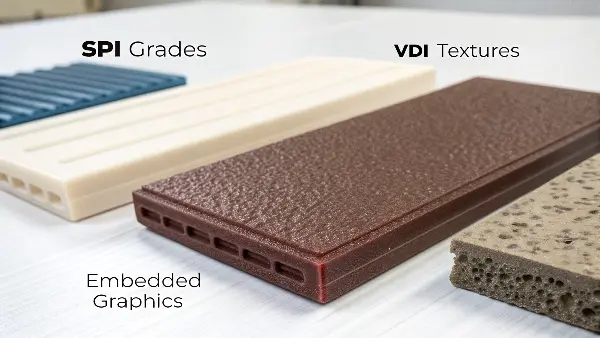
Now that you have a general idea, let’s explore these options in more detail. Over my years in mold making, I’ve seen how a small detail like surface finish can make or break a product. Getting this right from the start is crucial for your project’s success, and I want to walk you through the key considerations.
What Are the Different Types of Surface Finishes Available?
Feeling overwhelmed by the sheer number of surface finish options? Choosing incorrectly can mean your part doesn’t look or feel right, or even fails in its application. It’s a decision with real consequences for your product’s market success.
Surface finishes for injection molded parts are broadly categorized by the method used to achieve them. The most common are as-molded finishes, defined by standards like SPI or VDI, created directly by the mold’s surface. Next are secondary post-processing finishes, which include painting, plating, printing, and laser etching. Finally, there are in-mold processes like In-Mold Decorating (IMD) that apply a finish during the molding cycle itself.
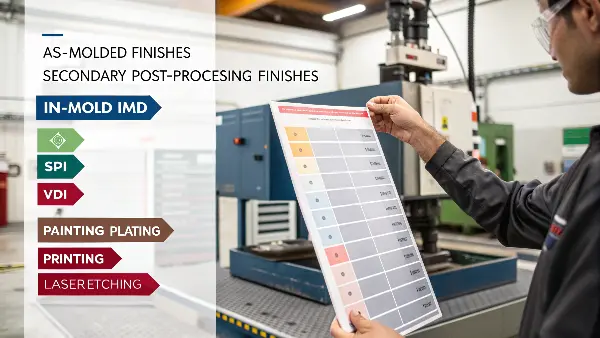
Let’s dive deeper into these categories. The finish you choose is not just about looks; it’s about function. I remember a project for a handheld medical device where the client initially wanted a high-gloss, smooth finish. It looked sleek, but during user testing, we found it was too slippery. We switched to a light VDI texture, which provided just enough grip without changing the overall polished aesthetic. This experience taught me to always think about the end-user first.
As-Molded Finishes
This is the most cost-effective approach because the finish is created directly by the mold tool’s cavity surface. No extra steps are needed after molding. The texture or polish of the steel mold is transferred directly to the PVC part. These are typically classified using industry standards, which we will discuss later.
Secondary Finishes (Post-Processing)
These are treatments applied to the part after it has been ejected from the mold. This adds cost and time but allows for effects that are impossible to achieve with the mold alone.
| Treatment | Description | Common Use Case |
|---|---|---|
| Painting | Applying a layer of paint for color, UV protection, or a soft-touch feel. | Automotive interiors, electronics housing |
| Plating | Coating the part with a thin layer of metal (e.g., chrome) for a metallic look and durability. | Plumbing fixtures, decorative trim |
| Printing | Adding graphics, logos, or text using methods like pad printing or screen printing. | Buttons, branding on products |
| Laser Etching | Using a laser to ablate the surface, creating precise permanent marks or textures. | Serial numbers, intricate patterns |
In-Mold Processes
These advanced techniques integrate the finishing process into the molding cycle itself. In-Mold Decorating (IMD) or In-Mold Labeling (IML) involves placing a pre-printed film or label into the mold before injecting the PVC. The plastic then fuses with the film, creating a highly durable and seamless finish. This is great for high-volume products where post-processing would be too slow or expensive.
What Determines the Surface Finish of an Injection Molded Part?
Have you ever received a batch of parts where the finish was inconsistent or not what you specified? This variation can ruin your product’s visual appeal and even its function. Understanding the root causes is key to preventing these costly issues.
The final surface finish of an injection molded part is determined primarily by the surface of the mold tool itself. The texture or polish on the mold’s cavity is directly replicated onto the plastic part. Other critical factors include the type of plastic material used (PVC in this case), molding process parameters like temperature and injection speed, and the part’s design geometry.
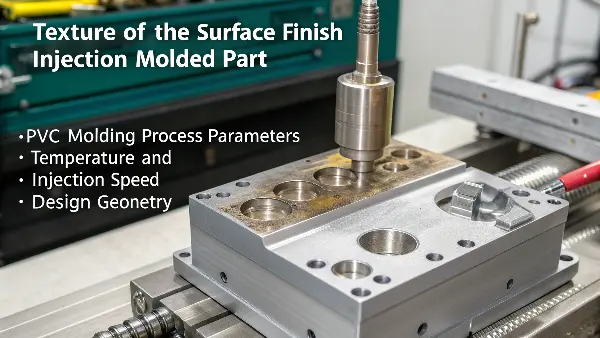
Let’s break down exactly how these elements interact. It’s a delicate balance. I learned this the hard way on an early project where we specified a high-gloss finish. The mold tool was polished perfectly to a mirror-like shine. However, the first parts came out with flow lines and dull spots. The problem wasn’t the mold; it was the process. The melt temperature was too low, and the injection speed was too slow, causing the PVC to cool before it could perfectly fill every microscopic detail of the polished surface.
The Mold Tool is King
The mold is the single most important factor. The finish you want on your part must first be applied to the mold steel.
- Polishing: For smooth finishes, the mold is carefully hand-polished using progressively finer stones and diamond paste. This requires immense skill.
- Texturing: For textured finishes, methods like chemical acid etching or EDM (Electrical Discharge Machining) are used to create the desired pattern on the steel.
Material Choice Matters
Different plastics replicate mold surfaces differently. PVC is generally very good at picking up fine details, but its properties can be affected by additives. For example, a PVC compound with a high percentage of plasticizer might behave differently from a more rigid compound, affecting how it flows and solidifies against the mold wall.
Process Parameters are Crucial
Think of these as the recipe for molding.
- Melt Temperature: If the plastic is too cold, it becomes viscous and won’t capture fine details. Too hot, and it can degrade or cause flashing.
- Injection Speed: A faster speed can help fill the mold and get a better finish, but it can also cause shear stress and burn marks.
- Packing Pressure: After the mold is filled, holding pressure ensures the plastic is packed tightly against the mold walls, improving surface replication.
Every project requires fine-tuning these variables to get the perfect finish consistently.
What Is the VDI Standard for Surface Finish?
Do you need a textured finish but aren’t sure how to specify it clearly? Simply saying "a light texture" is too vague and can lead to misunderstandings with your mold maker. The VDI standard eliminates this ambiguity and ensures everyone is on the same page.
The VDI 3400 standard, often just called VDI, is a German-developed specification for textured surfaces on injection molded parts. It defines a set of 45 distinct texture grades, from very fine to very coarse, which are achieved through Electrical Discharge Machining (EDM) on the mold tool. Each grade is assigned a reference number, like VDI 27 or VDI 33, providing a universal language for communicating texture requirements.
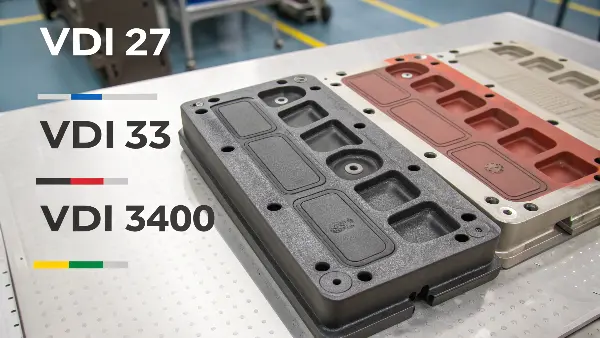
The VDI standard is one of my go-to tools when discussing projects with clients like Alex. It’s practical and widely understood in the industry. Instead of trying to describe a texture with words, a project manager can simply specify "VDI 30." I can then look at my reference plaque, and my tooling engineers know exactly what EDM parameters to use on the mold steel. This removes guesswork and guarantees the client gets the exact feel and look they expect.
How VDI Grades Work
The VDI grades are numbered from 12 to 45. The lower the number, the finer and smoother the texture. The higher the number, the rougher and more aggressive the texture.
| VDI Grade Range | Common Description | Typical Application |
|---|---|---|
| VDI 12 – 21 | Very Fine / Light Matte | Reduces gloss on cosmetic parts without feeling rough. |
| VDI 24 – 30 | Medium Texture | Provides a good grip and hides fingerprints. Common on enclosures. |
| VDI 33 – 39 | Coarse Texture | Offers excellent grip and wear resistance. Used for tool handles. |
| VDI 42 – 45 | Very Coarse / Rough | Used for non-slip surfaces or very industrial-looking parts. |
Why Use VDI Over Other Methods?
While chemical etching can also create textures, EDM offers better consistency and repeatability, especially across large or complex mold surfaces. It’s a very controlled process. Another benefit is its ability to hide minor imperfections. Flow lines, sink marks, and blush marks that would be obvious on a high-gloss part often disappear on a textured surface. This can lead to higher part yield and lower overall costs. When you’re choosing a VDI finish, think about both the aesthetic you want and the functional benefits, such as improved grip, scratch resistance, and manufacturing efficiency. It’s a powerful tool in a product designer’s toolkit.
What Is an RA 3.2 Surface Finish?
Are you working on a part that requires a specific level of smoothness but isn’t a mirror polish? Specifying something like "a fine matte finish" is not precise enough for engineering. This is where a quantifiable measurement like Ra comes into play.
Ra, or Roughness Average, is a calculated value that quantifies the smoothness of a surface. It measures the average microscopic peaks and valleys along a surface. An "Ra 3.2" finish means the average deviation from the surface’s mean line is 3.2 micrometers (μm). This corresponds to a standard machined finish, often achieved by fine milling or turning, and is equivalent to about 125 microinches (μin).
Let’s dive deeper into what this means in practice. I often get drawings from clients that specify an Ra value. It’s a very precise way to communicate, but it’s important to understand what it implies for the mold and the part. An Ra 3.2 µm finish is not a polished surface. It is a functional, machined surface. You will likely see very fine tool marks. For many internal components or non-cosmetic surfaces where fit is important but appearance is not, this is a perfectly acceptable and cost-effective specification.
Translating Ra to Other Standards
It’s helpful to compare Ra values to the more visual SPI (Society of the Plastics Industry) standards, which are based on polishing methods. This helps bridge the gap between engineering specifications and visual expectations.
| SPI Finish | Description | Equivalent Ra (µm, approx.) | Equivalent Ra (µin, approx.) |
|---|---|---|---|
| SPI C-1 | 600 Grit Stone | 0.8 – 1.0 | 32 – 40 |
| SPI B-1 | 600 Grit Paper | 0.2 – 0.3 | 8 – 12 |
| SPI A-2 | Grade #6 Diamond Buff | 0.05 – 0.1 | 2 – 4 |
| N/A | Standard Machining | ~3.2 | ~125 |
As you can see, Ra 3.2 is significantly rougher than even the most basic SPI polished finishes. It’s in a different category altogether.
When to Specify Ra 3.2
- Internal, Non-Cosmetic Parts: If the part is not visible to the end-user, there’s no need to pay for polishing. A standard machined finish (like Ra 3.2) on the mold is the most economical choice.
- Parts Requiring Adhesion: A slightly rougher surface can provide a better "tooth" for paint, glue, or overmolding to adhere to.
- Avoiding High Costs: Polishing a mold to a fine SPI grade is labor-intensive and expensive. If the function doesn’t require it, specifying a machined finish saves significant cost and time in mold manufacturing.
Specifying an Ra value is about defining function, not just appearance. Be clear with your mold maker about whether the surface is cosmetic or purely functional to ensure you get the right finish at the right price.
Conclusion
Choosing the right surface finish for your PVC parts is a critical decision. It impacts everything from aesthetics and user experience to manufacturing cost and part performance. By understanding the options—from standard SPI and VDI finishes to precise Ra values—you can make informed choices that ensure project success.