
Choosing the right manufacturing process feels like a high-stakes decision. Make the wrong call, and you could face crippling costs and project delays. Let’s break down the key differences to ensure you select the best method for your specific needs, budget, and timeline.
Thermoforming is typically better for large, simple parts and lower production volumes due to its lower tooling costs and faster lead times. Injection molding excels at producing complex, high-precision parts in high volumes. It offers a lower per-unit cost once the significant initial tooling investment is covered. The right choice depends entirely on your part’s design, material, production quantity, and budget.
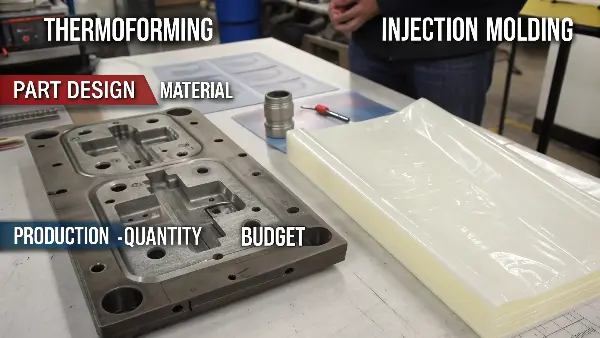
The decision isn’t always black and white. On paper, one process might seem like the clear winner, but hidden factors can change everything. Over my years in this industry, I’ve seen project managers get tripped up by details they overlooked. To help you avoid that, let’s dig into the specific questions I get asked all the time. This will give you the clarity you need to move forward with confidence.
How much does thermoforming cost?
Budgeting for a new manufacturing process can feel like you’re navigating without a map. You hear that thermoforming is the "cheaper" option, but what does that really mean? Underestimate the costs, and you risk derailing your entire project budget before you even begin.
The primary costs for thermoforming are tooling, materials, and labor for finishing. A simple prototype tool might cost a few thousand dollars, while complex, multi-cavity production tooling can exceed $50,000. Material costs vary by plastic type and thickness, and secondary operations like trimming add to the final per-part price. The total cost is a balance of these initial and recurring expenses.
Let’s take a closer look at where your money goes. The biggest single expense is almost always the mold, or "tool." Unlike injection molding, which requires complex two-sided steel molds, thermoforming often uses a simpler, single-sided mold typically made from aluminum. This is a huge reason for the lower upfront cost. A basic aluminum prototype tool can be made for under $5,000, while a robust, temperature-controlled production tool might be in the $20,000 to $50,000 range. That’s still a fraction of a typical injection mold’s cost.
Next is the raw material. With thermoforming, you’re starting with large plastic sheets. The cost depends on the type of plastic (like ABS, HIPS, or PETG), its thickness, and any special properties like color or UV resistance. It’s important to remember that not all of the sheet becomes your final part. The leftover material, or "webbing," is trimmed away. While this can often be recycled, it’s still a factor in the overall material cost calculation. Finally, there are the operational costs. This includes the labor to run the machine and, crucially, to perform any secondary finishing operations. Most thermoformed parts require trimming to remove them from the sheet, and this is often done with a 5-axis CNC router, which adds time and cost to each part.
Thermoforming Cost Factors Breakdown
| Cost Component | Description | Typical Price Range | Key Influencers |
|---|---|---|---|
| Tooling | Single-sided mold, usually aluminum. | $3,000 – $50,000+ | Part size, complexity, undercuts, mold material, number of cavities. |
| Material | Plastic sheets (ABS, HIPS, PETG, etc.). | $2 – $15 per pound | Polymer type, sheet thickness, color, texture, order volume. |
| Setup/Labor | Machine setup and secondary operations. | Varies per project | Part trimming method (CNC vs. manual), assembly, finishing. |
| Per-Part Cost | The final cost for each finished unit. | $1 – $100+ | Production volume (higher volume = lower per-part cost), cycle time. |
Is thermoforming cheaper than injection molding?
You’re trying to get your project off the ground, and every dollar counts. You hear conflicting advice: one person says thermoforming is the only affordable option, another insists injection molding is cheaper in the long run. Making the wrong choice could mean blowing your budget or getting locked into a process that isn’t scalable.
Yes, thermoforming is significantly cheaper for tooling, making it the more affordable option for low to medium production volumes (typically under 10,000 units). However, injection molding’s lower per-part cost and material efficiency make it the more economical choice for high-volume production runs. The break-even point where injection molding becomes cheaper depends on part complexity and size.
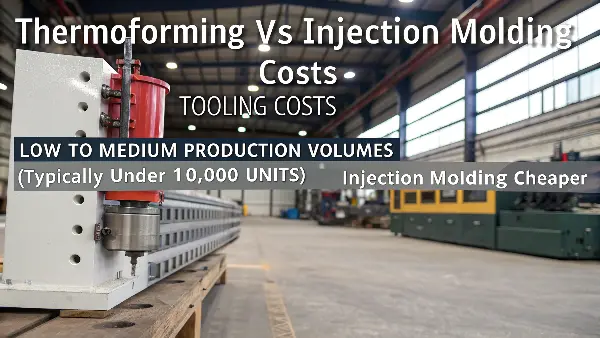
When we talk about cost, we need to split the conversation into two parts: tooling cost and per-part cost. This is where the real difference lies. For tooling, thermoforming is the undisputed champion of cost-effectiveness. As I mentioned, a thermoform tool is much simpler and is often made from aluminum. An injection mold, on the other hand, is a complex piece of engineering. It requires two hardened steel halves, cooling channels, an ejector system, and sometimes intricate features like sliders and lifters. This is why an injection mold can easily cost anywhere from $20,000 to over $100,000. For a startup or a project with a limited initial run, that high upfront cost can be a non-starter.
However, the story flips when you look at the per-part cost. Injection molding is highly automated and has very fast cycle times, often just seconds per part. It also uses raw plastic pellets, which are cheaper than the extruded sheets required for thermoforming. There’s also less material waste. Thermoforming has slower cycle times and requires secondary trimming operations, which adds labor and time to each piece. So, while you save a lot of money upfront with a thermoforming tool, you pay a little more for every single part you make. The key is to find your break-even point. I’ve worked on projects where the volume was low enough that the total cost of thermoforming never came close to just the tooling cost of injection molding. On the other hand, for a project that needed a million units, the slightly higher per-part cost of thermoforming would have been disastrous.
Cost Comparison at Different Volumes
| Feature | Thermoforming | Injection Molding | Winner |
|---|---|---|---|
| Tooling Cost | Low ($3k – $50k) | High ($20k – $100k+) | Thermoforming |
| Per-Part Cost (Low Volume) | Moderate | High (due to tooling amortization) | Thermoforming |
| Per-Part Cost (High Volume) | Moderate | Very Low | Injection Molding |
| Material Cost | Higher (plastic sheets) | Lower (plastic pellets) | Injection Molding |
| Ideal Volume | Prototypes to ~10,000 units/year | 10,000+ units/year | Depends on Volume |
What is the lead time for injection molding tools?
Your product launch date is set, and the pressure is on. You need parts fast, but the manufacturing timeline seems vague. Delays in tooling can create a domino effect, pushing back testing, marketing, and your entire launch schedule. You need a realistic timeline to manage expectations and keep your project on track.
The lead time for a typical injection molding tool is between 6 and 12 weeks. Simple, single-cavity prototype molds can sometimes be made in 4-6 weeks, while highly complex, multi-cavity production molds with intricate features can take 16 weeks or more. This timeframe includes design, fabrication, testing, and revisions. In contrast, thermoforming tools are much faster, often ready in 2-8 weeks.
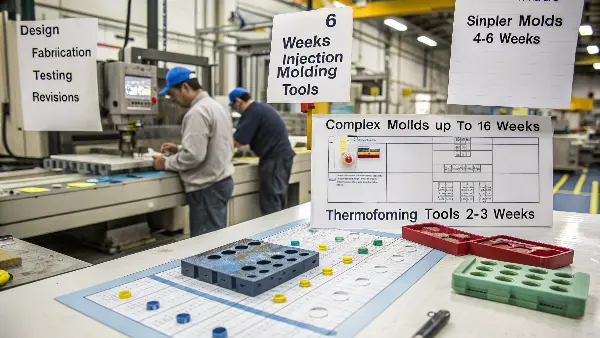
The long lead time for injection molds is a direct result of their complexity. It’s not just a block of steel; it’s a precision machine. The process starts with a detailed mold design, including a Moldflow analysis to simulate how plastic will fill the cavity. This design phase alone can take a week or more. Once the design is approved, the fabrication begins. This involves machining large blocks of hardened steel with incredible precision using CNC machines, grinders, and EDM (Electrical Discharge Machining) for fine details.
After machining, the mold components must be polished, assembled, and fitted. Then comes the critical testing phase, often called T1 sampling. We mount the tool in an injection molding press, run the first batch of parts, and inspect them meticulously. Almost always, there are small adjustments needed. This could involve tweaking dimensions, improving venting, or adjusting the cooling channels. Each revision cycle can add another week to the timeline. This is why rushing the process is a bad idea; a poorly made tool will produce bad parts for its entire lifespan. The 6-12 week timeframe is a necessary investment to ensure you get millions of perfect parts later. Thermoforming tools, being simpler and made from softer aluminum, can be designed and machined much, much faster, which is a major advantage for projects with tight deadlines.
Timeline Breakdown: Injection Mold vs. Thermoform Tool
| Stage | Injection Mold (Typical) | Thermoform Tool (Typical) |
|---|---|---|
| Design & Approval | 1-2 weeks | 2-5 days |
| Material Procurement | 1 week | 1-3 days |
| CNC Machining | 3-6 weeks | 1-3 weeks |
| Finishing & Assembly | 1-2 weeks | 3-7 days |
| Testing & Revisions (T1) | 1-2 weeks | 1-3 days |
| Total Lead Time | 6-12 weeks | 2-8 weeks |
What is the 10 10 5 rule for thermoforming?
You’re designing a part for thermoforming to take advantage of the low tooling cost, but your design keeps getting rejected for manufacturing. Features that seem simple are causing problems like tearing, webbing, or uneven walls. You’re frustrated because you don’t understand the fundamental design limitations of the process.
The "10-10-5 Rule" is a general guideline for thermoforming design. It suggests that inside corners should have a minimum radius of 10% of the part’s depth, outside corners should have a radius of at least 10% of the depth plus the material thickness, and the minimum draft angle should be 5 degrees. Following this rule helps ensure the plastic sheet can stretch evenly and the part can be easily removed from the mold.
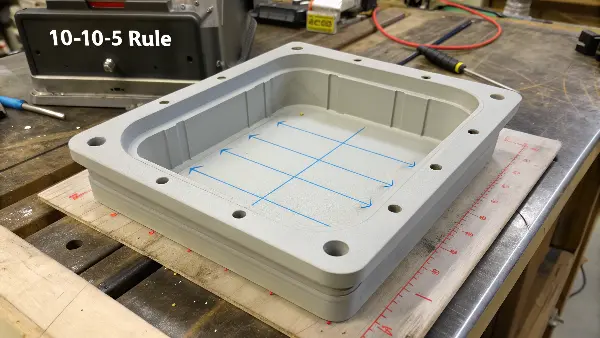
This rule isn’t a strict law, but it’s an excellent starting point for anyone new to designing for thermoforming. Let’s break it down. Thermoforming works by heating a plastic sheet and stretching it over a mold. If you have sharp internal corners, the material has to stretch dramatically to fill that corner, causing it to become very thin and weak. A generous radius—at least 10% of the part’s depth—allows the material to flow smoothly into the corner, maintaining a more consistent wall thickness. Imagine trying to line a square box with plastic wrap; it bunches up and tears at the corners. A rounded bowl is much easier.
The same logic applies to draft angles. A draft angle is a slight taper on the vertical walls of the part. Without it, the cooled, shrunken plastic part would grip the mold tightly, making it very difficult to remove without damage or scuffing. A 5-degree draft is a safe bet for most designs, allowing for easy release. The rule for outside corners is about ensuring there’s enough material to form the corner without excessive thinning. Following these guidelines—generous radii and adequate draft—is the single best thing you can do to create a successful, manufacturable thermoformed part. It prevents common defects and ensures a stronger, more consistent product. While these rules are a great guide, always consult with your manufacturer, as specific materials and techniques can sometimes allow for tighter tolerances.
Conclusion
Ultimately, the choice between thermoforming and injection molding comes down to your project’s specific needs. For lower volumes, large parts, and speed to market, thermoforming’s low tooling cost is a clear winner. For high-volume, complex, and high-precision parts, injection molding’s low per-part cost is unbeatable.